
Transoms, bays and tall sash around the common
The houses that ring Foxborough common were built with windows that no shop shelf was ever going to fit. Victorians and colonials there carry tall sash, transom lights over doors and between rooms, and bay windows that push out from the front parlor in three or five angled sections. Out toward Route 1 the story changes to post-war ranches and newer subdivisions with simpler openings. Whichever part of town you live in, cellular shades in Foxborough, MA, start with a tape measure, because every shade we fit is made to the window it hangs in.
That matters more here than in most towns. A bay with five narrow sections, each a slightly different width, cannot be covered with a ready-made product without gaps, and a transom over a front door needs a decision of its own: shade it, or leave it open to the light.
Honeycomb shades are well suited to that kind of custom work. They can be made very narrow or quite wide, tall or short, and some can be shaped for angled tops. Inside every one, a row of hollow cells holds still air against the glass, which is why they keep a draughty old front room warmer than anything else soft you can hang.
Three window problems we solve in Foxborough
The older houses and the newer ones raise different questions. These are the three we spend the most time on, with samples for each in the van.
Duette for bays, section by section
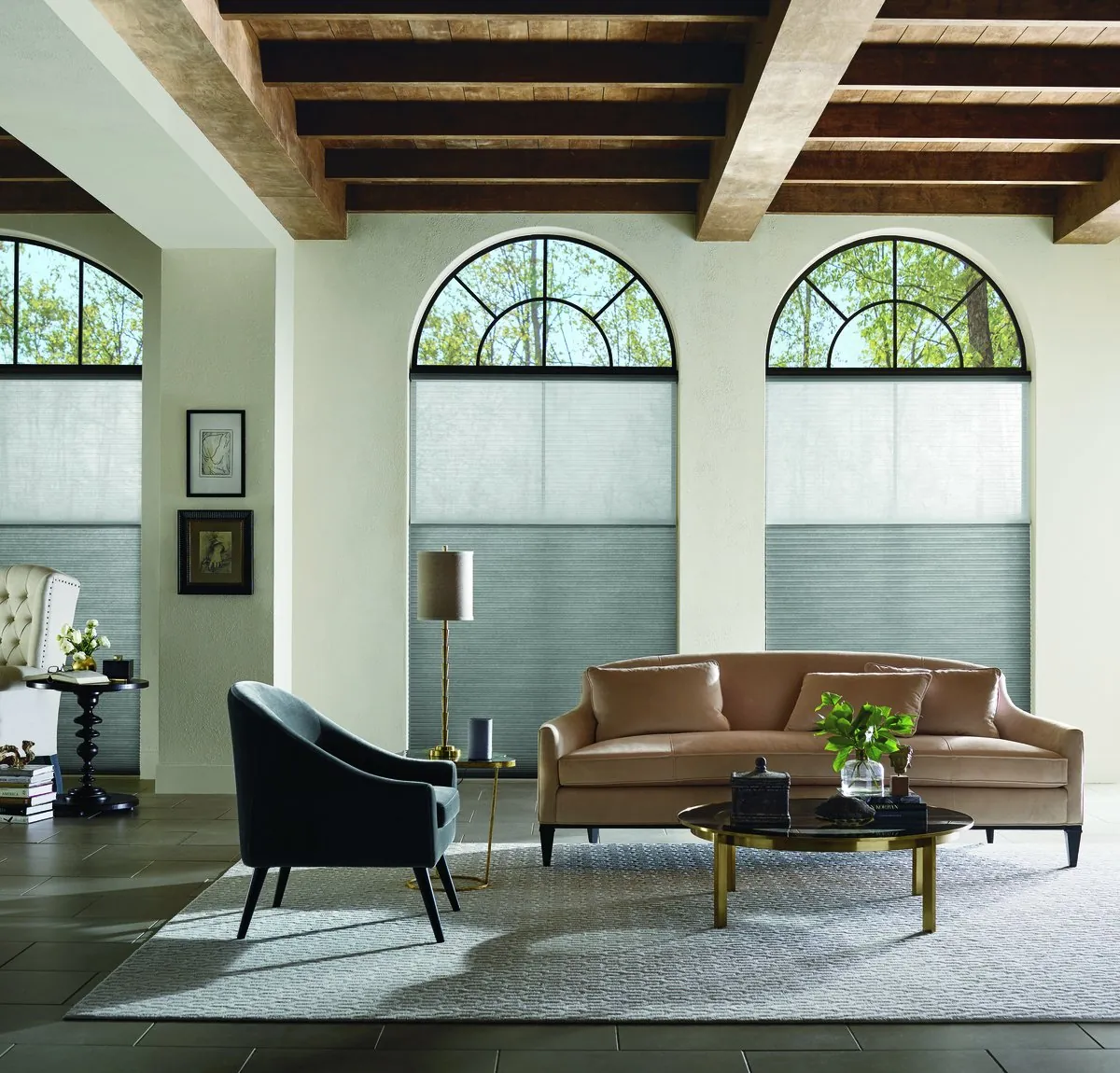
A separate shade made for each angled section of the bay, all set to stop at one line so the bay reads as a single window.
Transoms, arches and odd shapes
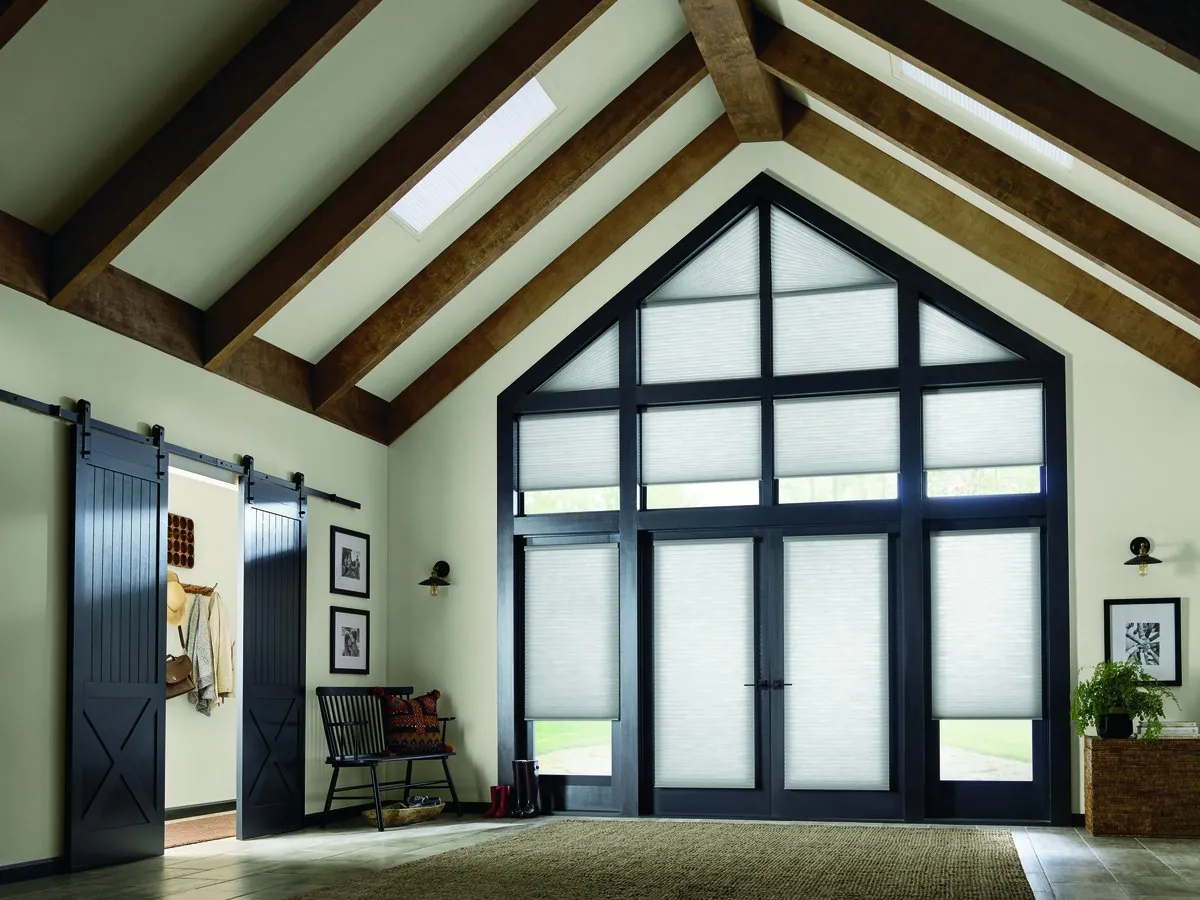
Fixed shades for a transom that needs covering, or a plan that leaves the transom clear while the window below gets a working shade.
Family rooms in the subdivisions
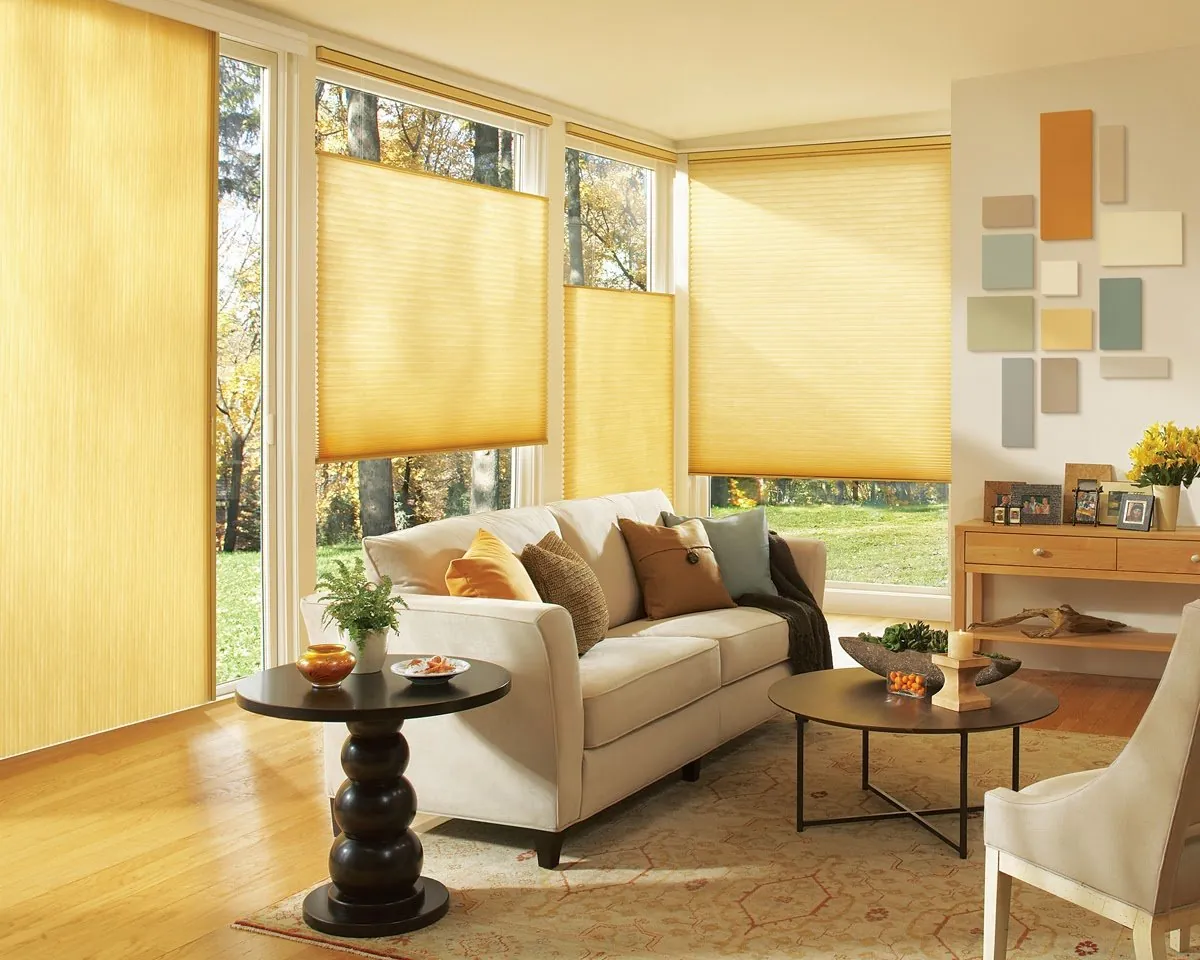
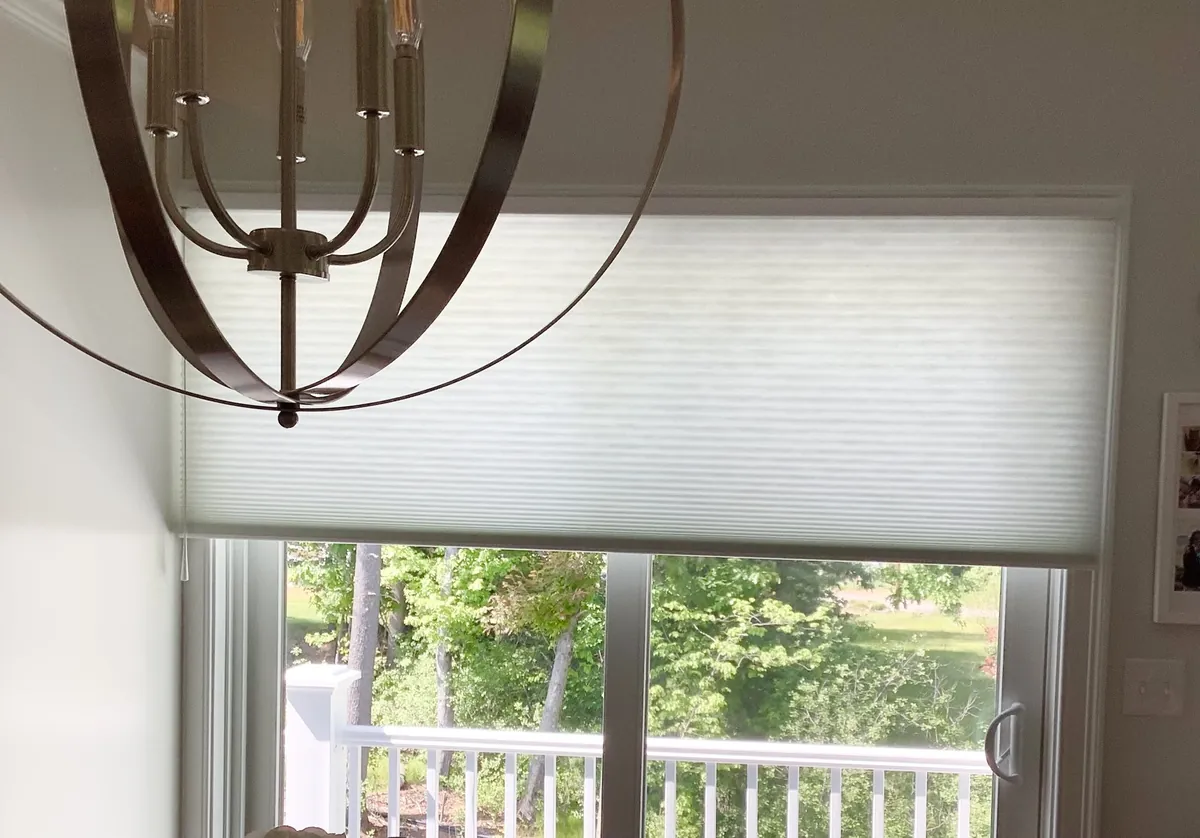
Standard openings and a slider to the deck, with matching honeycomb on the windows and a sideways shade on the door.
The Victorians and colonials around the common
Walk around the common and the old houses show off their windows. Tall sash reaches almost from floor to ceiling in the front rooms. Transom lights sit over the front door, and sometimes over interior doors too, so daylight can pass from room to room. Bays push the front parlor out toward the street, catching light from three directions.
All of that was built for light, and much of it was built before anyone expected a house to stay warm in every room through the winter. The tall sash is single glass in many houses, or an older replacement in the original opening. The bays have more glass and more joints than a flat wall. On a January evening, the coldest seat in the house is usually the one in the bay.
A honeycomb shade adds a layer of still air across each of those panes without changing the window itself. That is important to owners who have restored the woodwork and kept the original glass. Mounted inside the frame, the shade leaves the casing and trim in full view, and when raised it folds into a narrow stack at the top of the opening.
Working out a bay window
A bay is really three or five windows meeting at angles. Each section is its own opening, often a slightly different width from its neighbors, and the angled corners between them leave little room for hardware. Covering a bay well means a shade for each section, made to that section’s own size.
We measure each section on its own, at several heights, and check the depth of every frame. Where the corners are tight, we look at how the headrails meet so the shades do not knock into one another when they move. Once the shades are up, they can be set to stop at the same height, so the whole bay lines up as one window from inside the room and from the street outside.
A top-down, bottom-up lift is a popular choice in a front bay. You can lower the tops for daylight and keep the bottoms up for privacy from the sidewalk, all at the same line around the bay. If the bay is a reading nook or a window seat, a light-filtering fabric keeps it bright and comfortable to sit in.
What to do with a transom
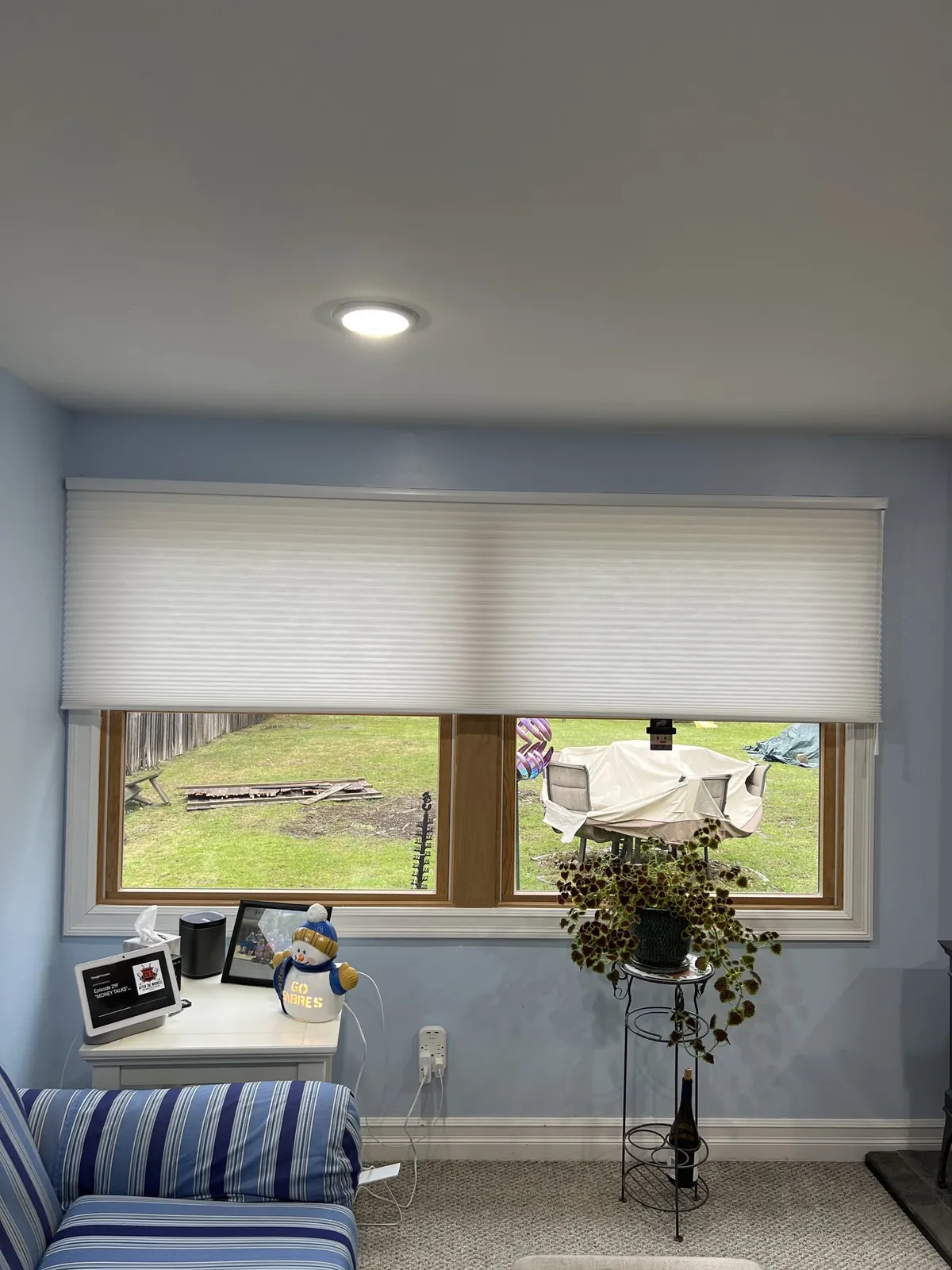
Transoms come up in nearly every older Foxborough house we visit, and the right answer depends on the room. Over a front door, a transom brings light into the hall and usually faces the street. Over an interior door, it lets light pass between rooms. Over a tall window, it may be a separate fixed pane above the working sash.
There are three common approaches.
- Leave it open. Many people like the light a transom lets in and choose to shade only the window or door below. The transom stays as a bright band of glass.
- Give it a fixed shade. A honeycomb shade made to the transom’s size, set in a fixed position, softens the light and adds a layer of insulation without needing to be moved.
- Treat it with the window below. Where a transom sits directly over a working window, a top-down, bottom-up shade on the window can be set to leave the transom clear, or the two can be covered as one.
Arched or angled transoms are a special case. Some honeycomb shades can be made to follow those shapes. We look at each one and tell you honestly what can be done and how it will look.
Tall sash and how to fit it
The tall sash in the older houses gives the front rooms their grand feel, and the shade has to respect that. Honeycomb shades can be made long and narrow, and because the raised stack is compact, very little of the upper sash is hidden when the shade is up. That matters on a tall window, where the top of the glass brings in most of the light.
Old frames are rarely square after so many winters. Before recommending an inside mount, we measure the width at the top, middle and bottom, the height on each side, and the depth where the headrail would sit, looking for sash weights, pulleys and paint build-up. Where a frame is too shallow or out of true, a mount on the face of the casing is the honest choice, and we will explain why at the window. Getting this step right is what makes cellular shades in Foxborough, MA, look as though they came with the house.
Ranches and subdivisions toward Route 1
Away from the common, the houses become simpler. Post-war ranches sit on their own lots with a picture window in the living room and a slider at the back. The newer subdivisions have colonials and contemporary layouts with regular, standard openings throughout.
These houses are straightforward to fit. Square frames mean inside mounts everywhere, and repeated window sizes mean the shades line up neatly across the front of the house. The planning is more about how each room is used than about the shape of the glass. For cellular shades in Foxborough subdivisions, that usually means deciding where you want darkness, where you want daylight and where you simply want the room to hold its heat.
In a ranch, the picture window usually takes two or three shades on one headrail, so you can lift them together or one at a time. In a newer colonial, the same fabric across every front window keeps the house tidy from the street. At the back, a sideways honeycomb shade on the slider glides along a track and stacks at one edge, so the deck door opens freely.
Why the cells keep a room warm
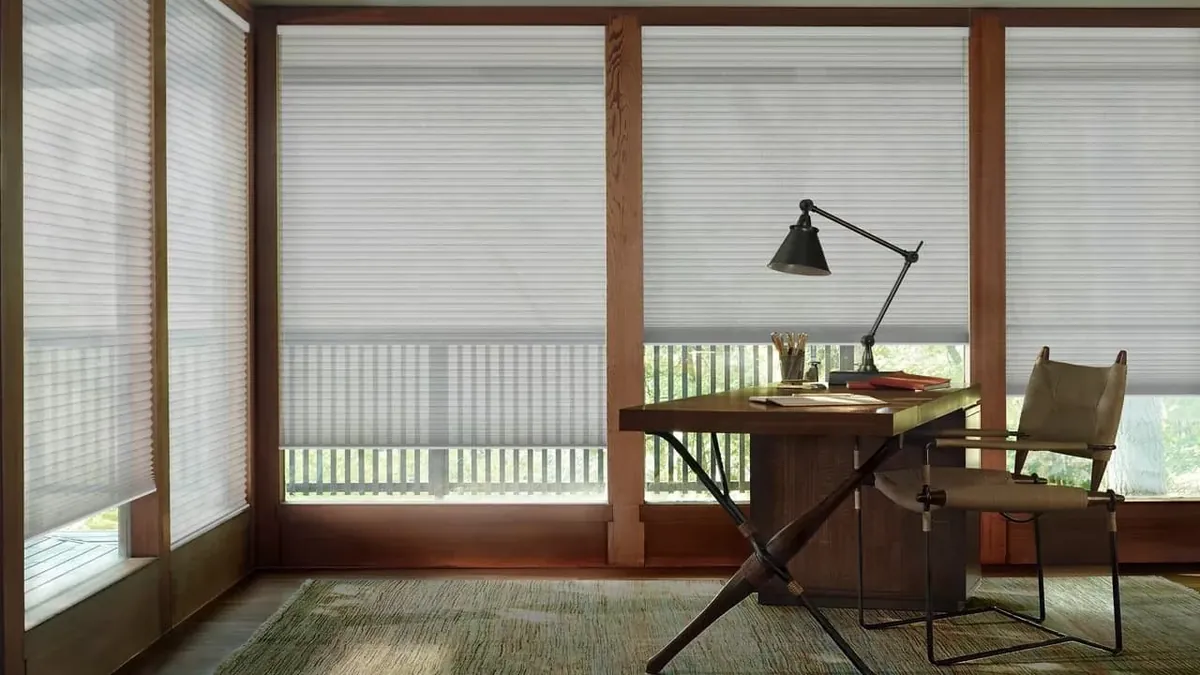
A honeycomb shade looks like a soft pleated fabric from the room. From the end, you see the reason it works: a stack of hollow cells, each one a tube of fabric running the width of the window. Lowered over the glass, those tubes hold air that hardly moves.
Air that stays still is slow to carry heat. So on a winter night the cold from the glass takes longer to reach the room, and the warmth from your radiators takes longer to reach the glass. In summer, the effect reverses, slowing the heat that comes through a sunny window. For an older house with single-glazed sash and a bay full of joints, it is one of the simplest ways to make the front rooms more comfortable.
Some Duette fabrics carry a smaller cell nested inside each larger one, and some shades stack two full rows of cells. The extra layer gives the air even more places to stay put, which can help in a bay that takes the full weather or a north-facing room in an old colonial.
Light, privacy and the street
Many of the older houses near the common sit close to the sidewalk, with the front rooms a few steps from people passing. A light-filtering honeycomb fabric gives daytime privacy while keeping the room bright, because from outside the fabric glows evenly rather than showing the room. At night, with lamps on, a denser fabric or a room-darkening shade gives full privacy.
In the subdivisions, privacy from the street matters less, but bedrooms still need darkness and home offices need glare control. A room-darkening fabric upstairs and a light-filtering one on the main floor is a common plan. Because the side of a honeycomb shade facing the glass is always a neutral color, the house looks uniform from outside whatever colors you choose for each room.
Motors for the windows nobody can reach
Old houses and new ones both have windows that are hard to get to. Around the common it might be a transom over a tall interior door or the upper part of a stairwell window. In a newer house it might be a two-story foyer or a window over the tub.
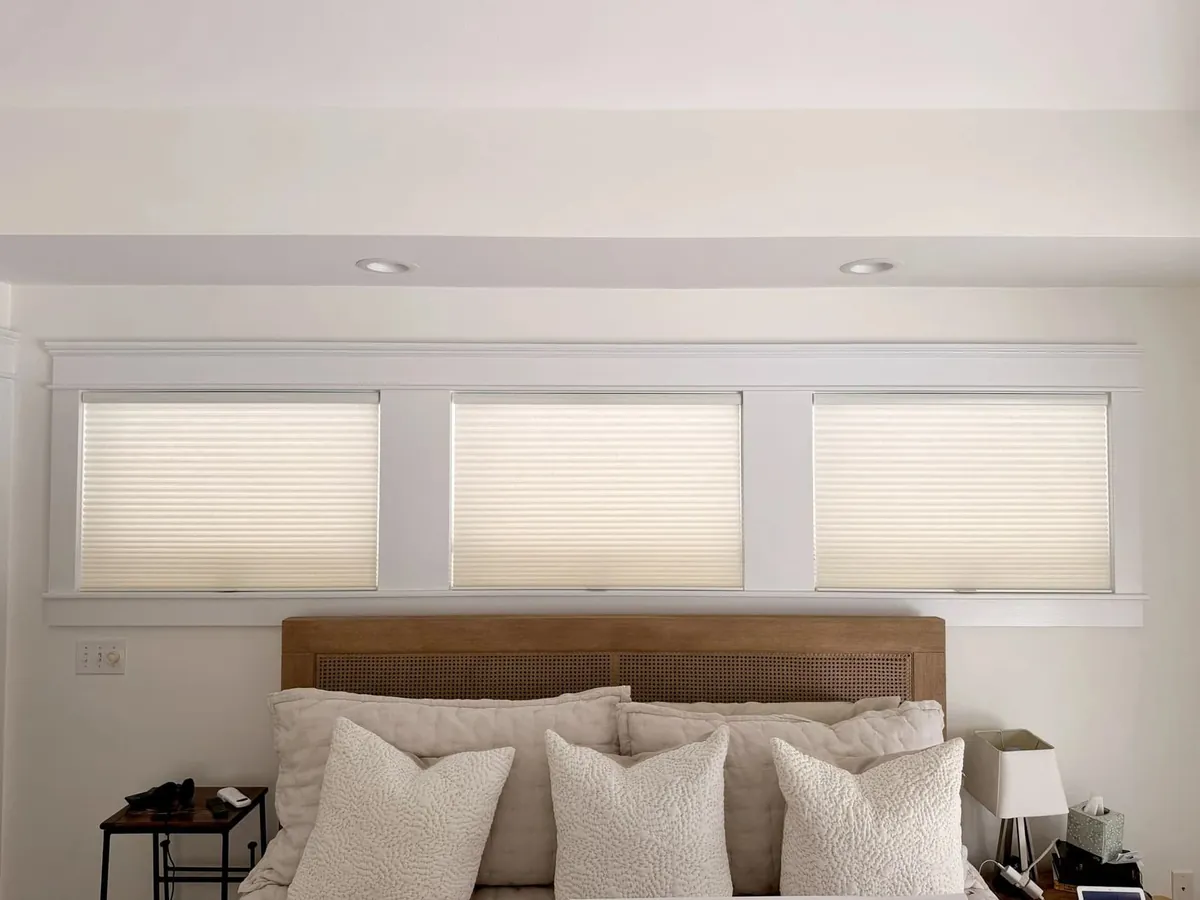
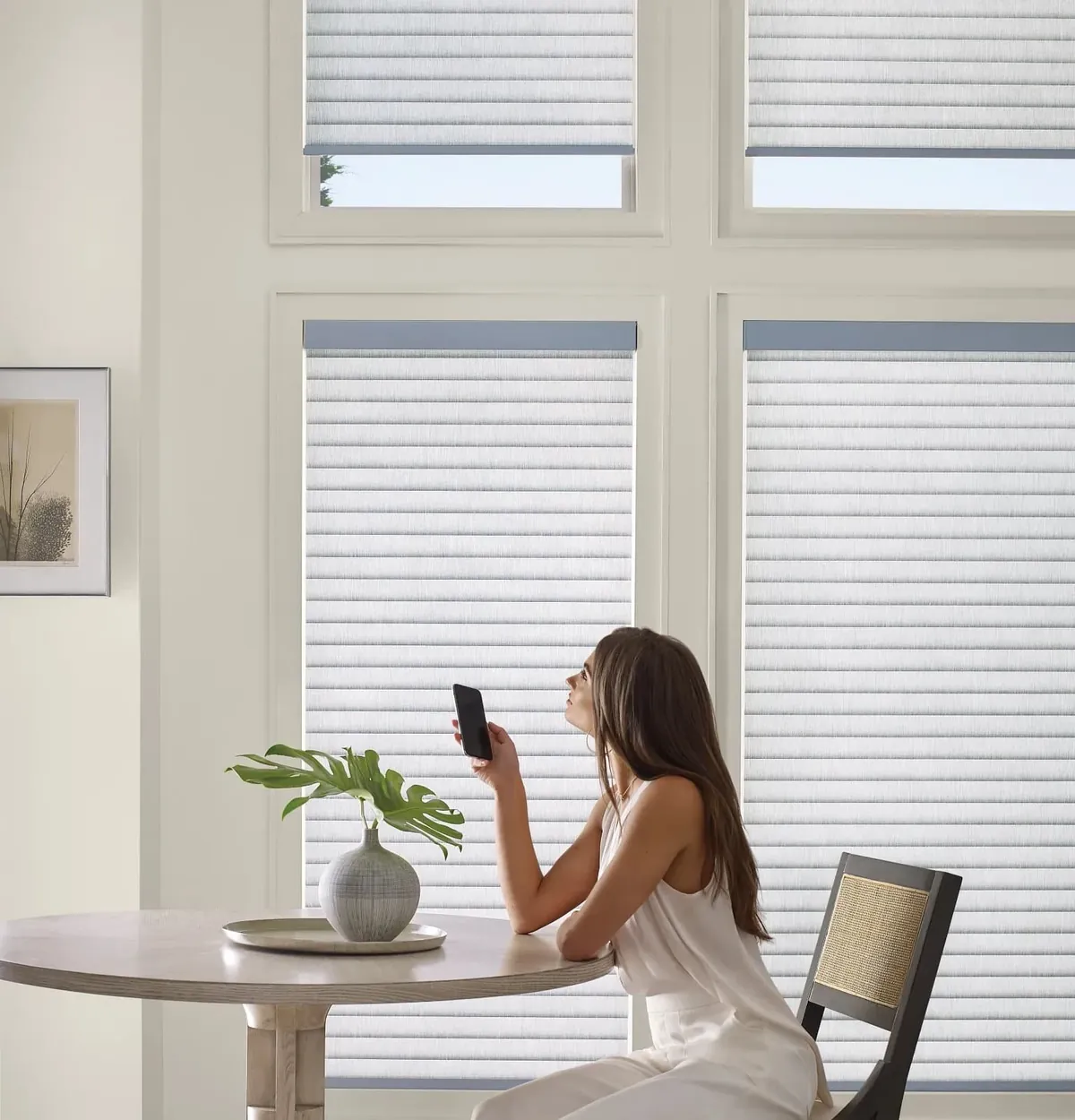
PowerView motorization solves that. You can raise and lower the shades from your phone, a handheld remote or a wall switch, group them by room, and set schedules so they open in the morning and close at dusk without anyone touching them. For a fixed shade on a transom, motorization is not needed, but for anything that moves and sits out of reach, it is often the neatest answer. Our motorized blinds in Foxborough page covers motorization in more depth, and how each motor will be powered is something we agree with you at the house.
A consultation at home
Bays, transoms and tall sash are hard to describe over the phone and impossible to judge from a fabric chip. That is why cellular shades in Foxborough are almost always chosen in the house itself. Our vans bring the samples to you, along with the tape measure.
- Request a consultation online, or use the call button, and choose a time when the rooms you care about are in their usual light.
- We unpack honeycomb fabrics across a range of colors and light levels, with the lift options and the PowerView controls.
- We look at the bays, transoms and tall windows first, and talk through what is possible for each, including what to leave uncovered.
- You try samples in each section of the bay and against the tall sash, so you can see the light change.
- We measure every opening, section by section.
- You receive a free estimate covering the shades you want to consider, and take your time over it.
If you are rethinking a whole room, our interior design consultations can cover fabric and color at the same visit.
Duette and Applause in an old house and a new one
Both are Hunter Douglas honeycomb shades with the same air-holding cell. Duette has the deeper range: more fabrics and opacities, very narrow and very tall sizes, specialty shapes and the sideways shade for sliders. In the older houses around the common, it is usually the line that can do what the bays and transoms need. Applause has its own fabric collection and suits the standard windows in ranches and subdivisions very well.
Plenty of Foxborough houses use both. The Applause page explains that line, and our cellular shades page describes the full range.
Installation
- Every fabric, lift and mount is agreed with you, window by window and section by section, before anything is ordered.
- When the shades arrive, our certified Hunter Douglas installers fit them, setting brackets into solid wood on old frames.
- In a bay, each shade is set to stop at the same height so the bay lines up.
- Every lift is tested, any PowerView schedules are set up with you, and you are shown how everything works.
Why a Hunter Douglas Gallery dealer
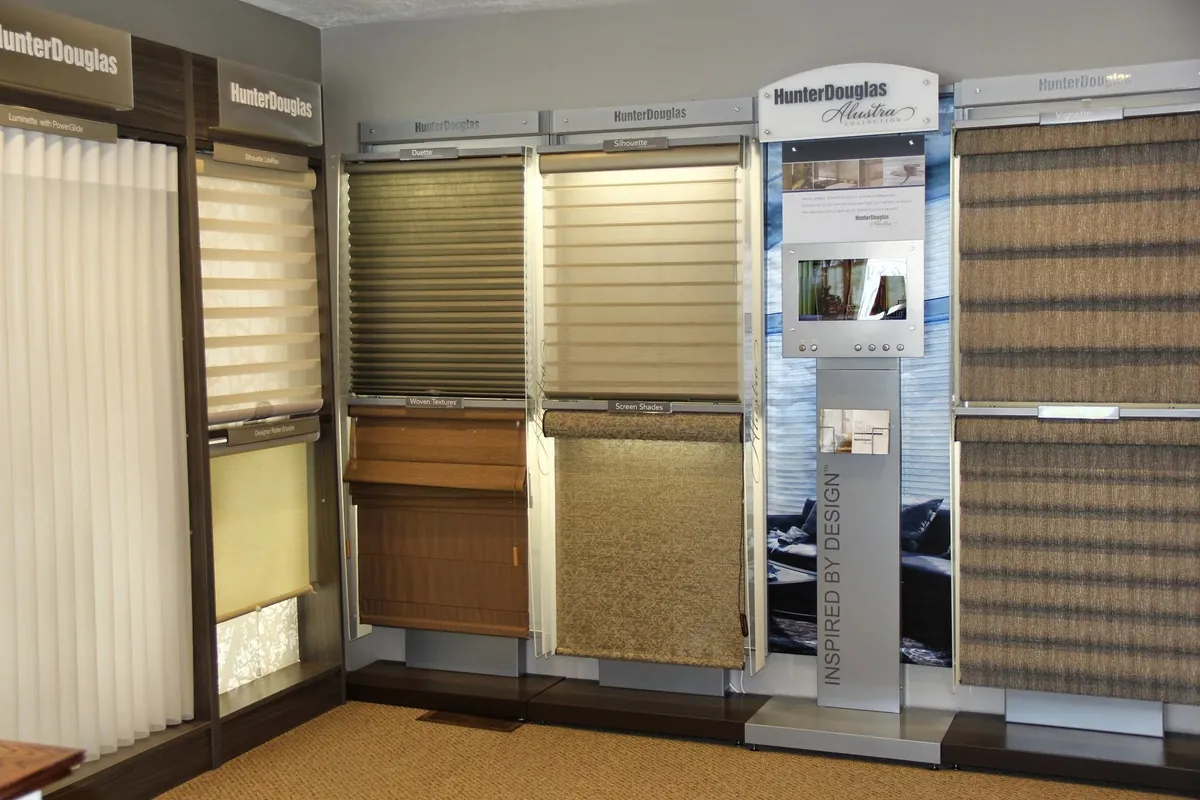
Blinds & Designs is a Hunter Douglas Gallery dealer. For an older Foxborough house, that is useful in a very practical way: the full Duette range, including the narrow widths, specialty shapes and fixed shades that bays and transoms often need, is available through us.
Our installers are certified by Hunter Douglas. We fit what we sell, and we also repair blinds and shades you already own.
For other rooms, see our plantation shutters in Foxborough, roman shades in Foxborough, or everything we offer in town on the Foxborough page.

Design help and our Franklin showroom
A bay or a run of transoms is often the focal point of a room, and choosing a fabric for it can feel like choosing a paint color for the whole house. We are glad to help, whether that is just the shades or the room as a whole through an interior design consultation.
Most people start with a visit to the house. If you would rather look in person first, our nearest showroom to Foxborough is in Franklin.
Questions from Foxborough
Can you cover each section of my bay window separately?
Yes. Each section of a bay gets its own shade, made to its own measurements. We set them to stop at the same height so the bay looks like one window, and we check the corners so the headrails do not clash.
Should I cover the transom over my front door?
It depends on how much light you want in the hall and how much privacy you need. Many people leave a transom open. Others choose a fixed honeycomb shade cut to its size. We look at each one and talk through the options at the house.
Will a honeycomb shade fit my tall original sash?
Usually. Honeycomb shades can be made long and narrow, and the raised stack is slim. We measure in several places, because older frames are seldom square, and suggest a mount on the casing where an inside mount would not sit well.
Are the newer houses toward Route 1 simpler to fit?
Generally, yes. Standard openings and square frames mean inside mounts throughout and shades that line up easily. The planning is mostly about which fabric suits each room.
Is there a charge to measure and quote?
No. We measure every opening and give you a free estimate.
Your next step
To see what cellular shades in Foxborough, MA, can do for your bays, transoms and tall sash, the best place to start is at the windows themselves. Request a consultation and we will come with the honeycomb range, measure every section and leave a free estimate. You can also use the call button, or visit our Franklin showroom.