
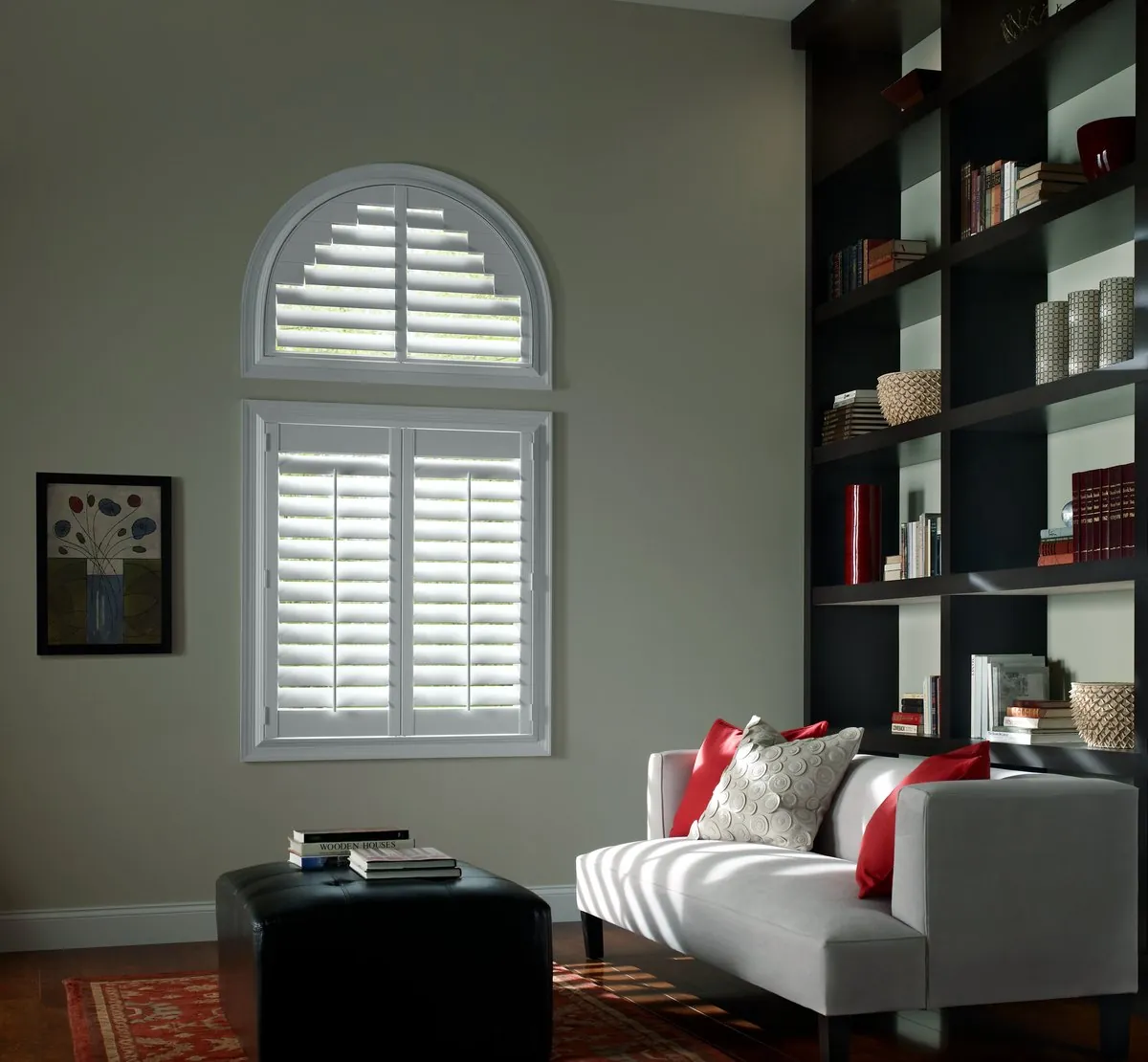
Old sash by the common, tall glass off Route 140
Franklin is where one of our showrooms sits, so we spend a lot of time inside the houses here, and they come in two clear groups. Near the common and along Main Street you find antique colonials and Victorians with tall, narrow sash, heavy casings and floors that have settled a little over the years. Out across the subdivisions off Route 140 the houses are newer and larger colonials, many of them with a two-story entry and a wall of glass above the front door. Fitting plantation shutters in Franklin, MA, means working comfortably with both.
The older houses ask for patience. Their openings are slim, rarely square, and framed by trim that someone has usually painted or stripped with care. A shutter there has to sit inside that trim without hiding it.
The newer houses ask for reach. A foyer window that climbs past the landing, or a stairwell window that sits over a drop, is the hardest window in town to cover well. We plan those openings panel by panel so the shutters work from where you actually stand.
Plantation shutters in Franklin, MA: three choices that shape the result
Every shutter we order comes down to the same three decisions. We bring samples of each to your house so you can make them at your own windows rather than from a brochure.
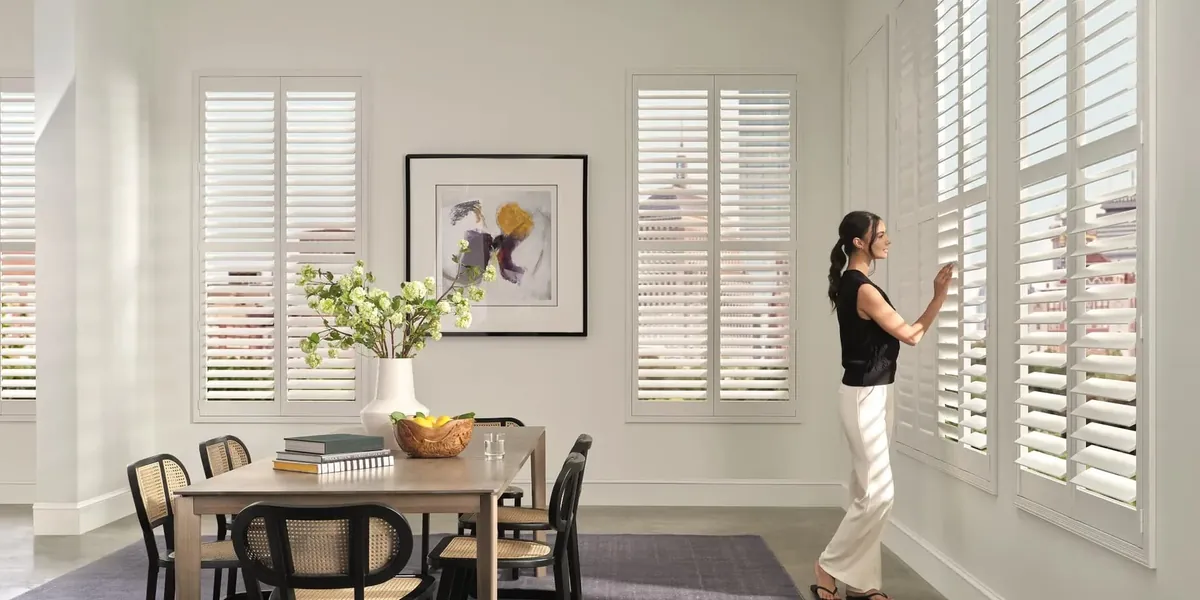
Which collection
Palm Beach for wet rooms, NewStyle for most of the house, Heritance hardwood where the woodwork deserves real wood. Many Franklin orders use two of the three.
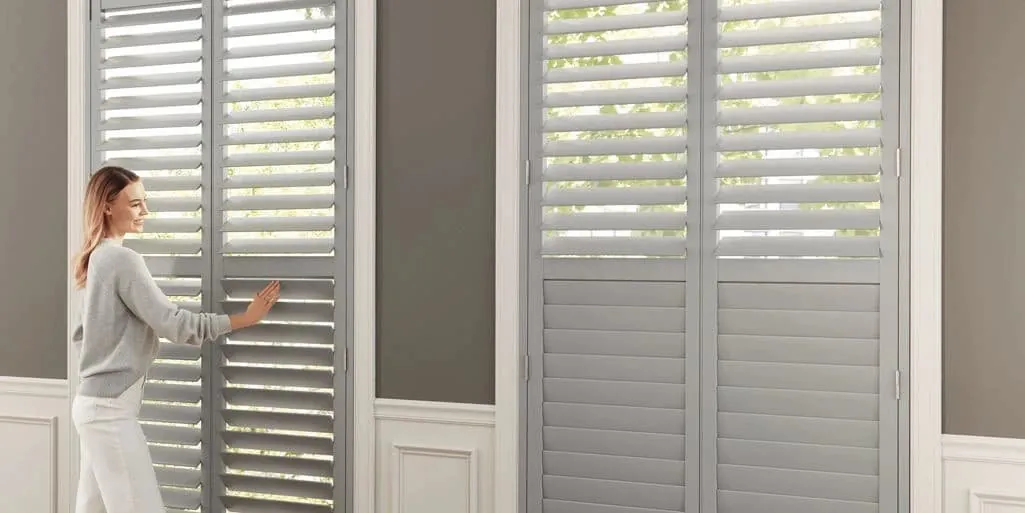
How wide the louvers are
Slim blades suit a narrow antique sash. Broad blades open up a big modern window and give a clearer view when tilted flat.
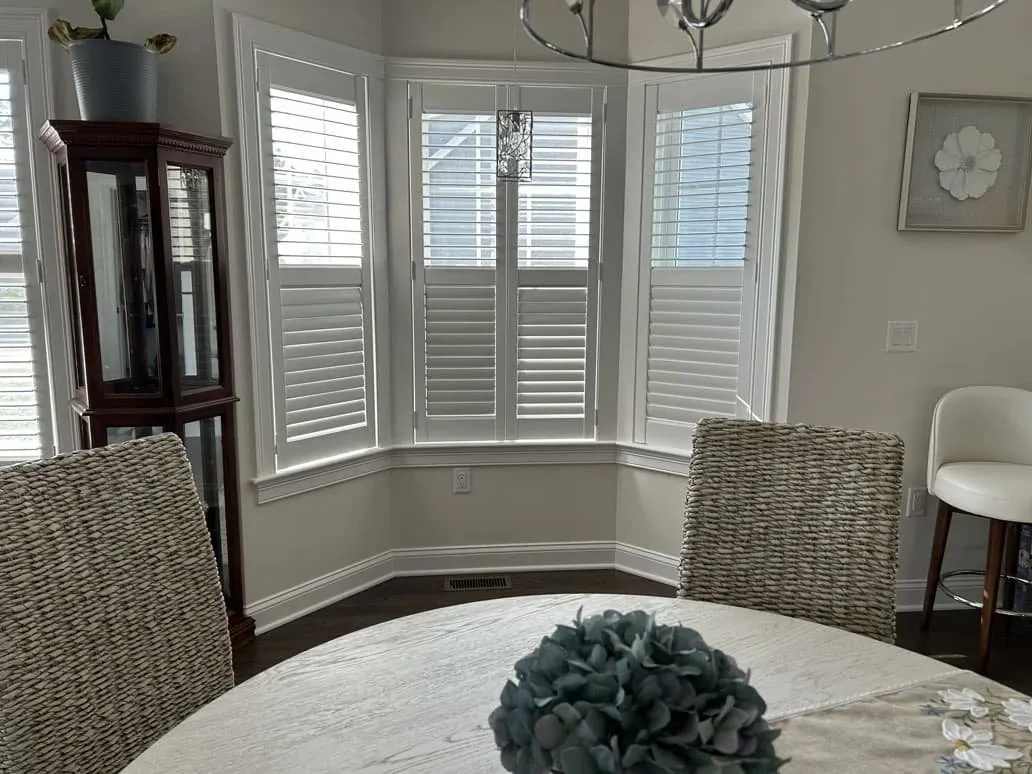
What frames the panels
An inside frame tucks into the opening, an outside frame sits on the casing, and a decorative frame can add trim where a newer window has very little.
Antique colonials and Victorians around the common
Walk the streets that lead off the common and the windows tell you how old the houses are. Sash runs tall and slim, often in pairs, with deep wood casings, a heavy sill and a stool you could set a plant on. Some still have the weights and pulleys behind the jambs. Very few are square any more.
That shape suits a shutter better than most people expect. A narrow sash wants a narrow louver, so the blades stay in proportion to the glass and the window does not look crowded. Two hinged panels per opening is the usual layout. They fold back against the jamb when you want the whole window clear, and they close flush when you want privacy from the sidewalk.
The real work is in the measuring. We take the width at the top, middle and bottom and the height at both sides and the center, then check the diagonals. If the opening has racked over the years, the frame is built to take up the difference so the panels still meet evenly in the middle. Where the stops or sash locks leave too little depth for the louvers to tilt, we say so and suggest a slim outside frame on the casing instead. Our guide to shutters for older windows explains those checks in more detail.
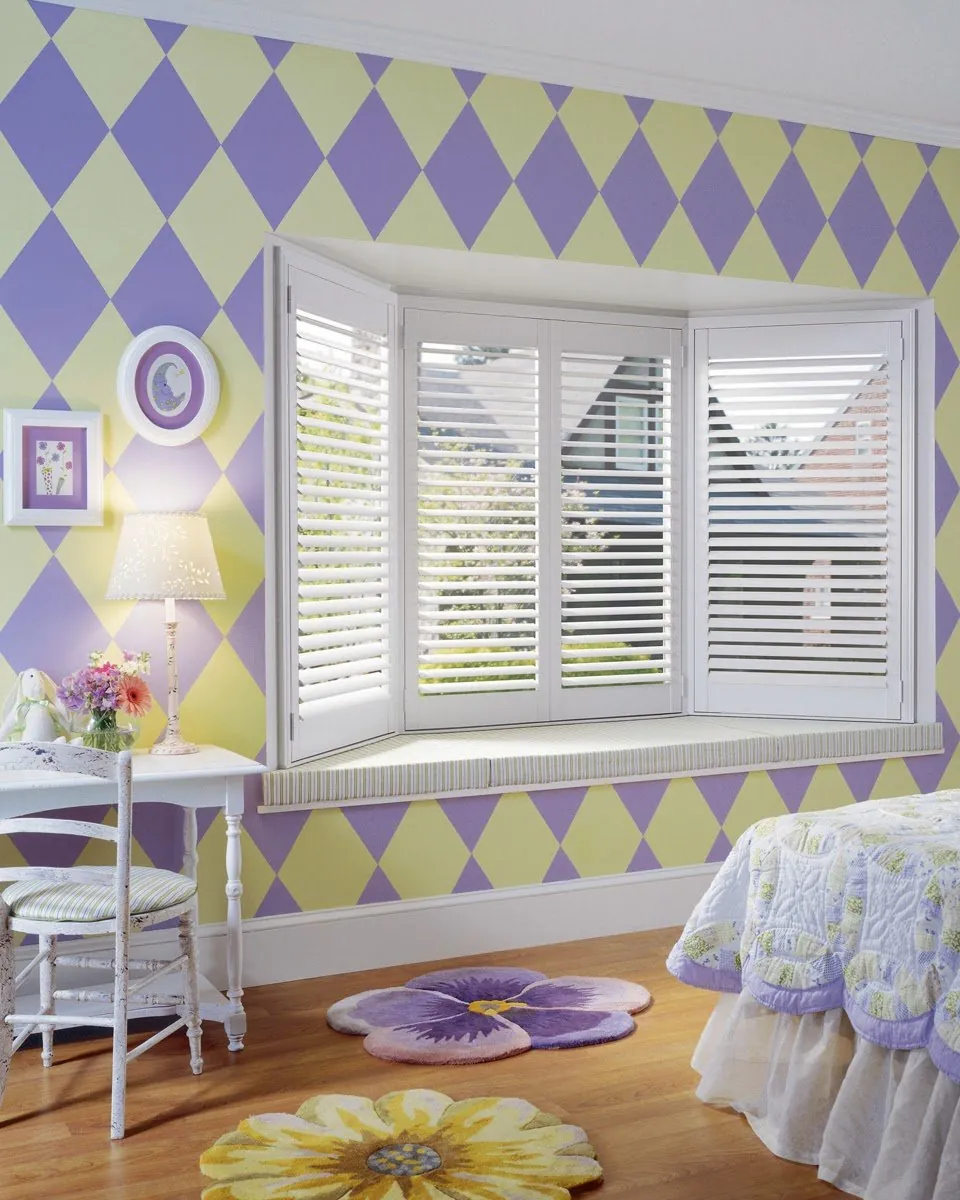
Victorian houses near Main Street add bays and tall parlor windows to the mix. A bay takes a shutter on each face, joined at the corners by a post so the angles stay tight, and every panel in the bay can share one louver size so the whole curve reads as a single piece.
Two-story entry glass in the newer subdivisions
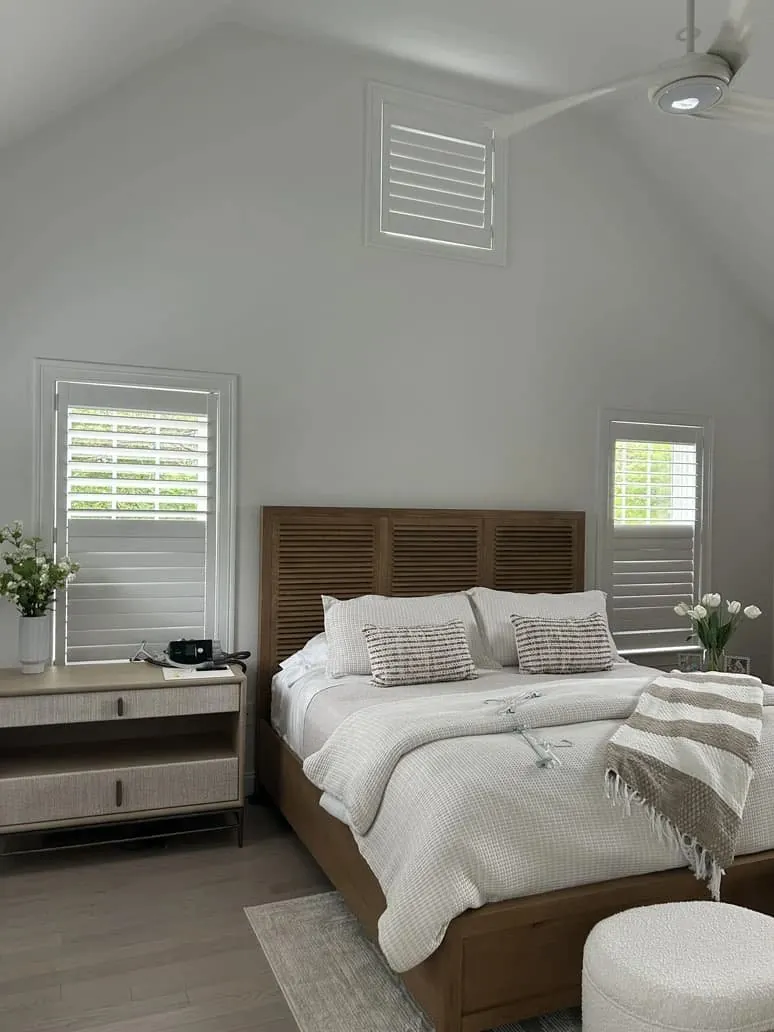
The colonials built across the subdivisions off Route 140 tend to share a front hall with a tall window above the door, sometimes a half-round transom on top, and a landing that looks straight out through it. That glass brings in a lot of light. It also lets anyone on the street see straight up the stairs once the lamps are on.
A shutter can cover a tall opening like that if it is broken into sensible pieces. We usually split the height into two or three tiers of panels. The lower tier, the one you can reach from the floor, opens and tilts like any other shutter. The upper tiers can be hinged too, or set with the louvers at one fixed angle if nobody will ever reach them. Divider rails across each panel keep the blades from running too long, which also helps the shutter look right from both inside and the street.
A half-round or arched transom gets a shaped panel of its own, made to follow the curve. It can have fixed louvers fanning out like a sunburst, or a solid insert, and it is mounted so the line of the frame below continues around the arch.
The stairwell window nobody can reach
Ask anyone in one of those newer colonials which window they never touch and the answer is usually the one halfway up the stairs. It sits over the stairwell, often high on the wall, with no floor in front of it to stand on. It catches morning or evening sun straight down the steps, and it is the hardest reach in town for any window covering.
Shutters are worked by hand, so we plan that window around how often it really needs to change. For many houses the honest answer is never: a panel with its louvers fixed at a comfortable angle lets light down the stairs, blocks the view in, and needs nothing from you once it is up. If you would like to open and close it, the louvers can be set so the tilt control sits where you can safely reach it from the landing.
Some people would rather have that one window move on its own. A Hunter Douglas shade with PowerView motorization can sit in the stairwell window and open or close from your phone, a remote or a schedule, while the rooms around it have shutters. We will show you both and let you choose. Our installers bring the right ladders and staging for the job on the day.
Louver size, room by room
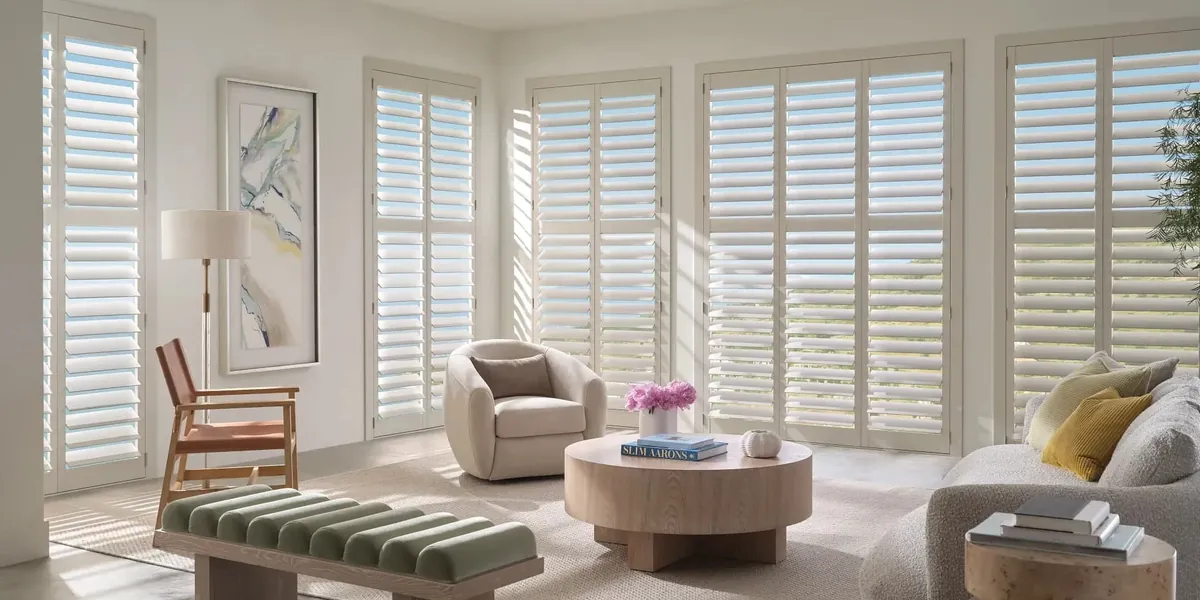
Louver width is the detail people notice most once the shutters are up, and it changes from room to room more than you might think.
- Narrow louvers suit the antique sash near the common, small bedrooms, and any window where the glass is divided into small panes. They keep the shutter in scale.
- Medium louvers are the everyday choice for a standard double-hung in a newer colonial. They balance light, view and privacy well.
- Wide louvers belong on big openings: a family room with a run of windows, a sunroom, or the lower part of a two-story entry. Tilted open, you look through fewer blades.
The tilt is the other half of the decision. A traditional tilt rod runs down the front of the panel and is easy to grab. A hidden tilt moves the blades from the edge, so the face of the shutter stays clean and the view through the middle stays clear. Both work well; it comes down to the look you want.
Privacy near the street, light at the back
The antique houses around the common were built close to the sidewalk, and their front rooms sit only a few steps from anyone walking past. In the evening, with the lamps on, an uncovered window there shows the whole room. The newer colonials off Route 140 are set further back, but their front windows still face the street and the house across it, while the back rooms look over a yard and want all the daylight they can get.
Louvers handle both without changing the covering. Tilted down slightly, the blades let you see out while blocking the view in from the sidewalk. Tilted up, they throw daylight onto the ceiling and keep the room bright while hiding it from the street. Closed, they shut the room off completely for the night.
A divider rail across the middle of a tall panel goes one step further. The lower louvers can stay closed for privacy while the upper ones open to the sky, which is often exactly what a front parlor near Main Street needs. Choosing plantation shutters in Franklin, MA, for the front of the house and the back is mostly a matter of where the rails go and how wide the louvers are.
Color and finish against old and new trim
White is the most common choice for good reason. It suits nearly any trim, it reflects light back into the room, and it looks crisp against both a restored antique casing and a builder’s flat trim. But old painted woodwork has often mellowed to a soft cream, and a bright white shutter beside it can make the trim look tired. An off-white or a warm white usually sits better there.
In newer houses with darker walls or a more modern feel, soft grays and taupes are worth a look. Stained Heritance suits the antique houses with natural wood trim. We bring finish samples so you can see them in your rooms in daylight and again under your own lamps, because a color that looks right at noon can look quite different at night. When people choose plantation shutters in Franklin, MA, for a whole house, we usually settle the color in the front hall first, since it is the room you see from every other.
Frames and mounting
The frame is what fixes the shutter to the window, and it does a lot to decide whether the finished shutter looks built in.
An inside mount sets the frame within the opening. On the deep antique sash near the common it often disappears completely, leaving the original casing on show. It needs enough depth for the louvers to swing and enough squareness for the panels to meet, which is why we measure so carefully on older windows.
An outside mount sets the frame on the casing or the wall around the opening. It solves a shallow window, a window with hardware in the way, or one that is badly out of square. On a newer colonial with plain flat trim it can also make the window look larger and more finished.
Decorative frames add a profile around the outside edge, a little like a picture frame. They suit newer houses where the builder left very simple trim and you would like the window to have more presence.
Each of these comes in every collection, so the frame and the material are separate choices.
Palm Beach for bathrooms and the sink window
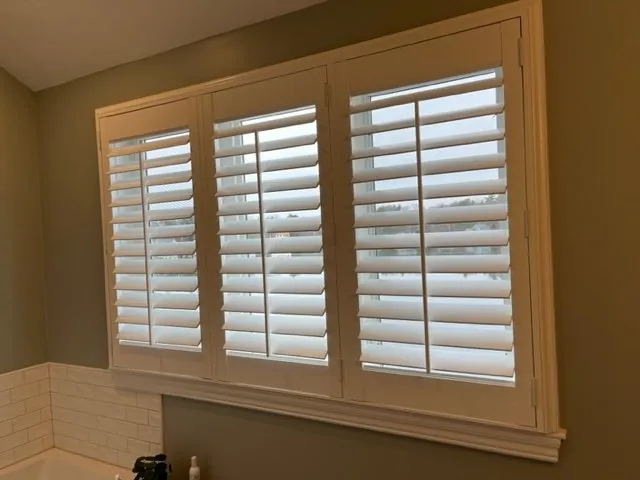
A newer colonial in the subdivisions usually has a primary bath with a big window over the tub, a powder room off the front hall, and a kitchen sink window that gets splashed every day. An antique house near Main Street often has one small bath tucked under a slope, with steam and no fan.
Those are the windows for Palm Beach. It is made from a solid polysatin material with no wood inside, so a hot shower or a wet hand on the louvers does it no harm, and it wipes clean. Painted to match the NewStyle or Heritance shutters elsewhere, it looks the same from the hallway.
A powder room on the street side is a good place for a cafe-style layout, covering only the bottom half of the sash so the room gets daylight above while the lower glass stays private.
Heritance hardwood for the older houses
Some antique houses in Franklin still have their original pine or oak trim, stained rather than painted. A painted shutter beside that woodwork can look like an afterthought. Heritance is real hardwood and can be stained, so the shutter can pick up the color of the trim and the floor and look as though it came with the house.
Heritance paints beautifully too, which is why it also turns up in newer colonials where the homeowner wants the feel of real wood in the front rooms. In a whole-house order we often see Heritance in the living and dining rooms, NewStyle in the bedrooms and family room, and Palm Beach in the baths. Our Heritance and Palm Beach pages go into each in more depth, and the main plantation shutters page compares all three.
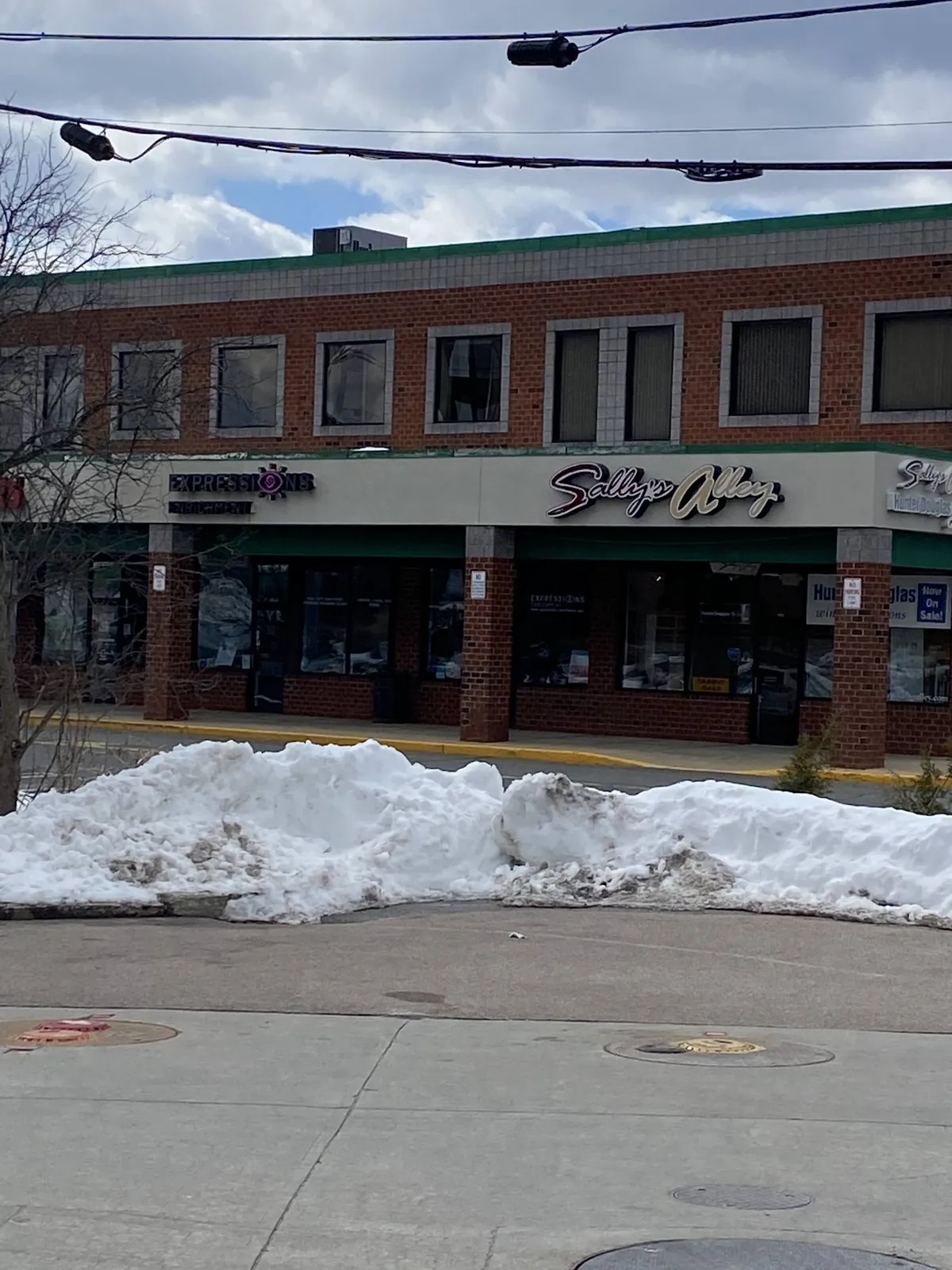
A showroom in town, or samples at your door
Because the Franklin showroom is right here in town, you have a choice about where to begin. Some people like to stop in first. Others would rather start at home, and for shutters that is usually where the real decisions get made.
A shutter has to fit the casing, suit the trim color and handle the light in that room, and you can only judge all three at your own window. Our vans carry shutter samples in each collection, louver size and frame style, so we can bring the showroom to you.
Either way, the measuring happens at your house, by us, before anything is ordered.
How a home visit goes for shutters
The visit starts wherever the problem is. For one household that is the antique front parlor; for another it is the entry glass and the stairwell window. From there it follows a simple order.
- You request a consultation online or through the call button and pick a time that suits you.
- We start with the rooms you care about most and talk about light, privacy and how each room is used.
- You hold Palm Beach, NewStyle and Heritance samples against your own trim and compare louver sizes in your own light.
- We look at each opening for depth, squareness and anything in the way, and agree a frame and mount.
- Every window is measured, including the tall ones.
- You receive a free estimate, and you decide in your own time.
If you would like help with color, fabric for the rest of the room or the other windows in the house, ask about our interior design consultations at the same visit. You can also read what happens at an in-home consultation before we arrive.

What being a Gallery dealer means for your shutters
Blinds & Designs is a Hunter Douglas Gallery dealer. That is the brand’s own name for dealers who meet its standards, and for shutters it means you can choose from all three collections, every louver size and the full range of frames and finishes in one consultation.
Our installers are certified by Hunter Douglas. They set each frame square and plumb, hang the panels, adjust the hinges until the panels meet cleanly and check that every louver closes flush. If a shutter or shade in your house ever needs attention later, we handle blind and shade repairs as well.
Shutters are only one part of what we carry. If another room suits a shade better, see our cellular shades in Franklin or roman shades in Franklin, or everything we do in town on our Franklin page.
Questions from Franklin
Can shutters go on the narrow sash in my antique colonial?
Usually, yes. Slim sash suits a narrow louver, and two hinged panels per window is the common layout. The question is depth and squareness. We measure each opening at several points and check the diagonals. If the stops or locks leave too little room for the louvers to tilt, a slim outside frame on the casing is the better answer, and we will tell you so.
How do you cover a two-story window above the front door?
We split the height into tiers. The lower panels open and tilt from the floor, and the upper ones can be hinged or set at a fixed angle. Divider rails keep long panels in proportion, and a half-round transom gets its own shaped panel.
What can I do about the stairwell window I cannot reach?
Many people choose a shutter with its louvers fixed at one angle, so it lets light down the stairs and needs nothing more. If you want that window to open and close, a shade with PowerView motorization can go there instead while the rest of the house has shutters.
Can I mix materials in one house?
Yes, and many orders do. Palm Beach in the bathrooms, NewStyle in the bedrooms and Heritance in the front rooms can all share one color and louver size, so they look the same from room to room.
Do I pay for the estimate?
No. Once we have measured your windows, the estimate is free, and there is no obligation to go ahead.
Ready when you are
To see plantation shutters in Franklin, MA, against your own trim, request a consultation and we will bring the samples to your door, measure every opening and give you a free estimate. You can also use the call button, or stop by the Franklin showroom.