
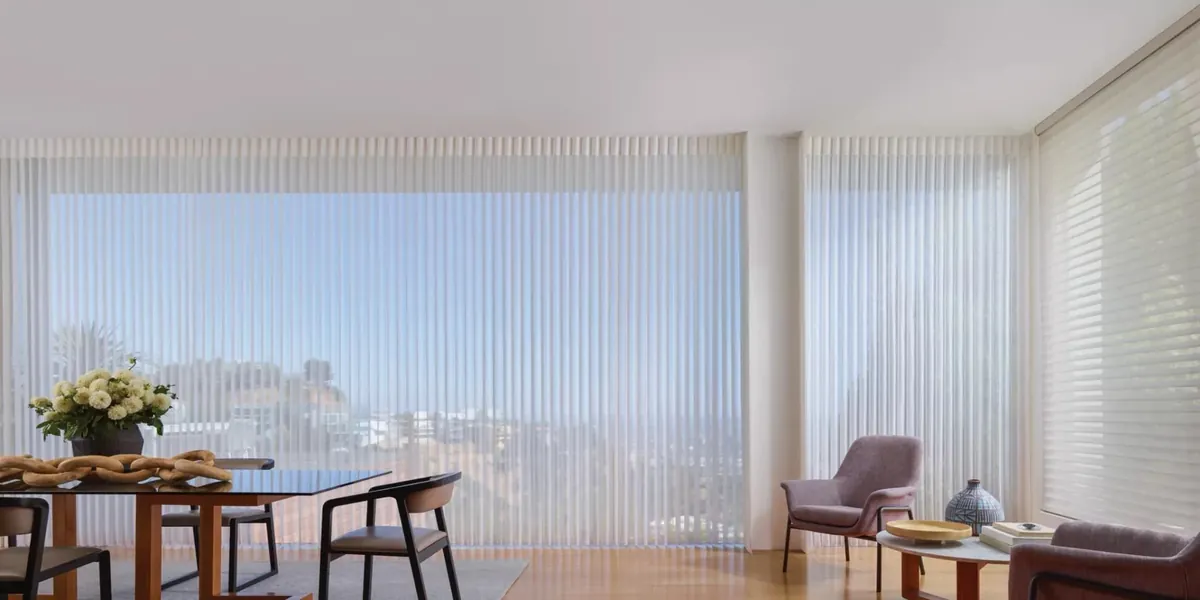
Walls of glass, formal rooms and salt air
Osterville’s houses are generous. Around the village and out along the roads to Wianno and Oyster Harbors, large shingled houses sit on wide lots, many of them built or rebuilt to a high standard and many of them lived in mainly through the warmer months. Their rooms facing the water are often walls of glass. Their front rooms are often formal, with the kind of proportions where drapery is expected. And almost all of them live with salt air. Planning motorized blinds in Osterville, MA means bringing those three things together.
The scale of these rooms is the first reason to motorize. A living room with eight tall windows toward the bay, or a two-story great room with glass to the roof line, has shades that are large, heavy and often out of reach. Working them by hand is slow, and getting them all to the same height is close to impossible. A motor moves the whole wall at once.
Hunter Douglas PowerView lets you do that from a slim remote, from the PowerView app on a phone or tablet, or automatically on schedules and scenes that you set once and change whenever you like.
Six ways to dress an Osterville window
Each of these can work with a PowerView motor, alone or layered with drapery. Our vans bring samples of all of them.
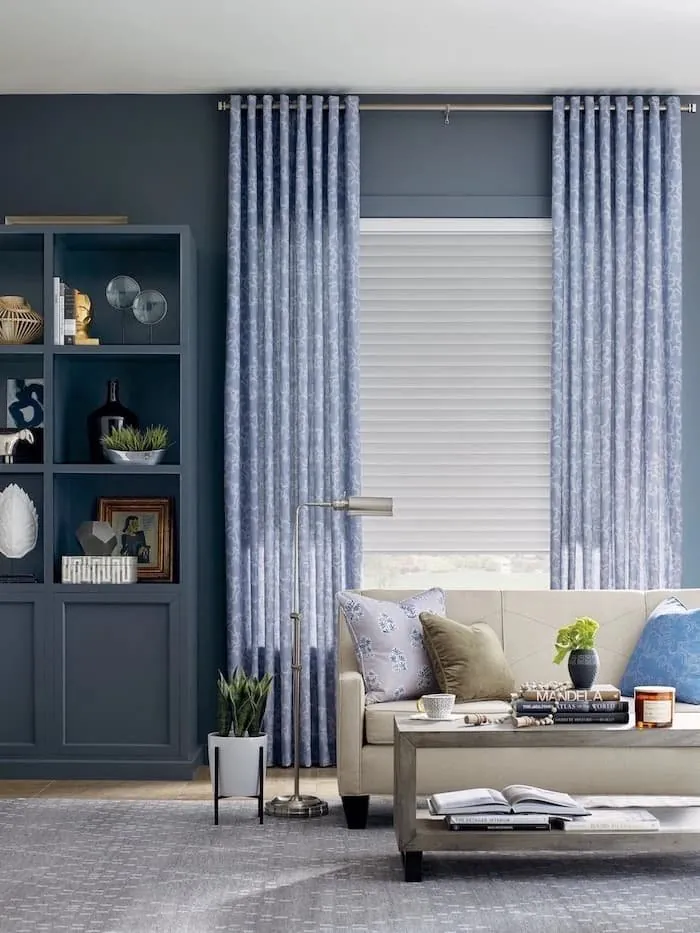
Shades behind drapery
Panels frame the window and stay put, while a motorized shade behind them does the daily work of light and privacy.
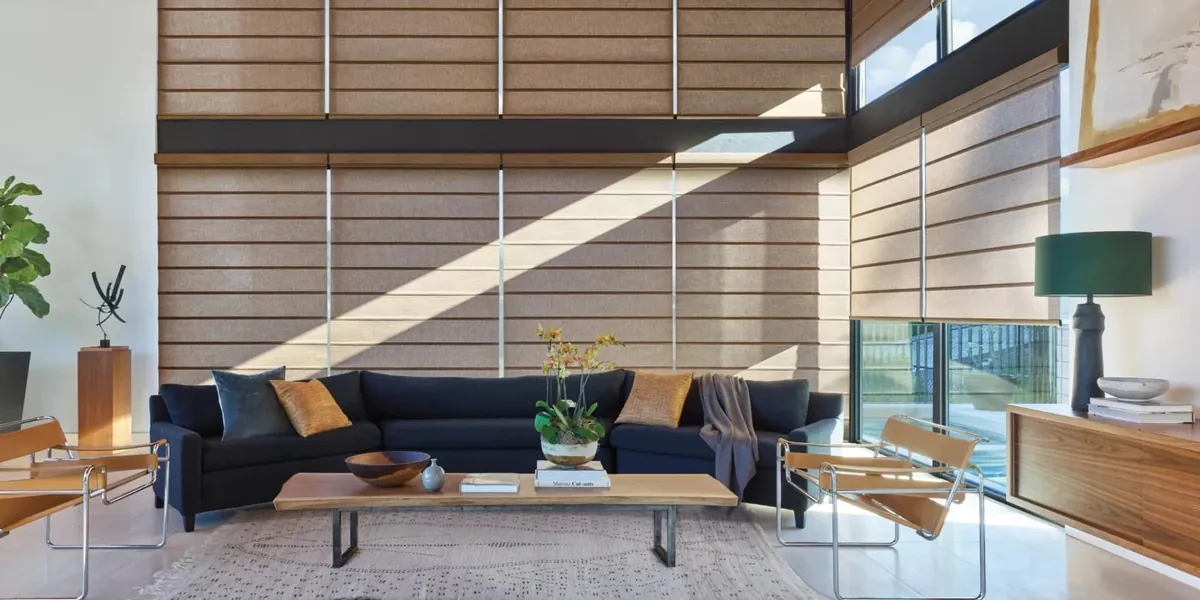
Banded shades for tall glass
Alternating sheer and solid bands that shift to open or close the view, well suited to a double-height wall.
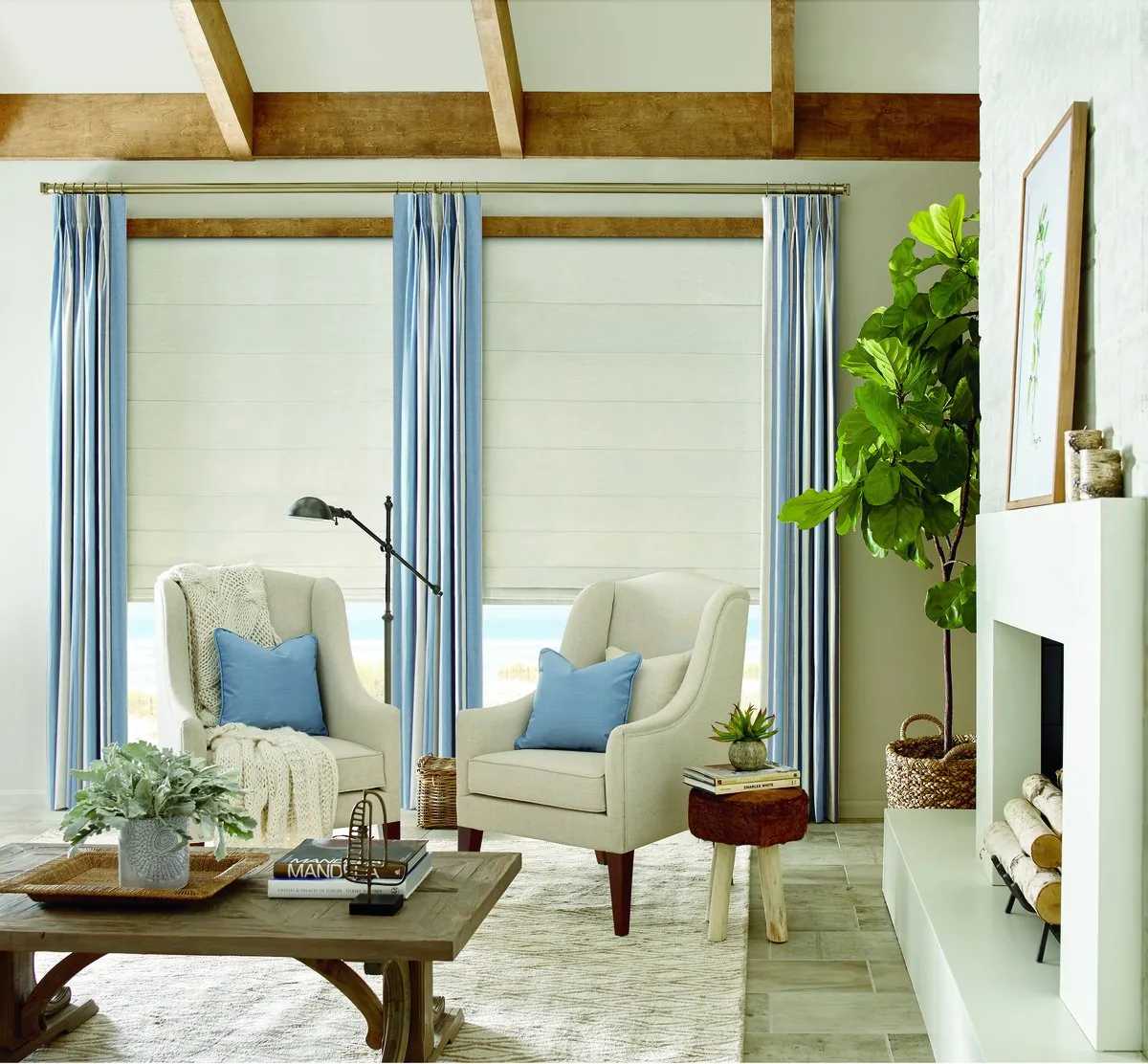
Roman shades for formal rooms
Soft folds that belong in a traditional room. On a motor, a row of tall Roman shades stacks evenly every time.
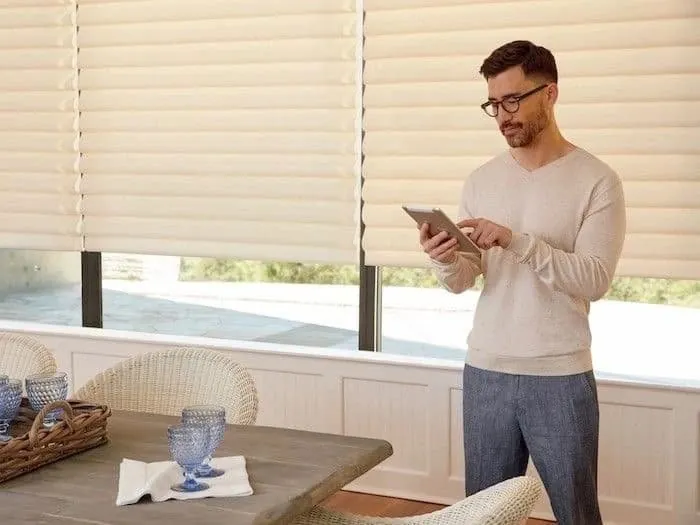
Tablet and phone control
The PowerView app shows every shade in a large house at once and stores the scenes you use for each room.
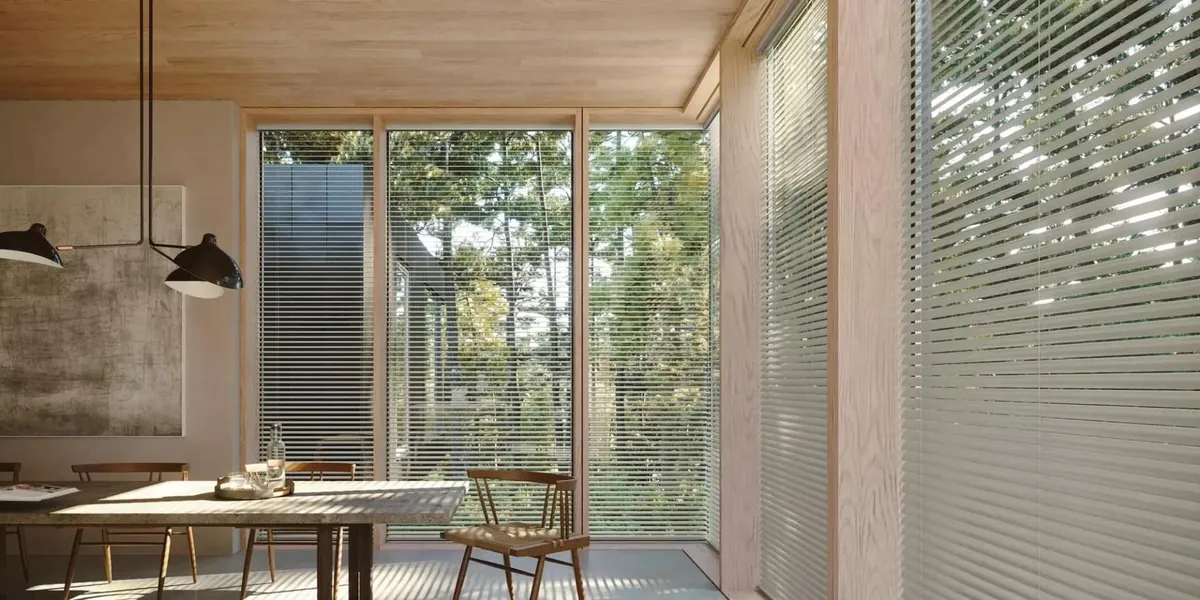
Metal blinds for a study
Fine slats that tilt to direct light. We check at your windows which sizes and styles can take a motor.
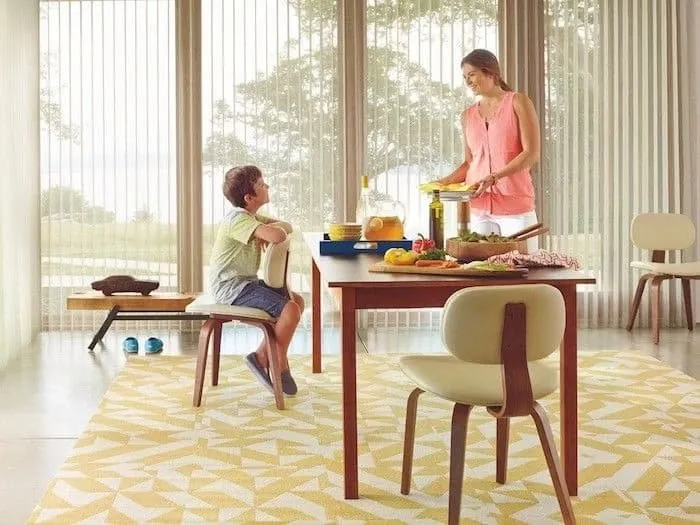
Vertical sheers for wide openings
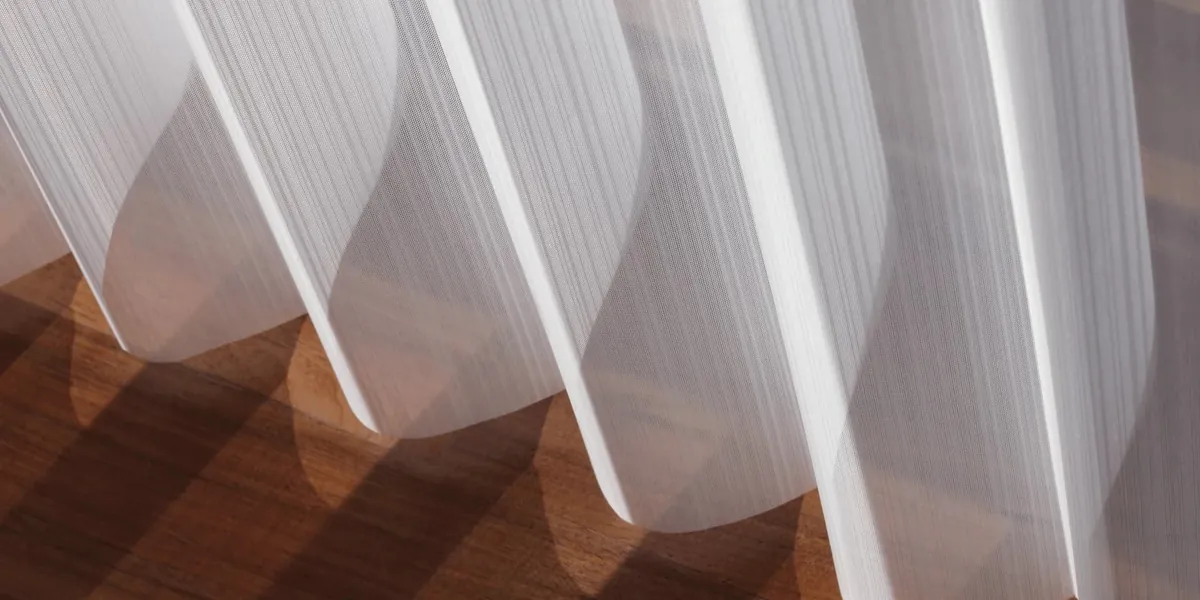
Soft vertical vanes that draw to one side, for wide openings and doors onto a terrace or lawn.
Houses around the village
The streets close to Osterville’s village center hold a mix of older shingled houses and newer ones built in the same spirit: two stories or more, with wide porches, steep roofs and plenty of windows. Rooms are well proportioned and ceilings are often high, so even a bedroom window can sit well above easy reach.
In houses like these, motorizing usually starts with the main rooms and spreads. Once the living room shades rise and fall together at a button, most customers want the same in the bedrooms, the kitchen and the stair windows. A PowerView system grows that way without any trouble: each new shade simply joins the app and can be added to the groups and schedules already set.
The village houses also have more neighbors than those out on the points, and the street side of the house matters. A group that closes every street-facing shade at dusk keeps the front rooms private, and a pale backing on each shade keeps the outside view even, whatever colors you choose inside.
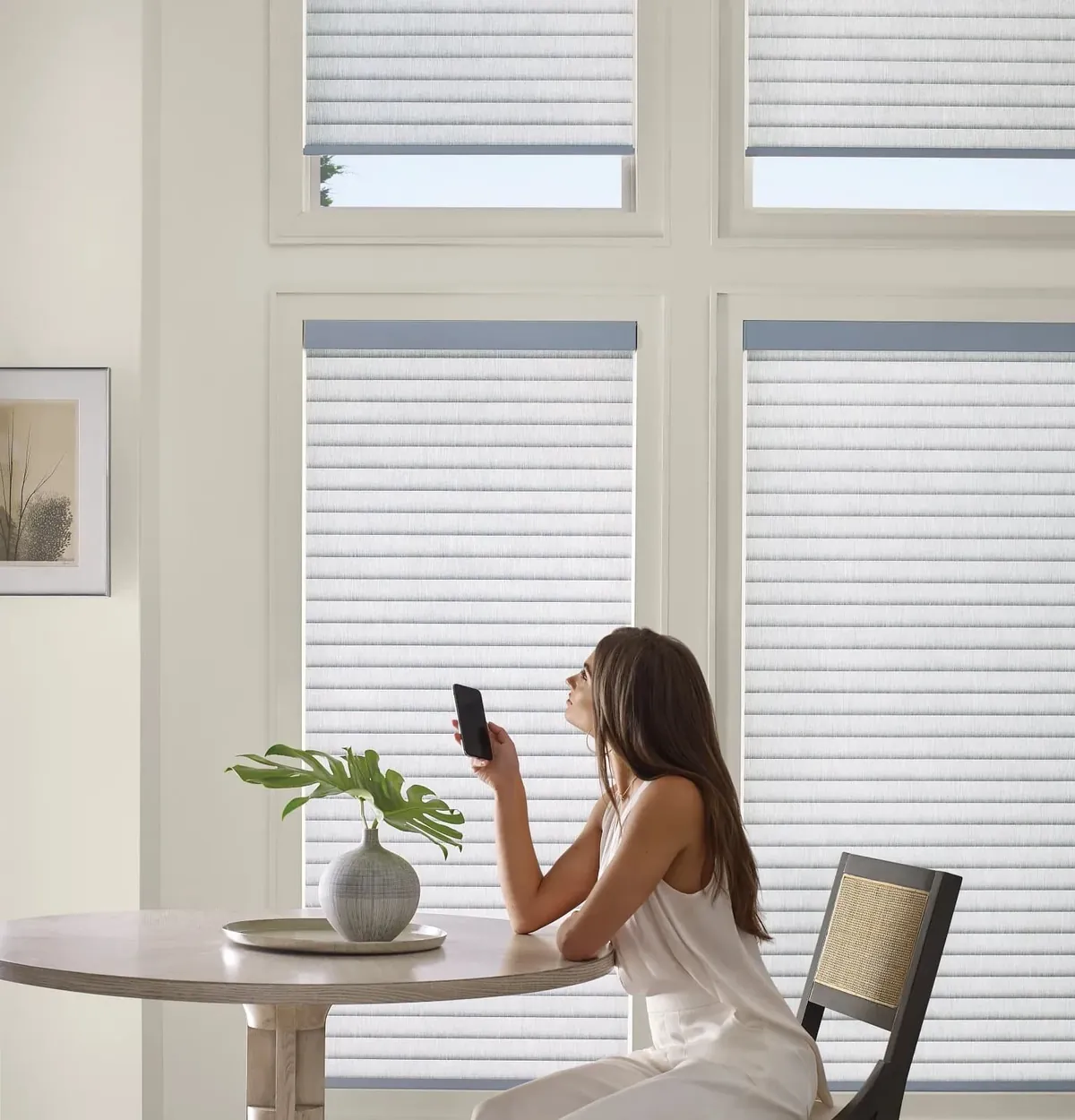
Wianno and the water-facing walls of glass
Out toward Wianno, the houses turn to face the sound, and the rooms on that side are built around the view. Floor-to-ceiling glass, tall French doors onto a terrace and great rooms that run the width of the house are common. They are beautiful in the morning and evening and can be hard to sit in through the brightest part of a summer afternoon.
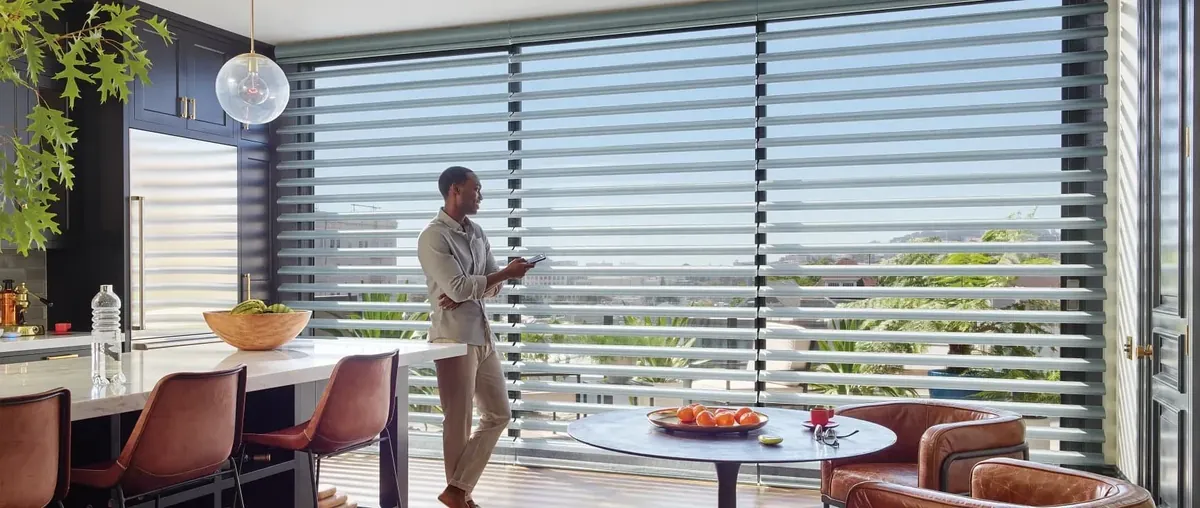
Motorized shades let a wall like that change through the day. In the morning it stays open. As the sun swings round, a schedule lowers the shades on the water side, partway or fully, and raises them again in time for the evening light. On a sheer or banded shade, the fabric can soften the glare without hiding the view entirely, so the room keeps its outlook even with the shades down.
The size of these walls is where a motor really earns its place. Big shades are heavy, and a row of them moved by hand never quite lines up. With PowerView, the whole run moves as one, every hem level with the next. For many Wianno houses, motorized blinds in Osterville, MA start with exactly this room.
Formal rooms where drapery is expected
The front rooms of many Osterville houses are formal: a living room with a fireplace, a dining room with a chandelier, perhaps a library. In rooms like these, a window looks unfinished without drapery, and the question is how to combine soft panels with the convenience of a motor.
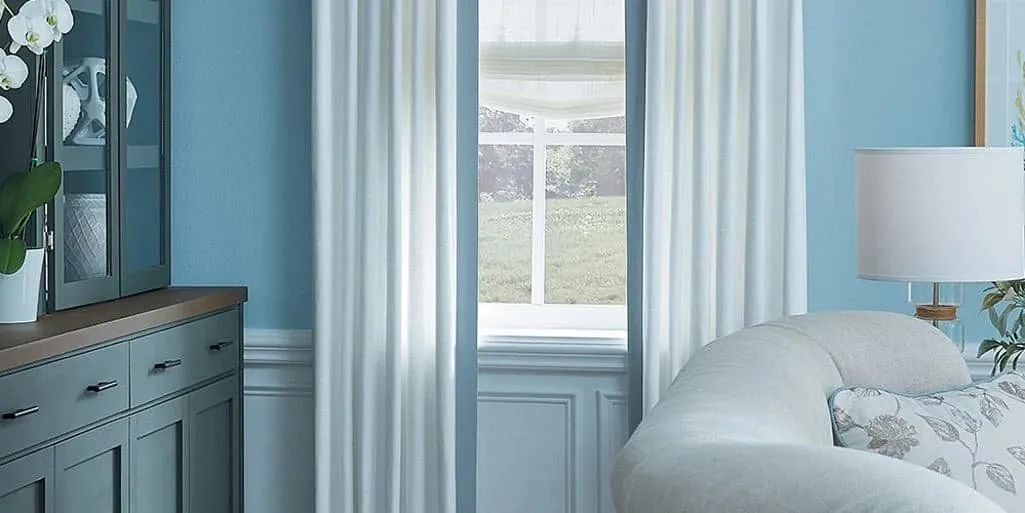
The usual answer is layering. Drapery panels frame the window and stay in place, or are drawn only now and then, while a motorized shade behind them handles everyday light and privacy. The drapery gives the room its softness and color. The shade does the work, rising in the morning and lowering at dusk on a schedule, with nothing for anyone to pull.
A Roman shade behind panels is a classic pairing in a traditional room. A sheer shade behind drapery gives a lighter, more airy feel. A roller with a room-darkening fabric behind bedroom drapery keeps the room dark for sleep. Our interior design consultations are there for exactly this kind of decision, when fabric, color and layering all need to be thought through together.
What moves and what stays
When drapery and shades share a window, it helps to decide early which layer does what. In most Osterville rooms we suggest the shade as the working layer and the drapery as the dressing. That keeps the daily movement in the shade, which is motorized and runs on schedules, and lets the drapery hang undisturbed and keep its shape.
The order of the layers matters too. The shade sits closest to the glass, inside or just outside the frame. The drapery hardware sits further out, wide enough that the panels clear the glass when open. Getting the clearances right means the shade can move freely behind the panels without catching. We measure for both layers at the same visit so they work together.
For rooms where the drapery is drawn more often, such as a bedroom, the panels and the shade can both be part of the evening routine. The shade lowers on its schedule, and the panels are drawn by hand for extra softness and darkness.
Oyster Harbors and strong salt exposure
On Oyster Harbors and along the shoreline, houses face the water on more than one side, and the salt in the air is constant. Windows left open through a summer let it in, and it settles on any metal near the frame. Over a season or two, corded hardware can show it.
PowerView shades keep their working parts inside the headrail, out of the way of the air coming through the window. With no lift cord and no cord lock, nothing at the side of the frame is left out in the salt, and nothing swings or taps in a sea breeze. That simplicity is one reason motorized blinds in Osterville, MA suit the shoreline houses so well.
Light is the other issue. With water on several sides, these houses take sun and glare from more than one direction through the day. Each side can have its own group and schedule, so the east rooms close against the morning and the west rooms against the evening.
Motor power is planned shade by shade during our visit, once we have seen each opening.
Opening and closing a seasonal house
Many Osterville houses are lived in from late spring to early autumn and visited now and then the rest of the year. Motorized shades suit that rhythm well.
While the house is closed, schedules keep the shades moving each day, so no room sits under full sun for weeks at a time and the house never looks shut up from the road. Water-facing rooms can lower through the bright hours and rise in the evening, just as they would with someone at home.
When you arrive, a single scene brings the whole house to life: harbor side open, bedrooms at half height, front rooms light-filtering. When you leave, another puts every shade into its away pattern, and the daily schedules take over again. The house is ready for the next visit without anyone walking from room to room.
Scenes for the way you use the house
In a big house, scenes are what make the system feel easy. A scene is simply a stored set of positions for a group of shades. You might have morning, with everything on the water side open; afternoon, with the west wall lowered halfway; dinner, with the dining room dimmed and the terrace doors open; and night, with every street-facing and bedroom shade closed.
You call a scene from the PowerView app or from a button on the remote, and every shade in it moves at once. Schedules can call scenes at set times, so the house moves through its day on its own, and you step in only when you want something different.
For the plain explanation of remotes, the app, scenes and schedules, see our guide to how motorized shades are controlled. The window covering automation page goes further into timing.
Guest wings and upper-floor bedrooms
Larger houses often have bedrooms spread across two or three floors, or a separate guest wing over the garage. Rooms like these are used unevenly: full for a fortnight in August, empty for weeks either side. Shades left down all season make a room stale, and shades left up let the sun work on the furnishings.
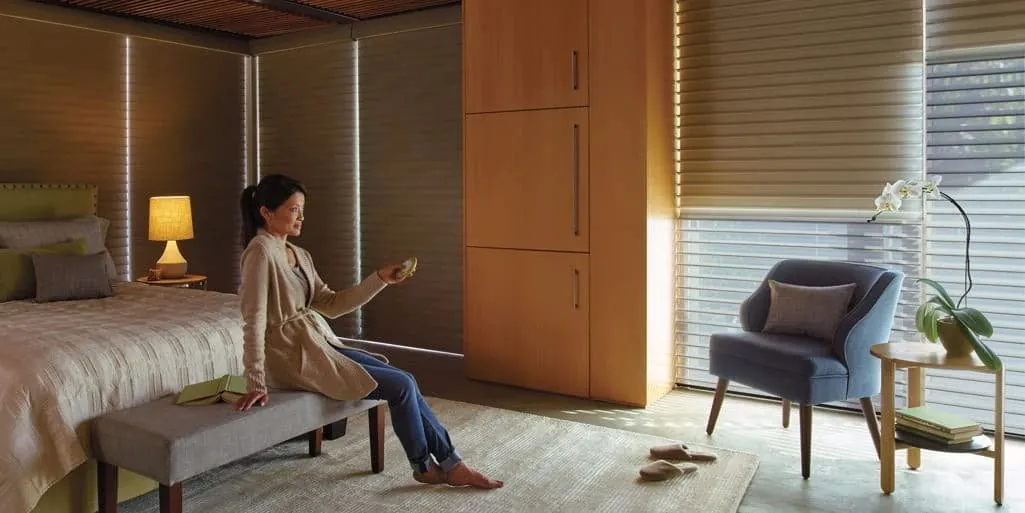
Putting those rooms on their own schedule solves it. While they are empty, the shades follow a gentle daily routine. When guests arrive, the remote on the nightstand gives them full control, and a room-darkening fabric lets them sleep past the early light off the water. A third-floor room with dormer windows, which nobody would climb to adjust by hand, simply becomes part of the plan for motorized blinds in Osterville, MA.
It is also a kindness to visitors who do not know the house. A single button by the bed is easier to explain than a set of cords on every window.
Remote or app
Both, usually. The remote is the quick everyday tool, kept in the kitchen, the bedroom or the main living room, and it moves a shade, a group or a scene with one press. The app is where the planning lives: setting up rooms, building scenes and changing schedules for the season. It also shows at a glance where every shade in a large house is sitting.
Many households have the installer set everything up and then use the remote and the schedules almost exclusively, opening the app only when the season changes.
Details that make a high-end installation
On houses built to a high standard, small details show. A few we pay particular attention to:
- Light gaps. A shade inside the frame leaves a narrow gap at each side. In a bedroom, a mount outside the frame, or a fabric with closer edges, keeps more light out.
- Linings. A lining changes how a fabric looks from outside and how much light it lets through. On a street-facing or water-facing house, the outside view is part of the decision.
- Stack height. When a shade is raised, it stacks at the top. On a tall window with a view, a slim stack keeps more of the glass clear.
- Even hems. On a wall of glass, every shade should stop at exactly the same height. Motors make that the norm rather than the exception.
We go through each of these at the window, with samples, so you can see the difference rather than imagine it.
Our consultation, step by step
- Request a consultation online, or tap the call button, and tell us when you will be at the house.
- We arrive with samples in our van, including drapery fabrics if you want to layer.
- We walk the house with you, from the formal rooms to the water side.
- We measure every window and, where drapery is planned, the space around it.
- We map out groups, scenes and schedules for the way you use the house through the year.
- You receive a free estimate to consider at your own pace.
- Our certified installers fit the shades and set up the remotes, app and schedules.
Read more about what happens at an in-home consultation before we come.
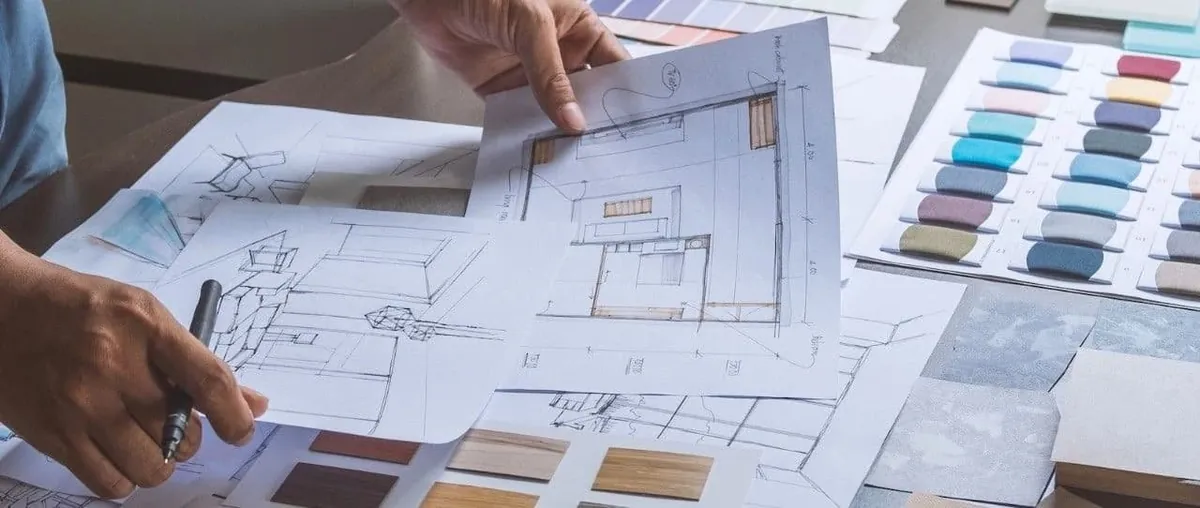
A Gallery dealer for a house of this scale
Blinds & Designs is a Hunter Douglas Gallery dealer. In a large house with formal rooms, walls of glass and bedrooms on several floors, that range matters: banded, Roman, sheer, roller and honeycomb shades, blinds and Hunter Douglas drapery can all be planned at one consultation, and every motorized shade runs from one PowerView app.
Hunter Douglas certifies our installers. They fit each shade, set its upper and lower limits, connect it to the remote and the app, and leave your scenes and schedules running. Interior design consultations help when the whole room is being considered, and we repair blinds and shades you already own.
See all our services in the village on the Osterville page, or look at roman shades in Osterville and roller shades in Osterville. The complete PowerView range is on the motorized blinds and shades page.
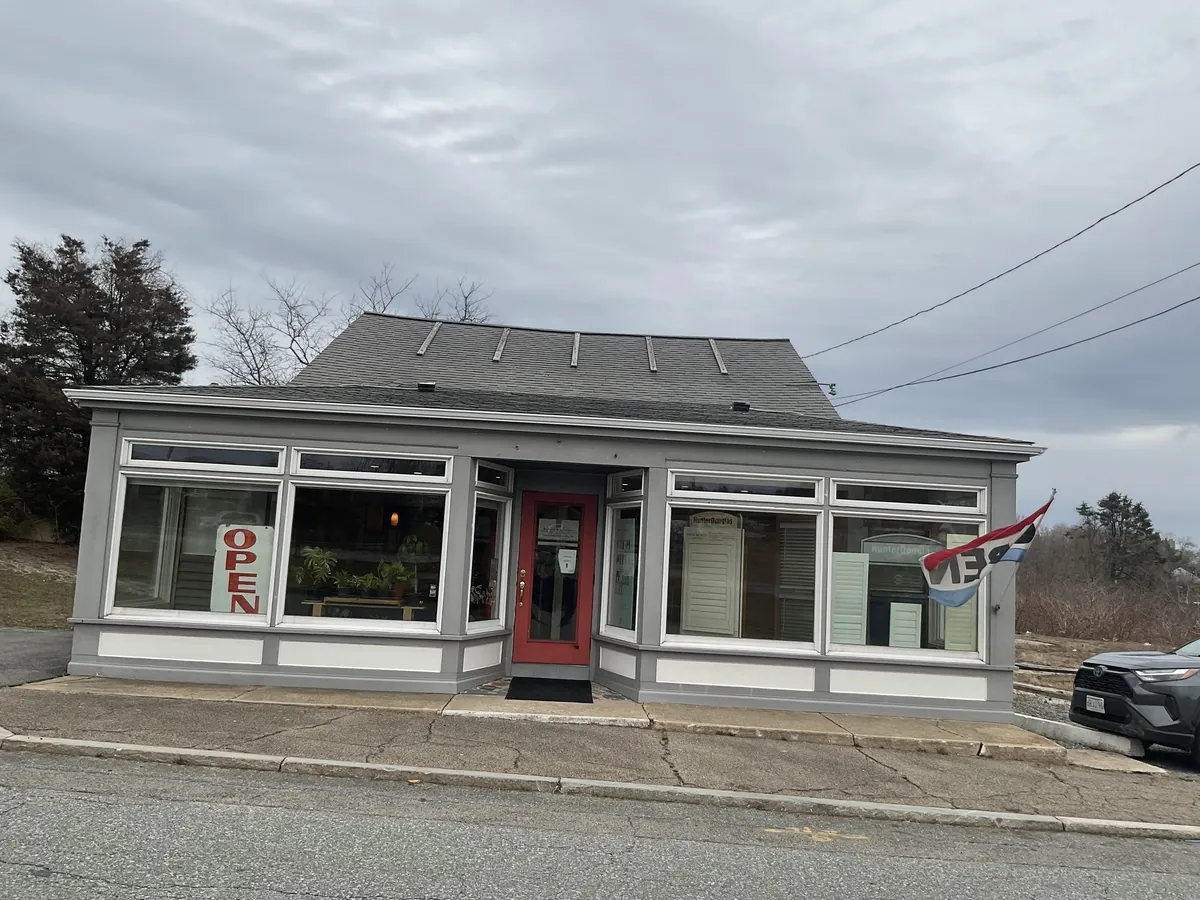
Sagamore is our closest showroom
The Sagamore showroom is our nearest location to Osterville, by the bridge onto the Cape. Call in whenever you are passing.
For a house of this size, we usually begin at the house itself, where we can see the glass, the rooms and the water. Motorized blinds in Osterville, MA are best planned standing in front of the windows they will cover.
Questions from Osterville
Can a motorized shade work behind our drapery?
Yes. The shade sits closest to the glass and does the daily work, while the drapery frames the window. We measure for both at the same visit so the shade moves freely behind the panels.
Our great room has glass to the roof. Can every shade move together?
Yes. Every shade on the wall can be grouped to move as one, stopping at exactly the same height, and high shades run from the same remote and schedules as the rest.
How do motorized shades cope with the salt air on the shore?
The working parts sit inside the headrail, and there is no lift cord or cord lock at the side of the window. That leaves far less exposed to the salt than a corded shade.
Will the shades still move while the house is closed for the winter?
Yes. Schedules are stored in the system and run every day, so the shades keep their routine whether anyone is there or not.
Is there a fee for the estimate?
No. After measuring, we give you a free estimate covering every shade, motor and layer we discussed.
Begin with a visit to the house
Request a consultation and we will bring samples to the house, walk the rooms with you, measure every window and leave you with a free estimate. If you would like to talk first, use the call button, or call in at the Sagamore showroom on your way.