
Why Franklin houses have windows nobody can reach
Every town has a few awkward windows. Franklin has a whole category of them. In the big colonials built across the subdivisions off Route 140, the front door usually opens into a two-story foyer, and above it sits a sheet of entry glass that no one can touch without a ladder. Climb the stairs and there is often a second tall window on the landing, set over the treads where a stepladder will not stand level. Those stairwell windows are the hardest reach in town, and they are exactly where motorized blinds in Franklin, MA, make the most sense.
Closer to the common and along Main Street the problem changes shape. The antique colonials and Victorians there have tall, narrow sash, often a whole row of them in a front parlor. Each one needs its own shade, and pulling six cords every evening gets old quickly.
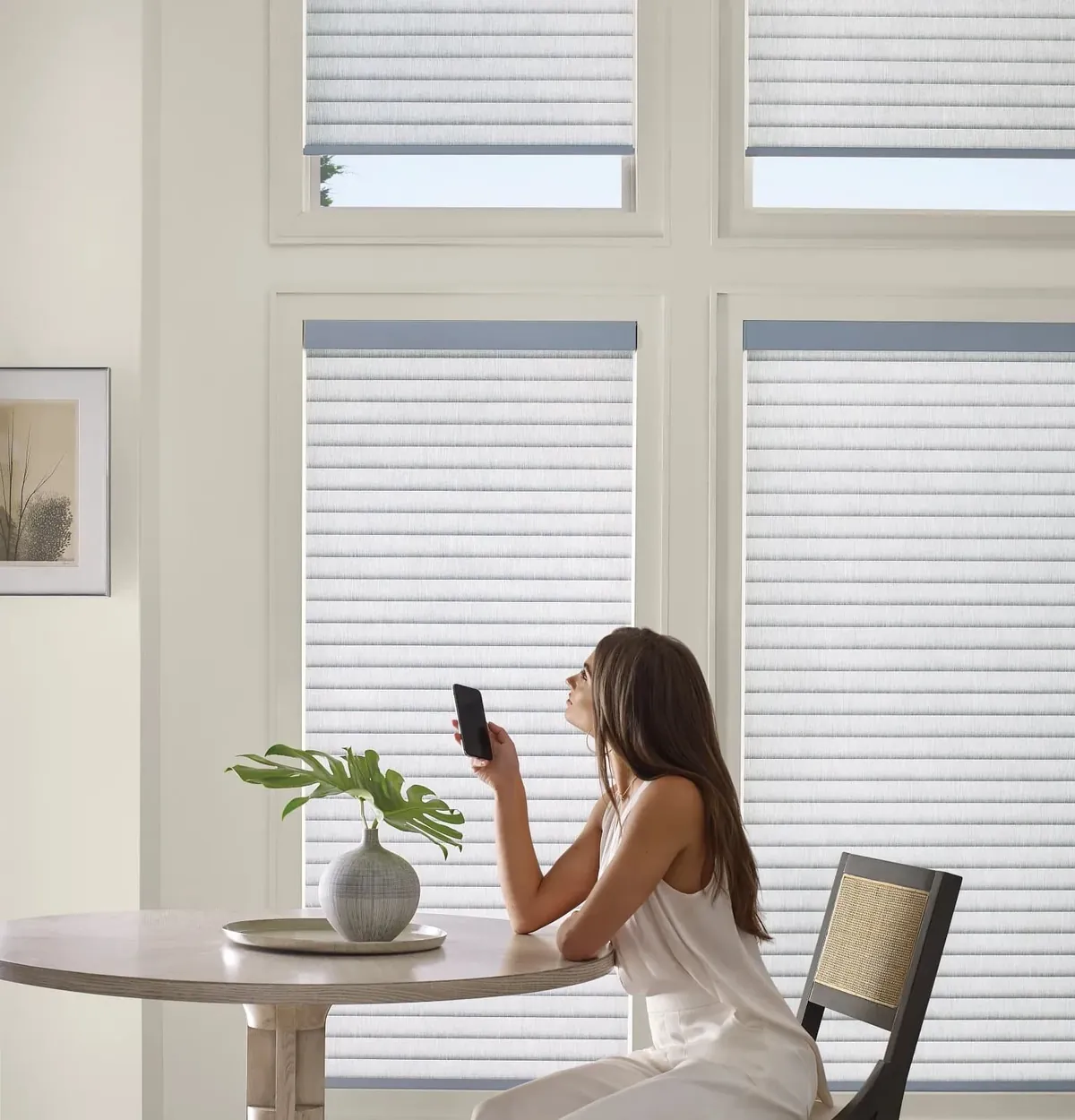
A PowerView motor solves both. The shade sits where it always would, inside the frame or on the casing, and moves when you press a button, tap your phone or let a schedule do it for you. Nothing to climb, nothing to tug.
Motorized blinds in Franklin, MA, across the Hunter Douglas range
A motor is not a separate product line. It is an option on many of the shades and blinds we already fit, so you choose the look first and the control second. These are the pairings that suit Franklin’s houses best.
Honeycomb shades on a motor
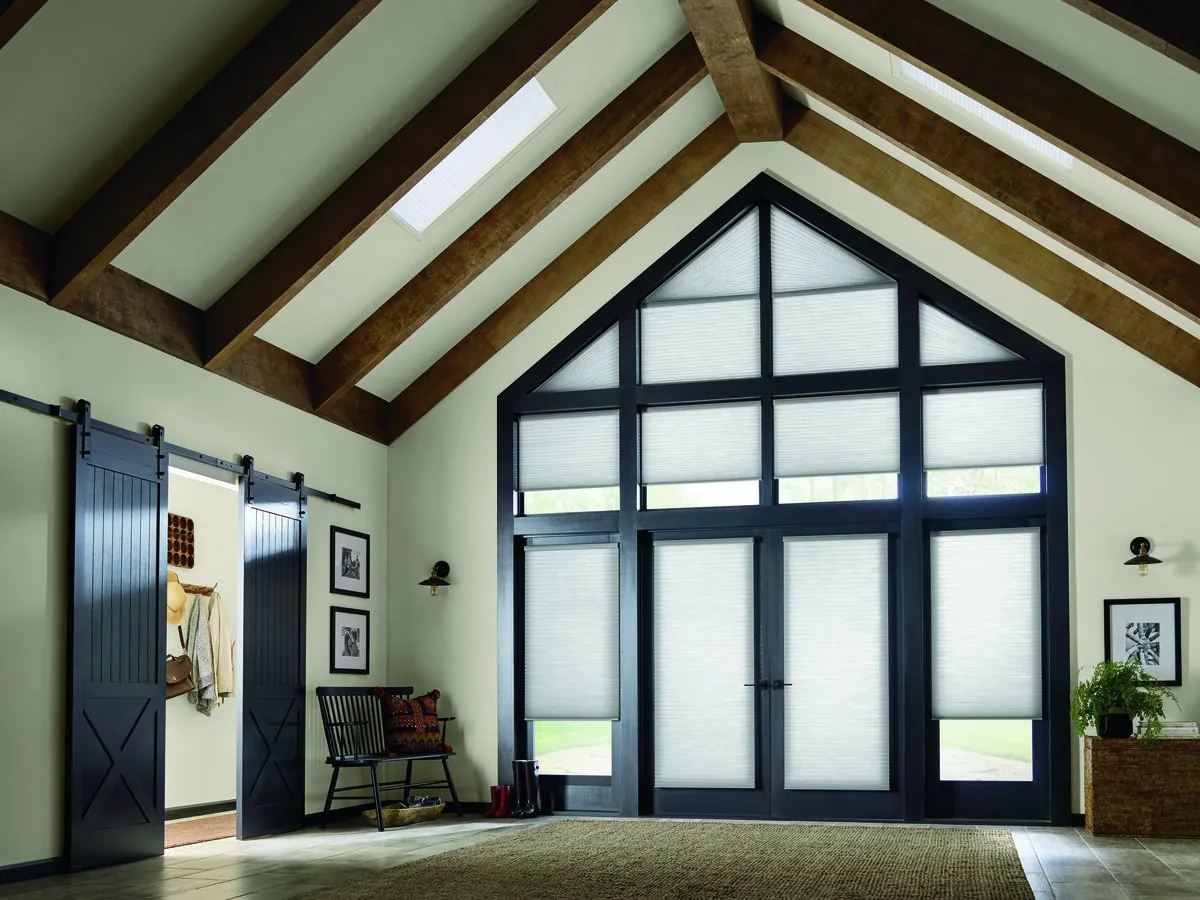
Duette and Applause cells hold air against the glass. Motorized, they cover a tall foyer or a gable wall in one smooth movement.
Sheer shades that tilt on command
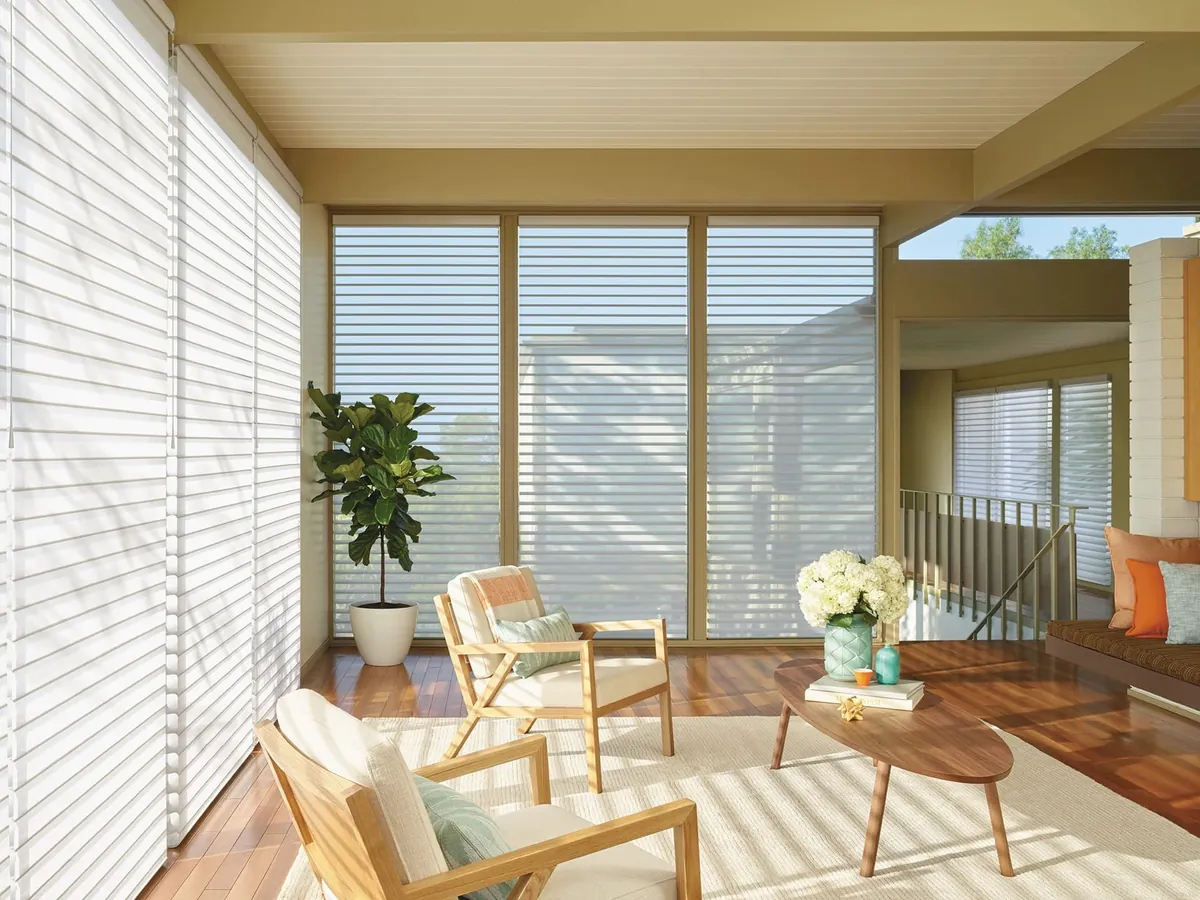
Silhouette’s soft vanes open and close like a blind. A motor lets you angle them from across the room as the sun moves.
Roman shades for the front parlor
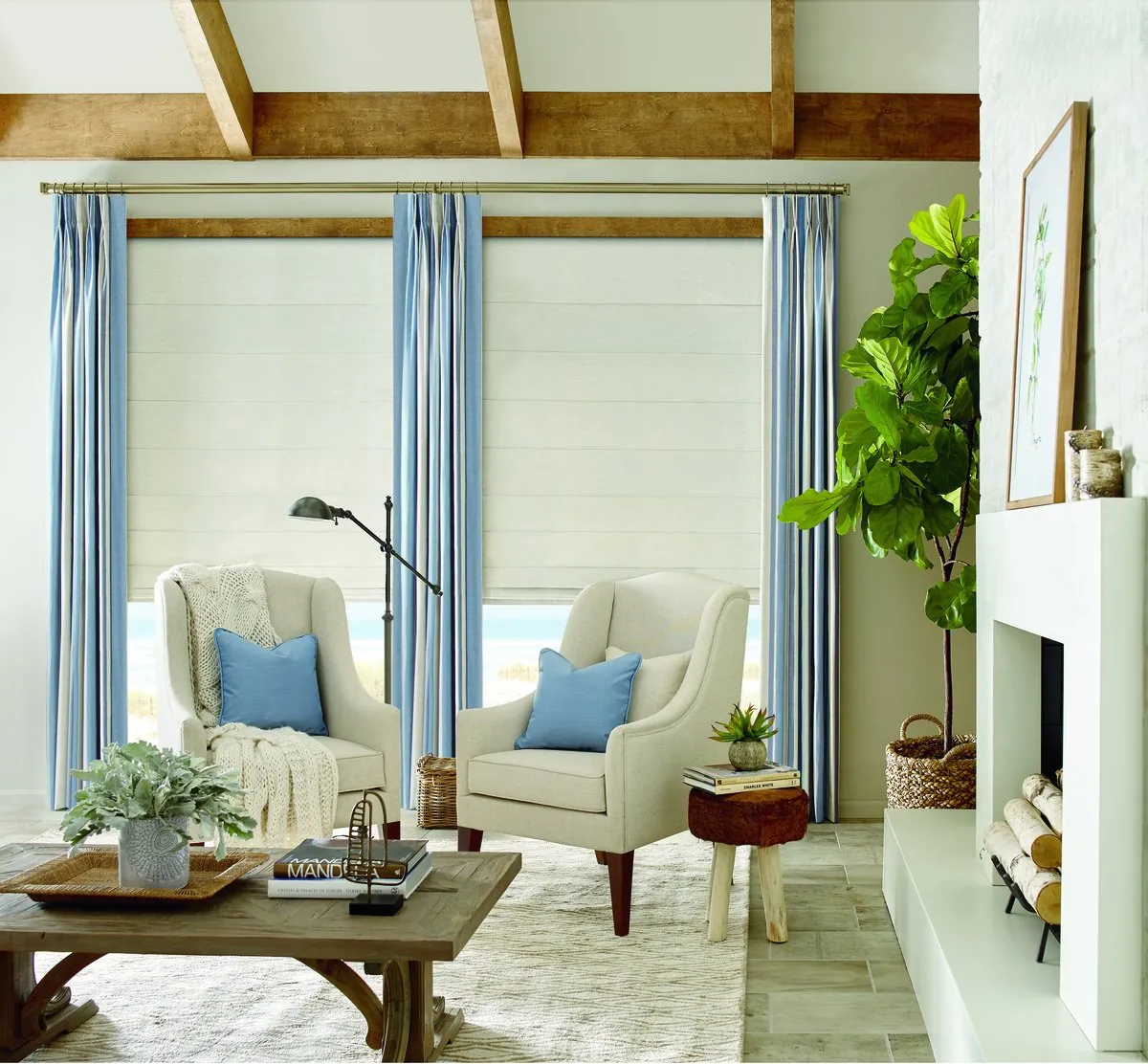
Vignette folds suit the tall sash of an older colonial, and a row of them can rise together at the press of one button.
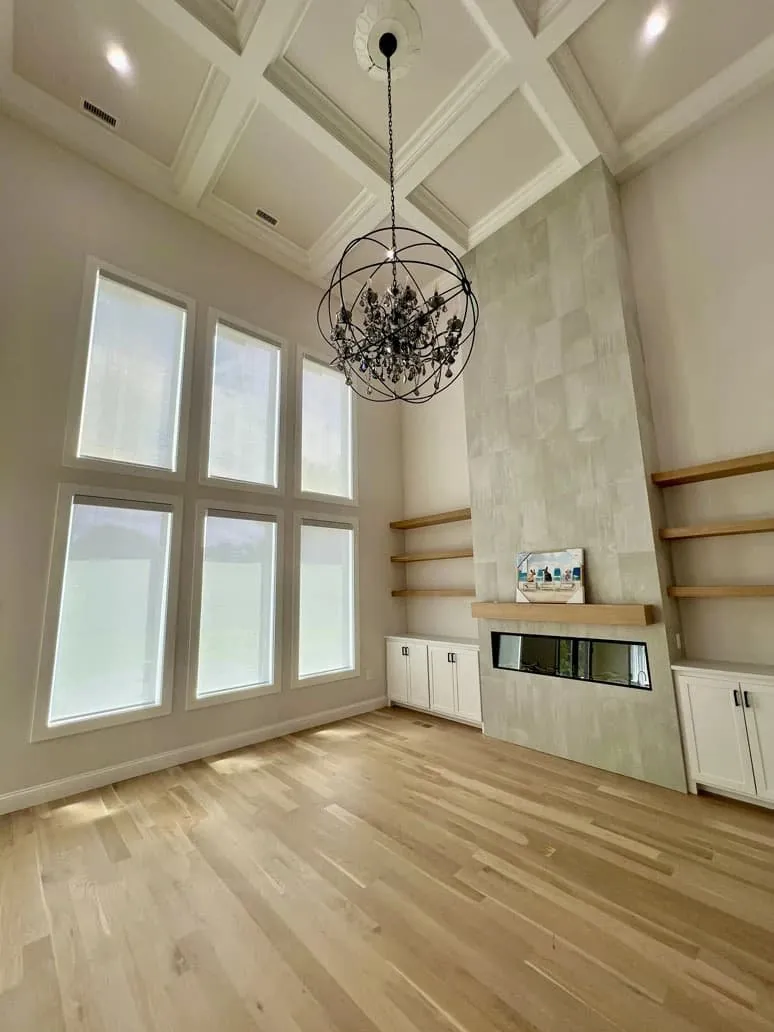
Roller shades for big glass
Designer Roller fabrics in one color across a double-height wall, from light filtering to room darkening.
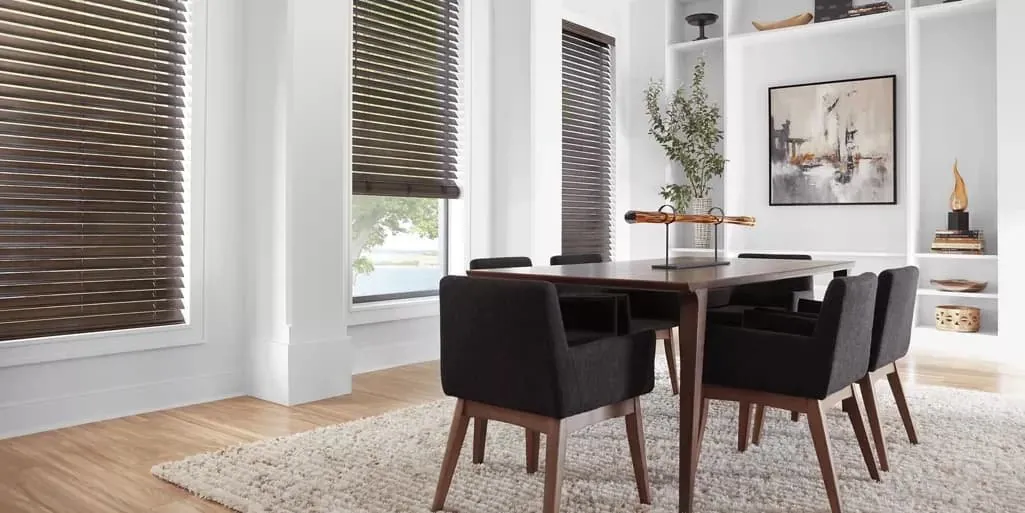
Wood blinds with a motor
Slats give the sharpest light control of all. With PowerView, the work of lifting and tilting is done for you.
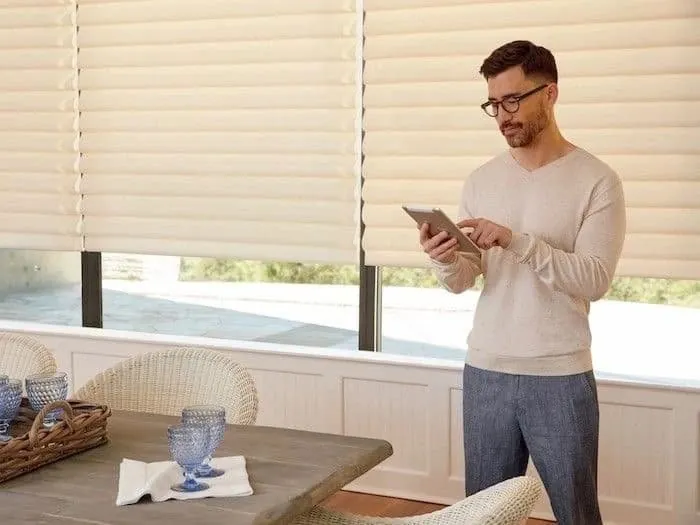
Control from a tablet
The PowerView app runs one shade, a room or the whole house from a phone or tablet.
The landing window over the stairs
Ask anyone in a newer Franklin colonial which window bothers them most and the answer is often the one halfway up the stairs. It is usually tall, it faces whichever way the front of the house faces, and it sits above a flight of treads with a railing in the way. You cannot lean over to reach a cord without stretching out over the drop, and a wand only helps if the top of the shade is within arm’s length, which it rarely is.
So most of these windows end up bare, or with a shade that stays in one position for years. That is a shame, because a landing window that faces south or west pours afternoon sun down the stairwell and into the hall below.
A motorized shade changes the arrangement completely. The headrail goes up once, during installation, and from then on you never touch the shade again. Lower it from the bottom of the stairs with a remote, from the kitchen with the app, or let it close by itself when the afternoon sun swings round. Our certified Hunter Douglas installers work from proper staging on a stairwell, not from a chair balanced on a step, and they set the shade’s upper and lower stopping points so it covers the glass exactly.
Two-story entry glass off Route 140
The foyer window in a big subdivision colonial is usually the largest single piece of glass in the house. Sometimes it is one tall pane; often it is a stack of rectangles with a half-round or a transom on top. From the outside it looks grand. From the inside it means bright sun straight into the hall in the morning or late afternoon, and at night a lit-up foyer that anyone on the street can see into.
There are a few ways to cover it. Honeycomb shades work well on the rectangular panes and keep the hall a little warmer in January. Roller shades in a light-filtering fabric give a crisp, plain look on a modern foyer. Sheer shades soften the light and let you see out while blurring the view in. Whatever fabric you choose, stacked panes can be set as a group so the whole window moves together, or kept separate so the upper glass stays open to the sky while the lower glass gives privacy.
Shaped tops such as half-rounds and arches are a separate conversation. Some can take a fixed covering, some are best left open, and we will tell you honestly what works on your particular window when we see it.
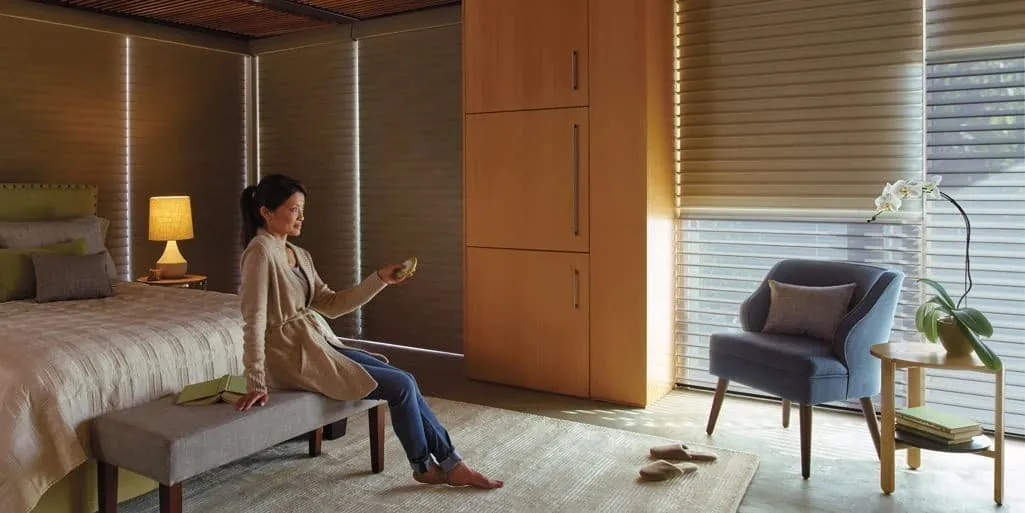
Tall sash around the common and Main Street
The older houses near the center of town were built with tall, narrow windows to let in as much daylight as possible. A front parlor might have four or five of them, a dining room another three. Each needs its own shade, and in a well-kept antique colonial nobody wants a jungle of cords hanging down beside the trim.
Motorized shades suit these rooms for two reasons. The first is tidiness: with no cords or loops at the side, the window frame stays clean and the restored casing gets the attention. The second is that a row of shades can be grouped, so all five parlor windows rise or fall together and stop at the same height. On a house where symmetry matters, that even line along the front looks right from the street.
Old windows do bring practical questions. Sash that has been painted many times, stops that sit close to the glass and frames that have settled over the years all affect how much depth there is for a headrail. A motor sits inside that headrail, so we measure depth carefully at each window and check the frame is square before recommending an inside mount. Where depth is short, a neat outside mount on the casing is the right answer. Either way, motorized blinds in Franklin’s older houses should look as though they belong to the room, not as though a piece of technology was bolted onto the trim.
How control works day to day
PowerView gives you three ways to move a shade, and most Franklin households end up using all of them.
- A remote. A small handheld remote for one room or several. It lives on a side table or mounts on the wall like a light switch, and anyone in the house can use it without a phone.
- The PowerView app. On a phone or tablet, the app shows each shade by room. Raise one, lower a group, or set a shade to sit at a particular height.
- Schedules. Tell the system when shades should move and it does the rest, whether you are home or not.
Groups and scenes sit on top of that. A group is simply a set of shades that move together, such as the five parlor windows. A scene is a set of positions you save, such as every shade on the street side lowered and the back rooms left open, and call up with one tap. Our guide to how motorized shades are controlled explains each option in plain terms.
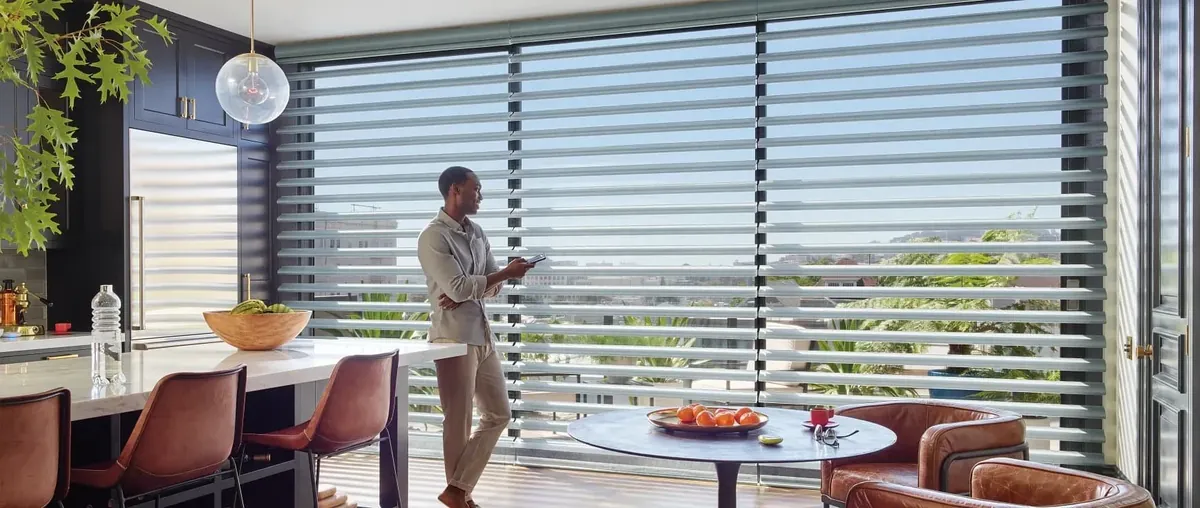
A schedule built around your house
Schedules are where motorization starts to feel less like a gadget and more like part of the house. A few examples of how they get set up in Franklin homes:
- The foyer shades lower in the late afternoon, before the low sun turns the hall into a hot spot, and rise again in the morning.
- Bedroom shades on the east side stay closed until a set time on weekdays, a little later on weekends.
- Street-facing rooms close at dusk so the house is private as soon as the lamps go on, even if nobody is home yet.
- The stairwell window opens in the morning to light the landing and closes after lunch when the sun comes round.
None of this is fixed. You change a schedule in the app whenever your routine changes, and a press of the remote overrides it for the moment without undoing the plan. If you go away, the shades keep moving on their usual pattern, so the house looks lived in from the road. There is more on schedules and scenes on our window covering automation page.
Schedules also help the fabric. A shade that lowers every afternoon on a sunny west wall protects the floors, rugs and furniture behind it from the hardest hours of light, and it does so on the days you forget as well as the days you remember. In a foyer with a wood floor and a staircase runner, that steady routine is worth having. On the north side of the house, where the light is gentle, most households simply leave the shades open all day and use a scene to close them at night.
From first visit to the first tap
Motorized shades are made to measure, so the process starts in your house.
- You request a consultation, or call the Franklin showroom with the call button, and we set a time to visit.
- We arrive with samples from the van and walk through the house with you, starting with the windows that are hardest to reach.
- You see fabrics against your own trim and light, and we talk about which windows should move together and how you want to control them.
- We measure every opening, check depth for the headrail, and note anything such as a stair rail or a high transom that affects installation.
- You receive a free estimate for the shades and installation you are considering.
- Hunter Douglas makes each shade to our measurements.
- A certified Hunter Douglas installer fits the shades, sets their limits, pairs them with your remote and the app, and shows you how to set your first schedule.
You can read more about what happens at an in-home consultation before we come.

Motorize the hard windows, keep the rest simple
Not every window in a house needs a motor, and we will not suggest one where it does not help. A common Franklin order puts PowerView on the foyer, the landing and perhaps a family room wall of glass, and fits cordless shades in the same fabric everywhere else. Because the fabric matches, the house still looks consistent from the street, and you only pay for motors where reach or convenience really calls for them.
Other households go the other way and motorize every window on the first floor so a single scene opens the whole house in the morning. Both approaches are reasonable. The right mix depends on how many windows are hard to reach, how you use each room and how much you want the house to run on its own. We will lay out the options window by window so you can decide.
Motorized shades can also be added later. If you start with a few, more can join the same system when you are ready.
No cords in the playroom or the nursery
The larger colonials in the newer neighborhoods are often busy houses, with a playroom over the garage, a nursery down the hall and a dog that likes the sunny spot under the window. Corded shades and blinds in those rooms mean a loop of cord at the side of every window, and keeping it tied up out of reach becomes one more chore.
Motorized blinds in Franklin homes take that chore away. There is nothing hanging at the window at all: the shade moves on its motor and the controls sit in your hand, on the wall or in the app. That keeps the window safer for small children and pets, and it also keeps it tidier, because a cord pulled at an angle for years tends to wear the fabric unevenly. A motor raises the shade straight every time.
In a nursery, a room-darkening fabric on a schedule is a quiet help. The shade lowers before nap time and rises in the morning on its own, and nobody has to tiptoe across the room to the window.
Light, glare and privacy on a busy street
Main Street and the roads around the common carry steady traffic, and the older houses sit close to the sidewalk. Front rooms there need privacy for much of the day. A light-filtering fabric keeps the room bright while blurring the view in, and sheer shades with tilting vanes let you angle the light so passers-by see little while you still see out.
In the subdivisions, the issue is more often glare. Big windows facing west turn a family room into a squint by late afternoon, and a television on the wrong wall becomes unwatchable. Motorized screen or roller fabrics cut the glare while keeping the view of the yard, and a schedule lowers them just before the sun reaches the worst angle. For the full picture of what else we fit in town, see our cellular shades in Franklin and roller shades in Franklin pages.
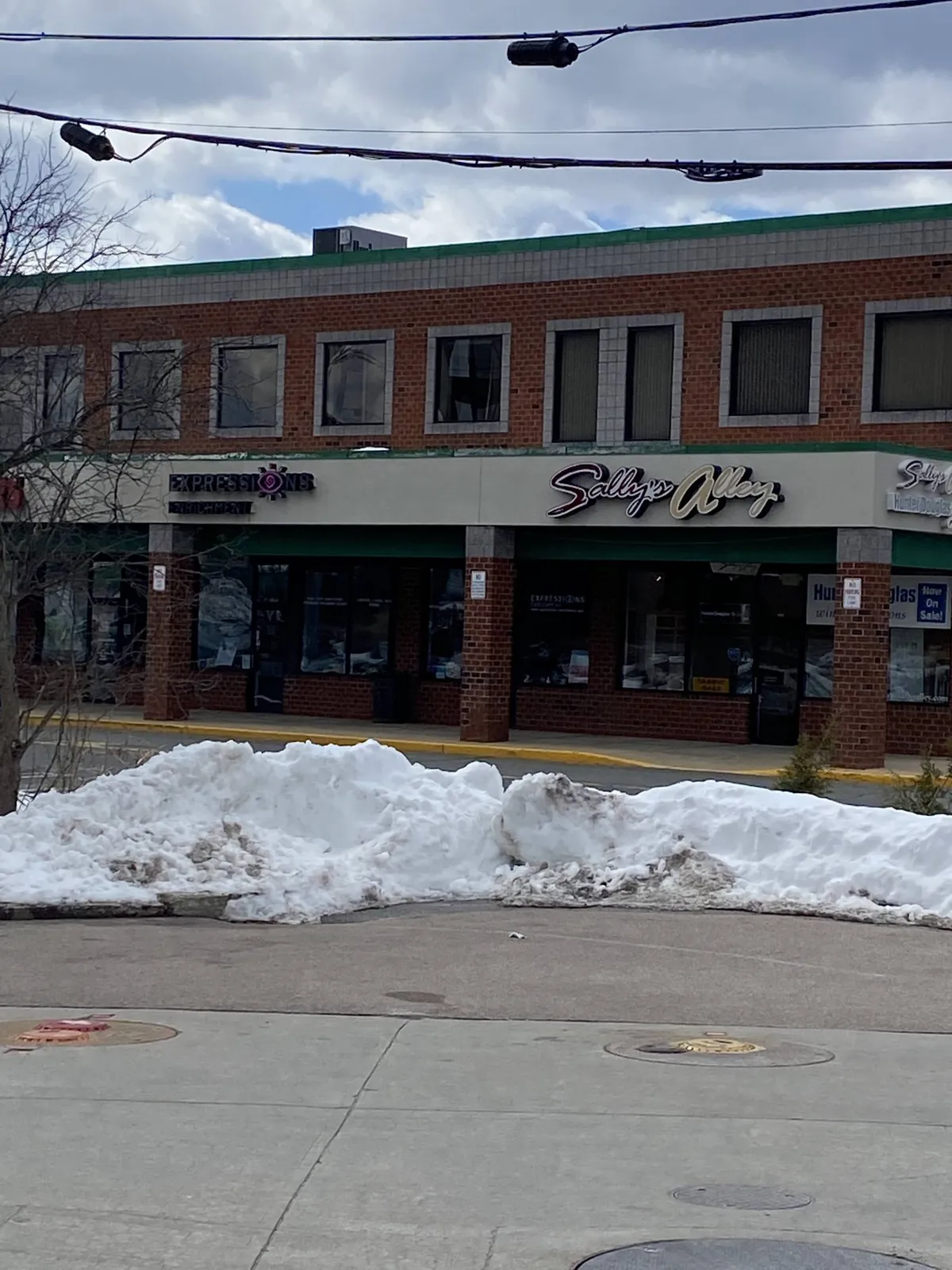
Shop motorized shades at the Franklin showroom
Franklin is home to one of our three showrooms, so for most of town it is a short drive. Stop in to talk through motorized blinds in Franklin with us and pick up ideas before we visit, or start at home and let us bring the samples to you.
Either way, the consultation ends at your windows. That is where we measure, where you see fabrics in your own light and where we work out which shades should share a remote.
Why buy from a Hunter Douglas Gallery dealer
Blinds & Designs is a Hunter Douglas Gallery dealer, a designation Hunter Douglas gives to dealers who meet its standards. That means PowerView is available across the full range we carry: honeycomb, sheer, roller, roman and blinds, so the motor never limits your choice of fabric.
Our installers are certified by Hunter Douglas. They fit, pair and test each motorized shade before leaving, and the same business that sold the shades is the one you call if anything needs attention later, because we handle blind and shade repair in Franklin too. We also offer interior design consultations when a room needs a fuller plan, and every estimate is free. Our main motorized blinds and shades page covers the range, and our Franklin page lists everything else we do in town.
Questions from Franklin
Can you motorize the shade on my stairwell window?
Yes, and it is one of the most common requests we get in newer Franklin colonials. Our installers fit the headrail from safe staging, set the shade’s stopping points, and from then on you run it from the bottom of the stairs with a remote or from anywhere with the app.
Will a motor fit inside the frames of my antique colonial?
Often, yes. The motor sits in the headrail, so the question is depth. Old sash with heavy paint or close-set stops sometimes leaves too little room for an inside mount, and in that case we recommend a slim outside mount on the casing. We measure every window before suggesting either.
Can all my front windows move at the same time?
Yes. Shades can be grouped so a row of windows rises and lowers together and stops at the same height, from one button on the remote or one tap in the app.
Do I have to use my phone?
No. A handheld remote works on its own, and schedules run without you touching anything. The app is there when you want it, for setting schedules and scenes or moving shades when you are away from the room.
Is the estimate free?
Yes. After we measure, you receive a free estimate for the shades and installation you are considering.
Start with the window you dread
Most motorized projects begin with one window: the landing, the foyer, the one behind the sofa. Tell us which it is when you request a consultation and we will plan the visit around it, bring the right samples and show you how a motor would handle it. You can also ring the Franklin showroom from the call button or drop in during opening hours.