
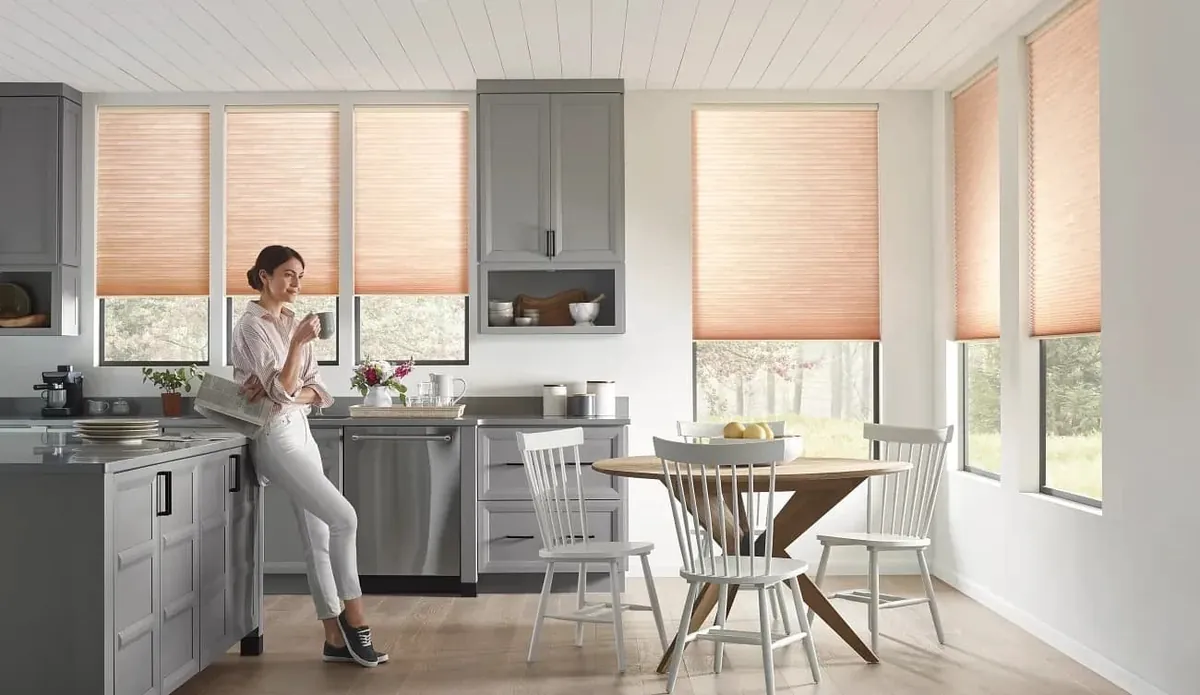
Close quarters and small windows
The village at the western end of the canal was built tight. Older houses stand a short walk from one another on narrow lots, former cottages have been turned into year-round homes, and the floors above the shops on Main Street have been converted into apartments. Windows here are often the small original openings the buildings started with, and the sightline from one house into the next can be only a few steps long. That makes privacy the first problem any window treatment has to solve, and it is where we begin with cellular shades in Buzzards Bay, MA.
Honeycomb shades are well suited to it. A light-filtering fabric glows softly when the shade is down, so the room stays bright inside while nobody outside can see in. A top-down, bottom-up shade covers the lower part of the window, where the neighbor’s kitchen or the passing sidewalk can look in, and leaves the top open to daylight. On a small window, the raised shade stacks into a slim band that barely takes any glass away.
Warmth comes with it. Each honeycomb cell holds still air against the pane, so an older house with original sash, or a converted cottage that was never built for winter, holds its heat better on a cold night by the canal.
Six honeycomb features for a small window
Duette and Applause are the two Hunter Douglas honeycomb lines behind our cellular shades in Buzzards Bay, MA. These are the features that earn their place on the smaller, closer windows of the village.
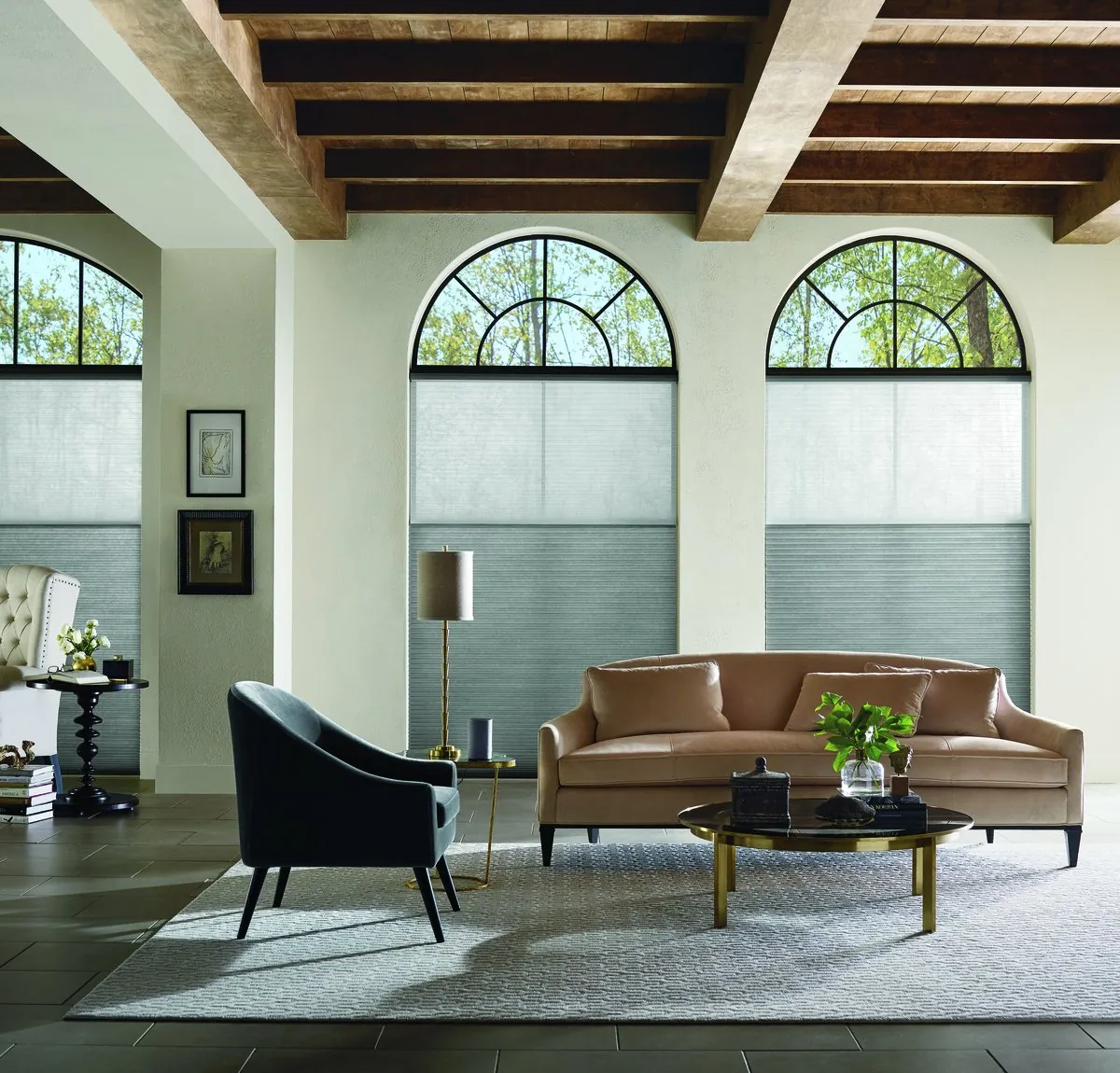
Top-down, bottom-up
Cover the lower sash and leave the top open. Privacy from the house next door, with the sky still in view.
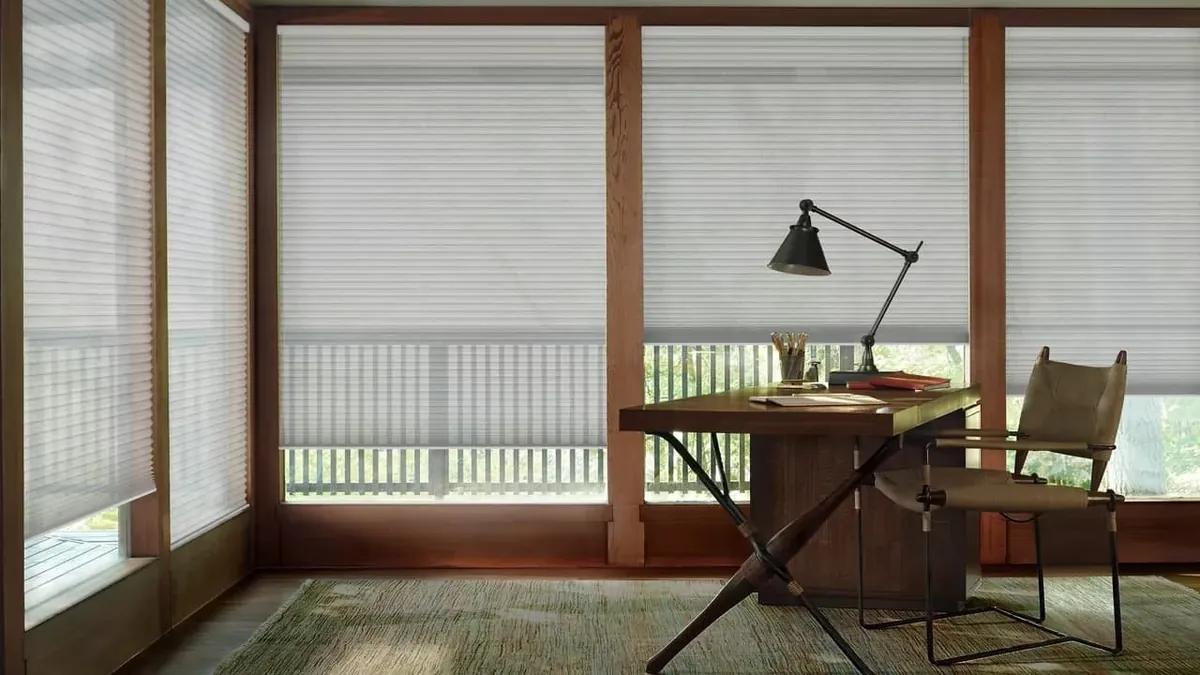
Light-filtering fabric
Daytime privacy without darkness. The fabric glows rather than showing what is in the room.
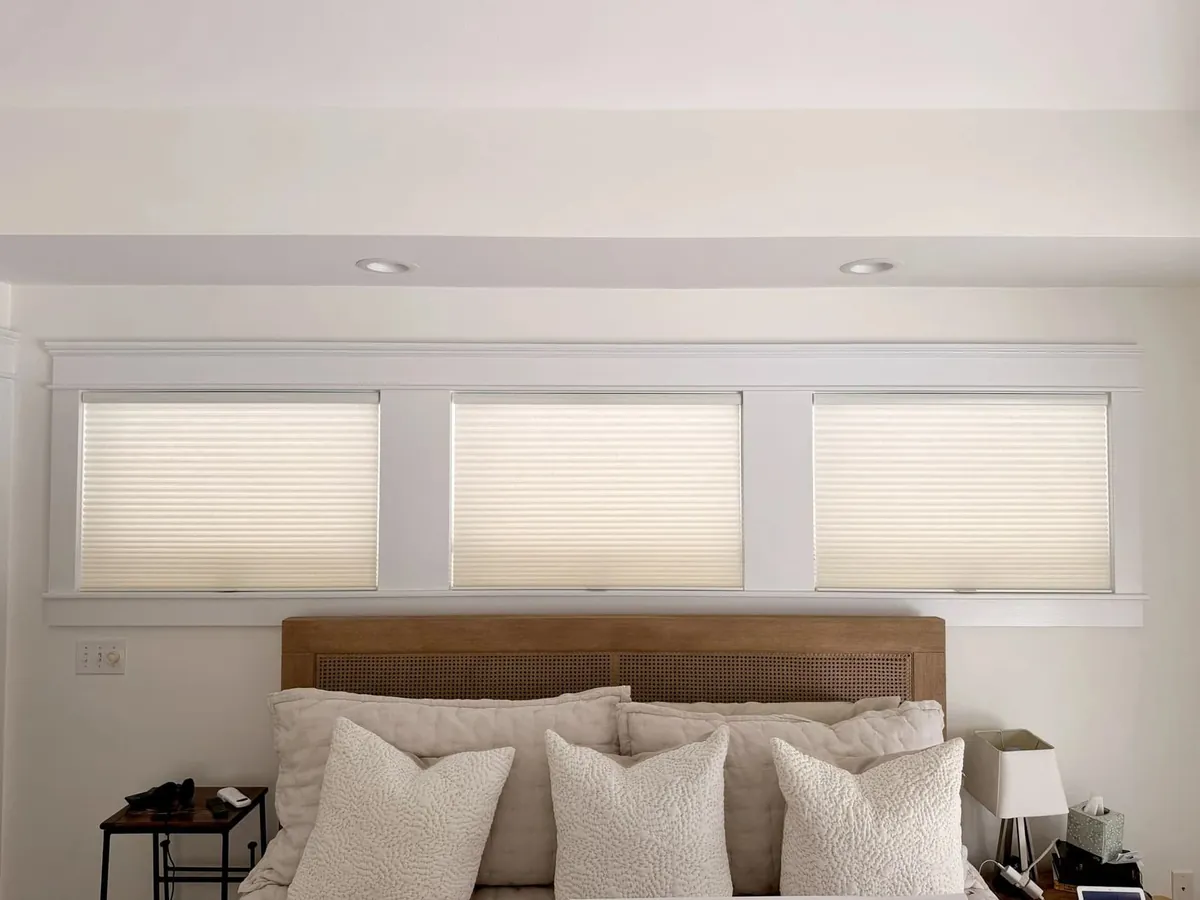
Room-darkening bedrooms
For bedrooms that face a streetlight or a lit window across the way. The cells still trap air for warmth.
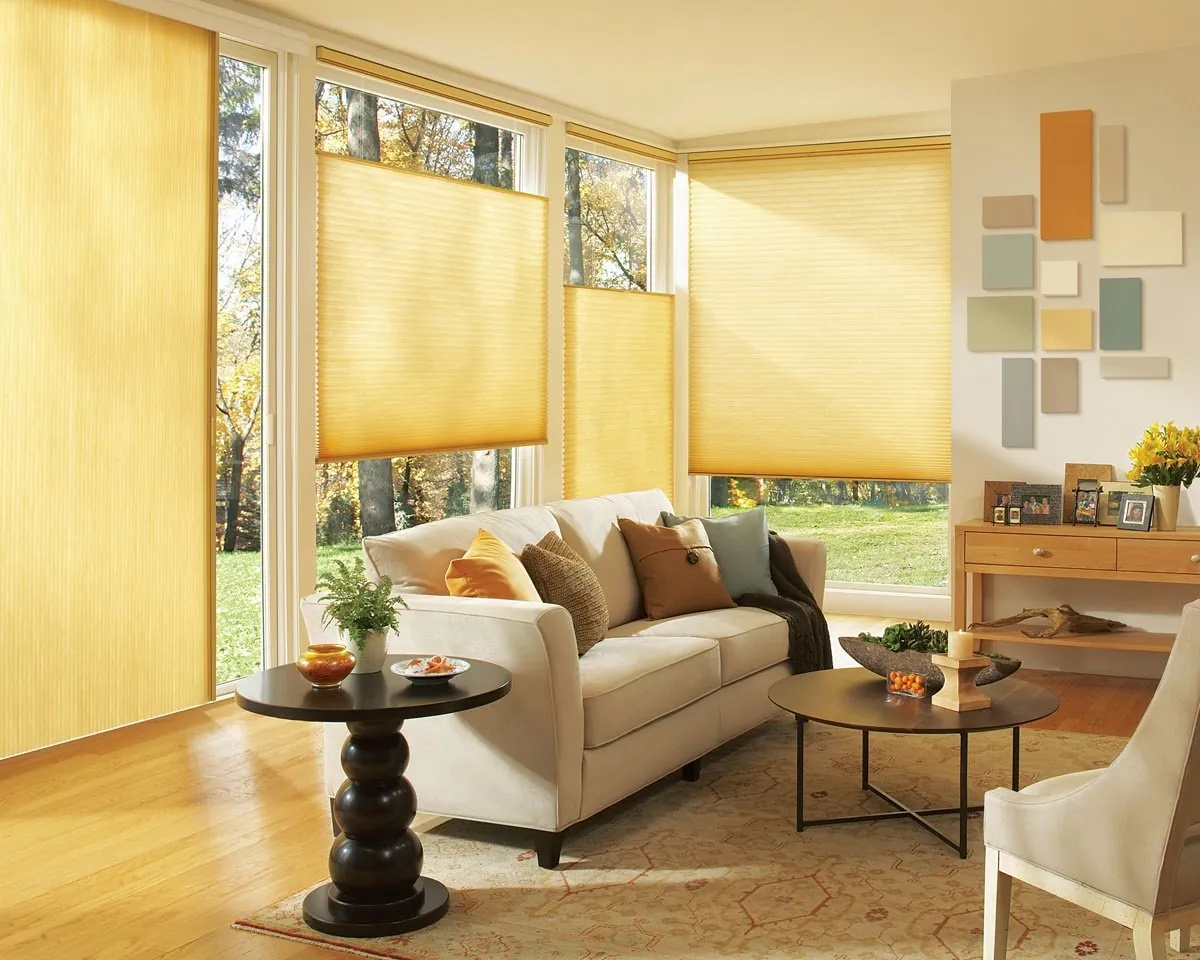
A slim stack
Raised, a honeycomb shade folds into a narrow band at the top of the frame, so a small window keeps nearly all of its glass.

Fabrics for compact rooms
Light colors make a small room feel bigger. We bring samples so you can see how each one reads in your own space.
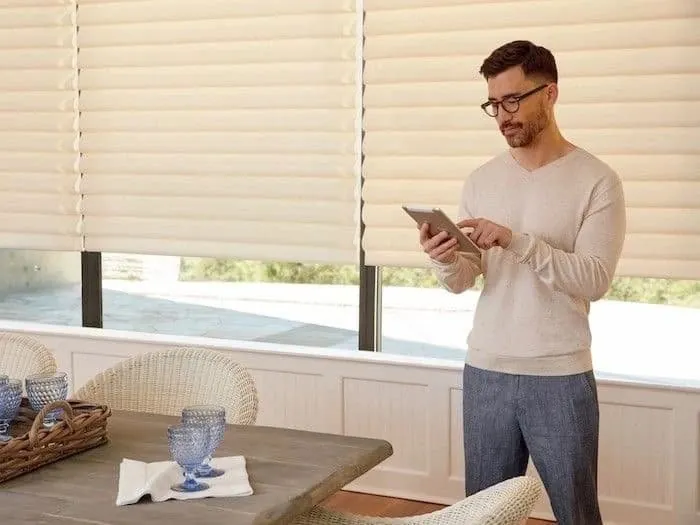
Easy motorization
PowerView raises every shade from a remote or an app, useful for a window behind furniture in a room with little floor space.
Privacy when the next house is close
In much of the village, the house next door is close enough that you can see into each other’s rooms without trying. Side windows face side windows across a narrow driveway, back rooms look onto a neighbor’s yard, and first-floor front rooms sit right on the sidewalk. Bare glass is not an option, but a heavy curtain drawn all day makes a small room gloomy.
This is the exact problem honeycomb shades handle best. With the shade fully lowered in a light-filtering fabric, daylight still comes through, spread evenly across the room, but the view in is gone. In the evening, with lamps on inside, a light-filtering fabric still keeps the room private, though a room-darkening fabric gives total privacy where you need it most, such as a bedroom or a bathroom facing the next house.
Top-down, bottom-up is the other tool. Lower the top of the shade a little and you get a strip of sky and light above, while the lower part of the window stays covered at eye level. On a side window facing a neighbor, it often turns a room you kept shaded all day into one that feels open again.
Small original openings
Many of the older buildings near Main Street still have their original window openings, and many of them are small: narrow double-hung sash, short windows tucked under eaves, little square windows in a stairwell or a bathroom. They are easy to overlook and hard to fit with off-the-shelf treatments.
A made-to-measure honeycomb shade can be built very narrow and very short, so even the smallest window gets a proper fit. Mounted inside the frame, it sits flush with the casing and leaves the trim visible. Raised, it disappears into a slim stack at the top. The smaller the window, the more that compact stack matters, because a bulky treatment can block a third of a little window even when it is open.
Small openings in old buildings are also often not quite square. We measure each one separately, at several points, and order each shade to its own window. When a frame is noticeably out of true, we explain the options and suggest the mount that will look straightest.
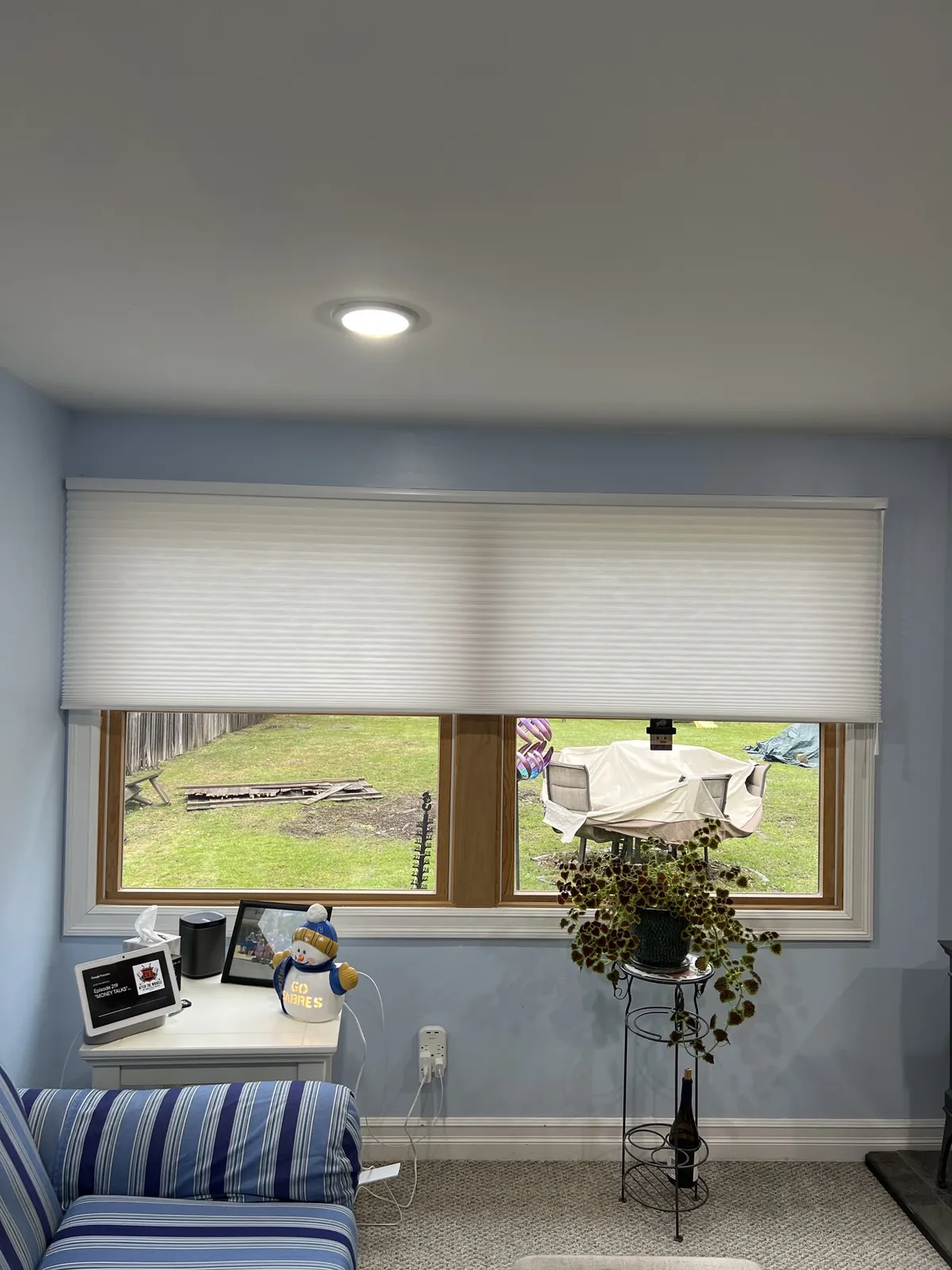
Converted cottages
A good share of the housing here started life as seasonal cottages. Over time they have been insulated, extended and turned into year-round homes, but the windows often tell the story: a mix of sizes and ages, single glazing in the original rooms, newer windows in an addition, and sometimes a former porch enclosed with a wall of glass.
Honeycomb shades bring that mix together. Because each shade is made to measure, every window in the house can take the same fabric and the same pleat size, so the rooms feel connected even though the windows do not match. From the street, every shade shows the same neutral backing, which tidies up the outside of the house as well.
The insulating side matters most in these houses. A converted cottage can be cold at the windows in a way a newer house is not. A double-cell honeycomb, or a Duette Architella fabric with a cell inside each cell, holds the most trapped air and suits the coldest rooms, including an enclosed porch. Our guide to cellular shades and winter heat explains why.
Apartments above Main Street
The upper floors of the commercial buildings along Main Street have been converted into apartments, and their windows face a busy street. That brings its own set of needs. Daylight is welcome, but so is privacy from the windows opposite. At night, streetlights and lit shopfronts throw light upward into bedrooms.
For these rooms we usually suggest light-filtering honeycomb shades in the living spaces and room-darkening honeycomb shades in the bedrooms. A top-down, bottom-up design in the main room lets in light above the line of sight from across the street. Cordless lift keeps the windows clean and simple. Honeycomb fabric also softens sound a little, which some people notice on a street-facing window, though we do not make any promise about noise.
If you rent and are thinking about shades, it is worth talking to your landlord before you order, since the shades are fixed to the window frame. We are happy to explain to both of you how they are mounted.
Light without being seen: choosing a fabric
The fabric decides how a honeycomb shade handles privacy and light, and it is the part people find hardest to judge from a photo. In Buzzards Bay houses, three families cover almost every room.
- Sheer and semi-sheer fabrics soften light and keep some view. They suit an upstairs window that nobody can see into.
- Light-filtering fabrics give privacy by day while keeping the room bright. They are our most common choice for front rooms, side windows and kitchens near a neighbor.
- Room-darkening fabrics block nearly all light and give full privacy at night. They suit bedrooms and bathrooms, especially those facing a streetlight or a house close by.
A Duolite design puts a sheer and a darkening shade on one headrail, so one window can do both jobs. It suits a small bedroom that has only one window and needs daylight and darkness at different times. Pale colors make compact rooms feel larger, and the neutral street-side backing keeps the house looking uniform from outside.
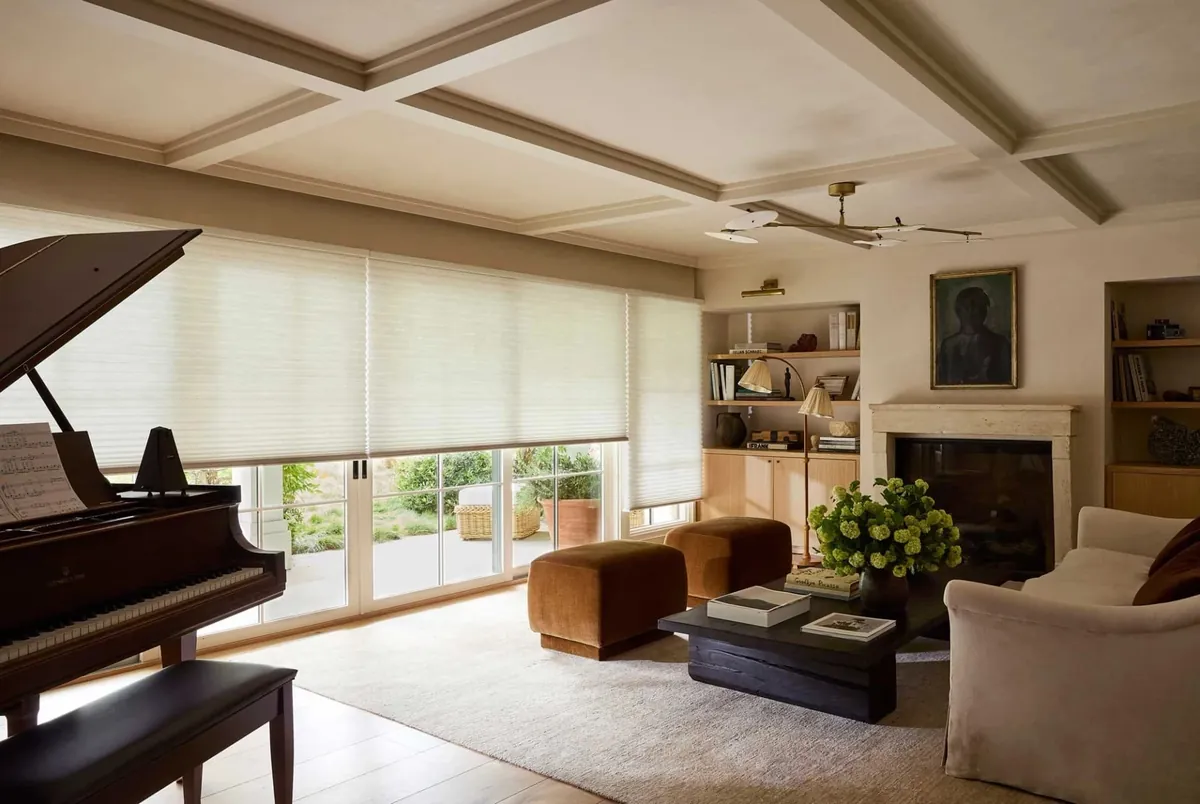
Bathrooms and kitchens that face the neighbors
In a village house the bathroom window often looks straight across at the house next door, and the kitchen window over the sink can face a neighbor’s side door. These are rooms you use every day, and they are usually the ones left with a frosted film or a café curtain that never quite works.
Cellular shades in Buzzards Bay bathrooms solve that cleanly. A light-filtering or room-darkening honeycomb lowered from the top down covers the lower glass completely while leaving a band of daylight above, so the room is bright and private at the same time. The fabric wipes clean with a light dusting, and a cordless lift means nothing dangles near a tub or a sink.
Over the kitchen sink, where you cannot reach the window without leaning across the counter, PowerView is worth considering. A press of the remote raises or lowers the shade, and you can set it to close at dusk with the rest of the house. In a small galley kitchen, a light fabric keeps the room feeling as open as possible.
Weather at the western end of the canal
The village sits right where the canal opens toward the bay, and the wind comes down the waterway with little to stop it. Older windows in the village let the cold in around the sash, and rooms on the canal side can feel noticeably cooler on a winter evening.
A honeycomb shade lowered at dusk puts a layer of trapped air between the cold glass and the room. On the windows that face the weather, an inside mount sitting snug in the frame, with the bottom rail close to the sill, cuts down the cold air that spills around the edges. On a bright day, the same shade diffuses the light that bounces off the water toward the village, keeping a room comfortable to sit in.
Windows that get opened often in summer and shut tight against a winter blow need a shade that stays square. Our installers fix every bracket into solid wood in the frame rather than relying on old plaster, so the shade keeps running level through the seasons. In older village buildings, where a frame may have been patched or repainted many times, we check what is behind the paint before we drill.
Cords, cordless and PowerView in tight rooms
In a small room, a window is often right next to a bed, a sofa or a child’s play space. That makes the lift system more important than it would be in a big open house.
Cordless lift is our usual suggestion. There is no cord hanging at the side, which suits rooms where children or pets spend time and keeps the window looking clean. You simply raise and lower the bottom rail by hand. Where a window is behind a piece of furniture you cannot easily move, or set high under the eaves, PowerView motorization lets you control the shade from a remote, an app or a wall switch. You can also set the bedroom shades to lower at dusk each evening, so the room is private before you think about it. Our page on motorized blinds and shades covers the controls.
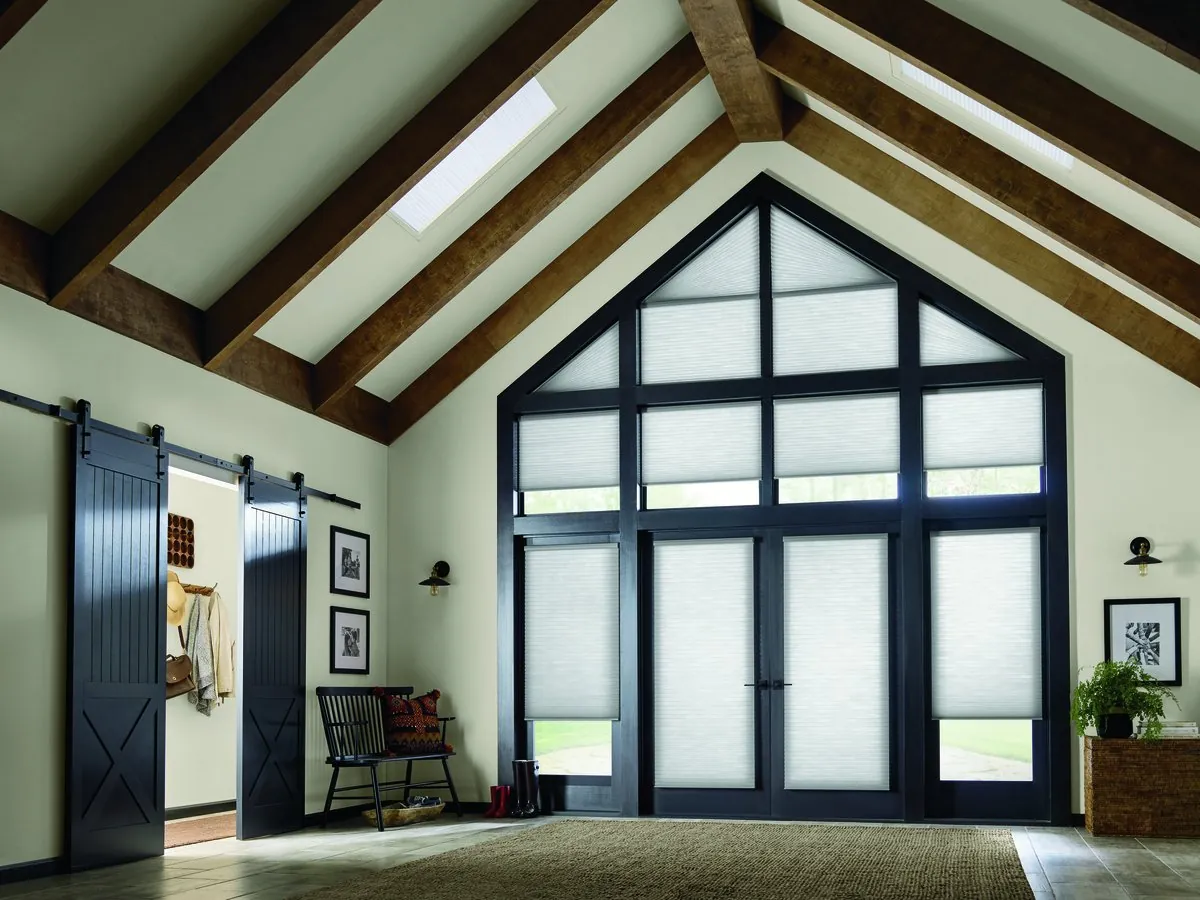
Duette or Applause
Both are Hunter Douglas honeycomb shades with the same air-filled cell. Duette has the largest choice of fabrics and the special designs, including Architella, Duolite and shapes for arched or angled windows. Applause has its own palette and suits most standard windows well. In a village house, the choice usually comes down to which fabric looks right in your rooms. We bring both, and you can compare them at the same window. The main cellular shades page, the Duette honeycomb shades page and the Applause honeycomb shades page explain each line.
How the home visit goes
Choosing cellular shades in Buzzards Bay is easiest when you can see the fabric against your own window, with the house next door behind it. So we come to you, with vans that carry samples, and bring the showroom to your door.
- Request a consultation and choose a time.
- We start with the windows that bother you most, usually the ones facing a neighbor or the street.
- You hold light-filtering, room-darkening and sheer samples at the glass and see how private each one is.
- We measure every opening, small ones included, and check whether each can take an inside mount.
- We talk through lift options, from cordless to PowerView.
- You receive a free estimate and decide when you are ready.
When you order, our certified Hunter Douglas installers fit every shade, check it runs smoothly and sits level, and show you how it works. You can read about what happens at an in-home consultation before the visit.
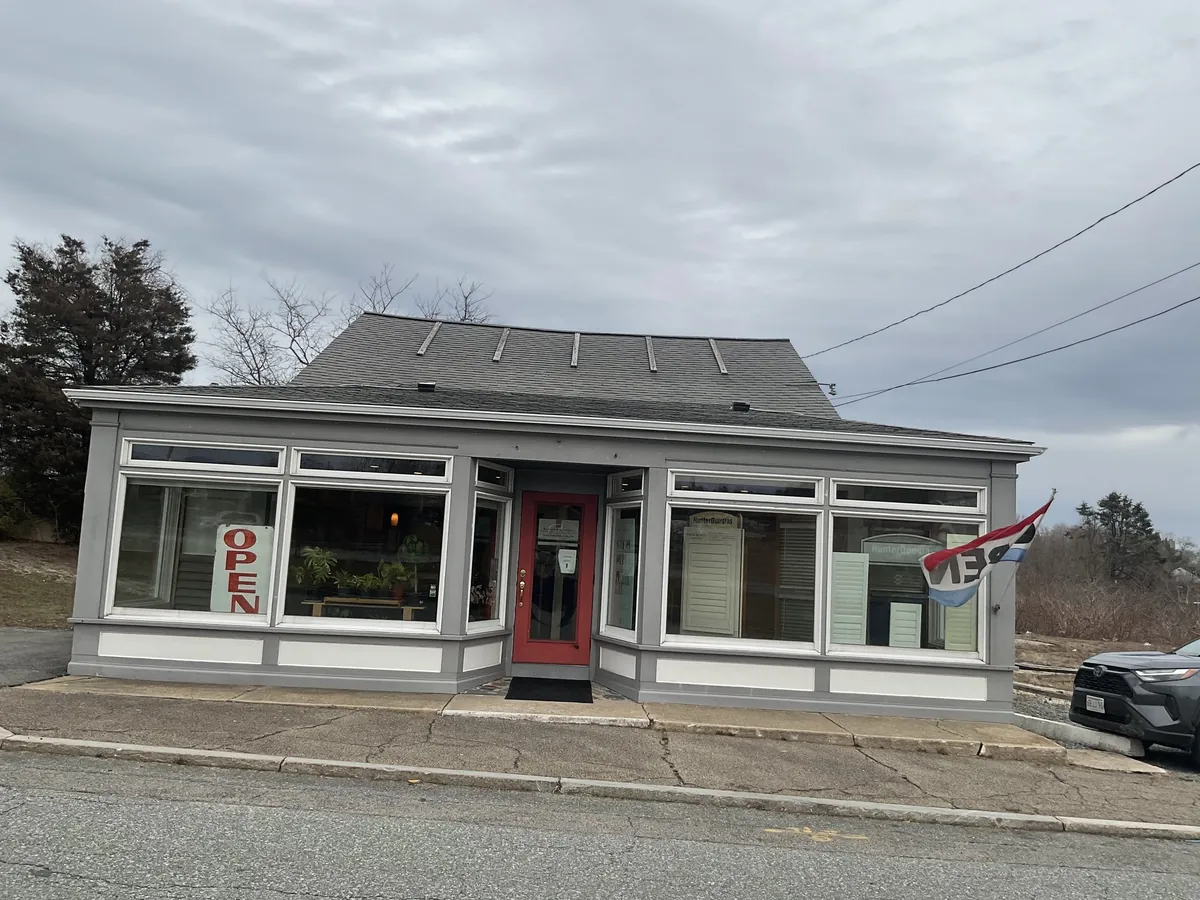
The Sagamore showroom, just across the canal
Our nearest showroom to the village is the Sagamore showroom on Cranberry Highway, a short drive along the canal. If you would like to see Duette and Applause before booking a home visit, you are welcome to stop in during opening hours.
Bring a photo of the windows you are thinking about and rough sizes if you have them. We can talk through privacy and fabric choices there, then arrange a visit to measure.

Why a Hunter Douglas Gallery dealer
Blinds & Designs is a Hunter Douglas Gallery dealer, which gives you the full honeycomb range through one company, from every Duette and Applause fabric to PowerView motorization.
Our installers are certified by Hunter Douglas, so small, out-of-square and awkward windows get fitted properly. We also offer free estimates, interior design consultations and blind and shade repairs on window coverings you already own.
For other rooms, see roman shades in Buzzards Bay or everything we do here on our Buzzards Bay page.
Questions from Buzzards Bay
How do I keep my privacy with the next house so close?
A light-filtering honeycomb shade gives daytime privacy while keeping the room bright. A top-down, bottom-up shade covers the lower window at eye level and leaves the top open for light. For bedrooms, a room-darkening fabric gives full privacy at night.
My windows are very small. Can you still fit a honeycomb shade?
Yes. Honeycomb shades are made to measure and can be built very narrow and short. Raised, they fold into a slim stack, so a small window keeps almost all its glass.
I live in an apartment above Main Street. Which shade suits it?
Light-filtering in the living space and room-darkening in the bedroom work well, with a top-down, bottom-up design in the main room. If you rent, check with your landlord first, since the shades are fixed to the frame.
Will honeycomb shades help with the cold in a converted cottage?
They help. Each cell holds still air against the glass, which slows heat leaving the room. A double-cell or Architella fabric holds the most air for the coldest rooms.
Is the estimate free?
Yes. After we measure your windows, the estimate is free. Request a consultation and we will bring samples to your home.
Take the next step
The surest way to choose cellular shades in Buzzards Bay, MA, is to see the samples against your own windows. Request a consultation and we will bring the honeycomb range, measure every window and give you a free estimate. You can also use the call button or visit the Sagamore showroom.