
Why tree-shaded Westwood houses suit a motor
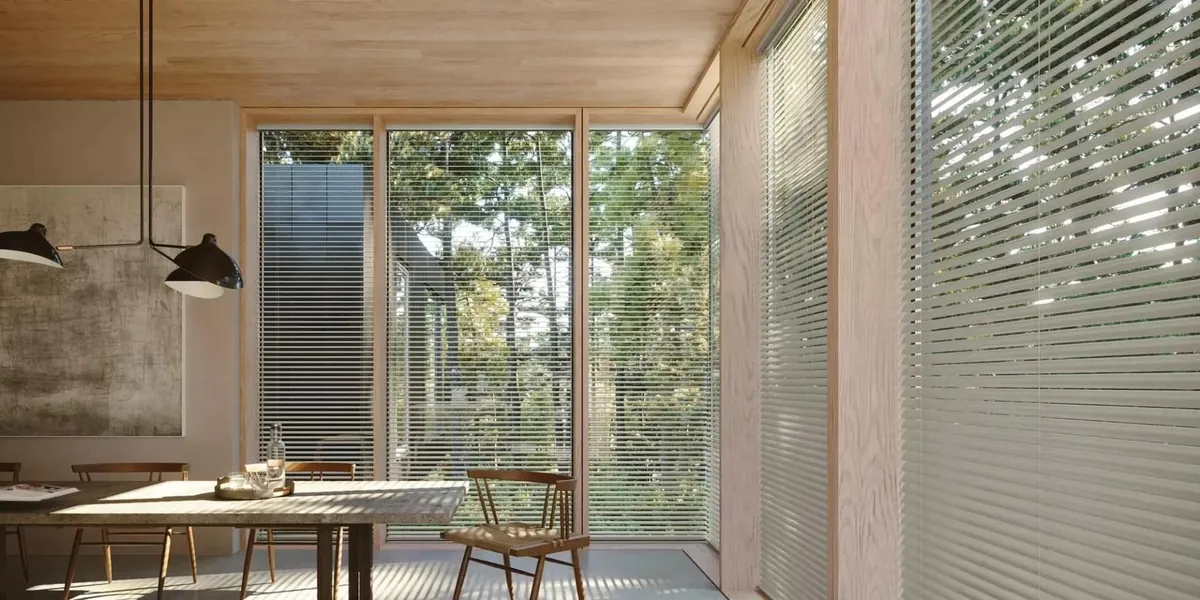
Westwood is a town of trees. The post-war colonials and the larger newer houses sit back on wooded lots with generous setbacks, and heavy tree cover spreads across most of the town. Inside, that means rooms where daylight is precious for much of the year, filtered through leaves and shifting by the hour and by the season.
Windows in a house like that get adjusted a lot: opened fully to catch what light there is, lowered for the short spell when the sun breaks through at a low angle, closed at night when the dark woods outside make a lit room feel exposed. Doing all that by hand, window by window, is the kind of chore that quietly stops happening. Motorized blinds in Westwood, MA, make it effortless, so the shades actually move as often as the light changes.
The good news for installation is that most Westwood houses have standard modern openings. Square frames with plenty of depth make it simple to fit PowerView shades and blinds throughout, operated by remote, app or timetable.
Choosing shades for motorized blinds in Westwood, MA
PowerView is offered on much of the Hunter Douglas range. Settle on the look and the light you want in each room, and the motor goes into that shade’s headrail.
Honeycomb shades
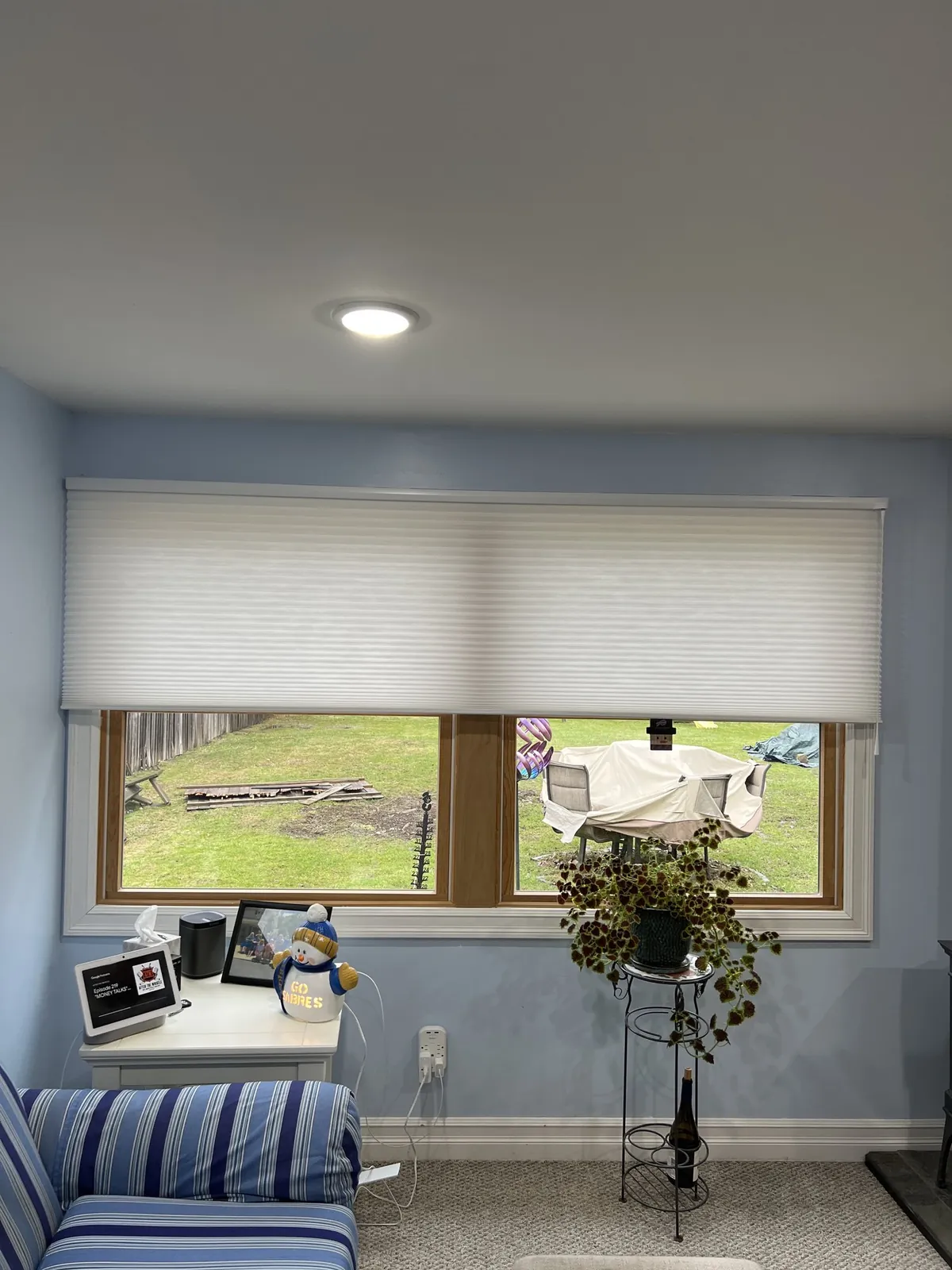
Duette and Applause stack neatly when raised, leaving most of the glass clear in a room that needs every bit of daylight.
Sheer shades
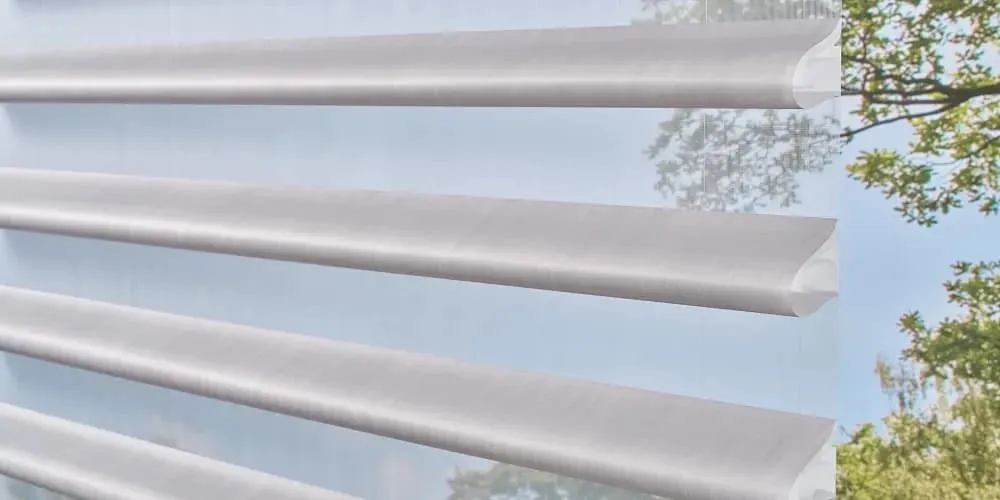
Silhouette’s vanes float between two sheer layers, so the trees stay visible even with the shade down.
Cellular roller shades
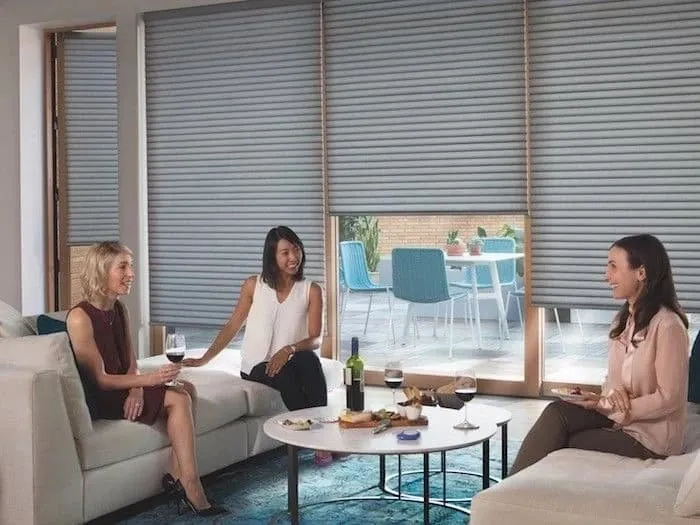
A crisp roller look on a run of patio windows, with each shade moving on its own or as a set.
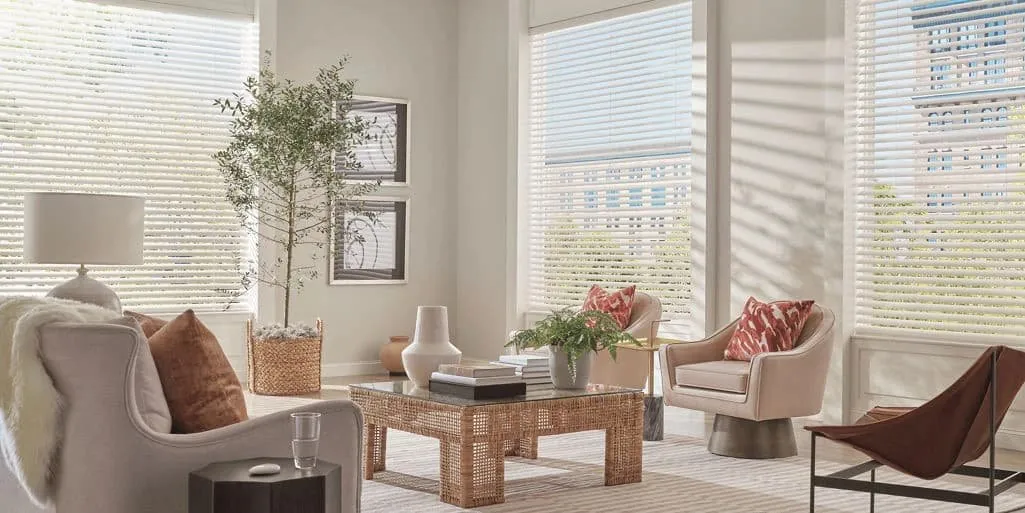
Blinds
Slats for exact control, tilted to catch soft light off the canopy or closed when the sun breaks through.
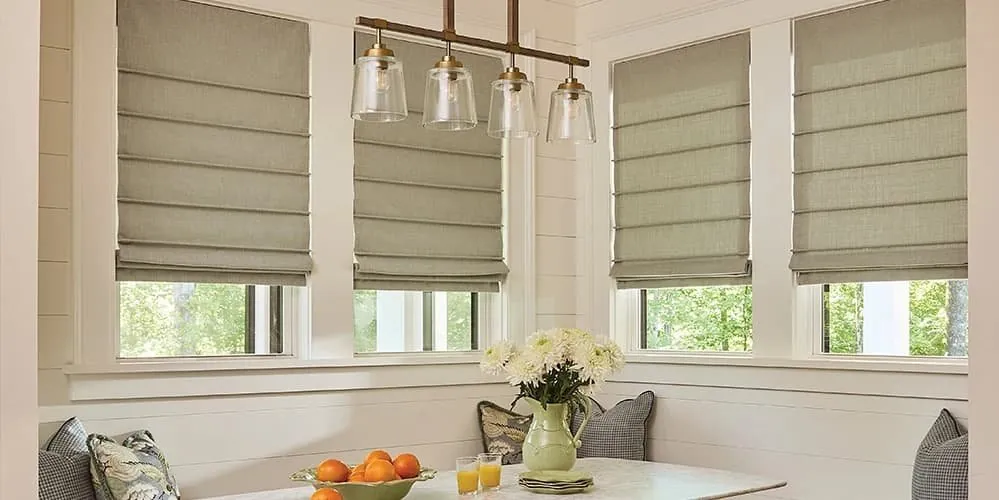
Flat roman shades
Vignette folds for a breakfast nook or dining room, in a color that warms a room the trees keep cool.
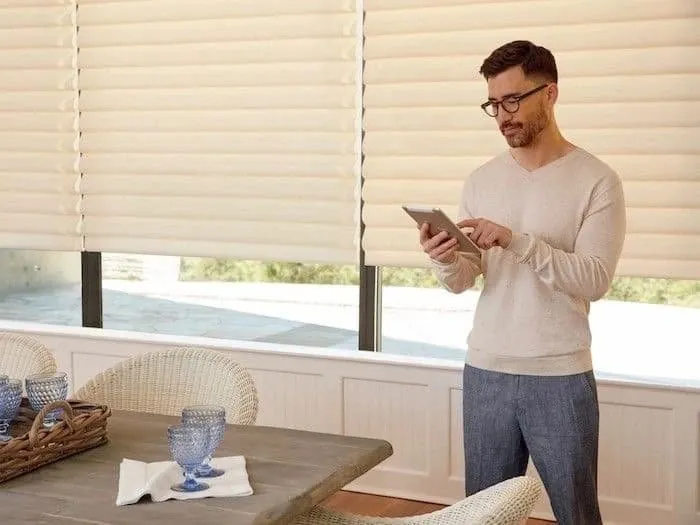
The PowerView app
All your shades by room on a phone or tablet, with groups, scenes and timetables.
Keeping tree-shaded rooms bright
Under a heavy canopy, the first job of a window covering is to get out of the way. A shade that is left half down because raising it is awkward costs a dim room a large share of its daylight. So in Westwood, the case for a motor often begins with the simple fact that motorized shades get raised all the way, every morning, without anyone thinking about it.
The style of shade matters too. When a honeycomb shade is fully raised, its pleats fold into a slim stack under the headrail, so very little glass is hidden. Roller shades disappear onto their roller. Sheer shades with fabric vanes let light through even when lowered, which suits rooms where you want some softening without losing brightness. We can show you how much glass each style leaves clear when raised, using samples at your own windows.
Fabric color plays its part. Lighter, warmer fabrics bounce what light there is back into the room, while darker ones absorb it. In a north-facing room beneath tall trees, a pale light-filtering fabric keeps the space feeling open; in a south-facing room that does get the sun, a slightly heavier fabric earns its place.
Motorized shades can also stop at any point you choose. A favorite position, such as just below the top of the frame to cut the glare off a bright patch of sky while leaving the view of the trees, can be saved and called up with one press.
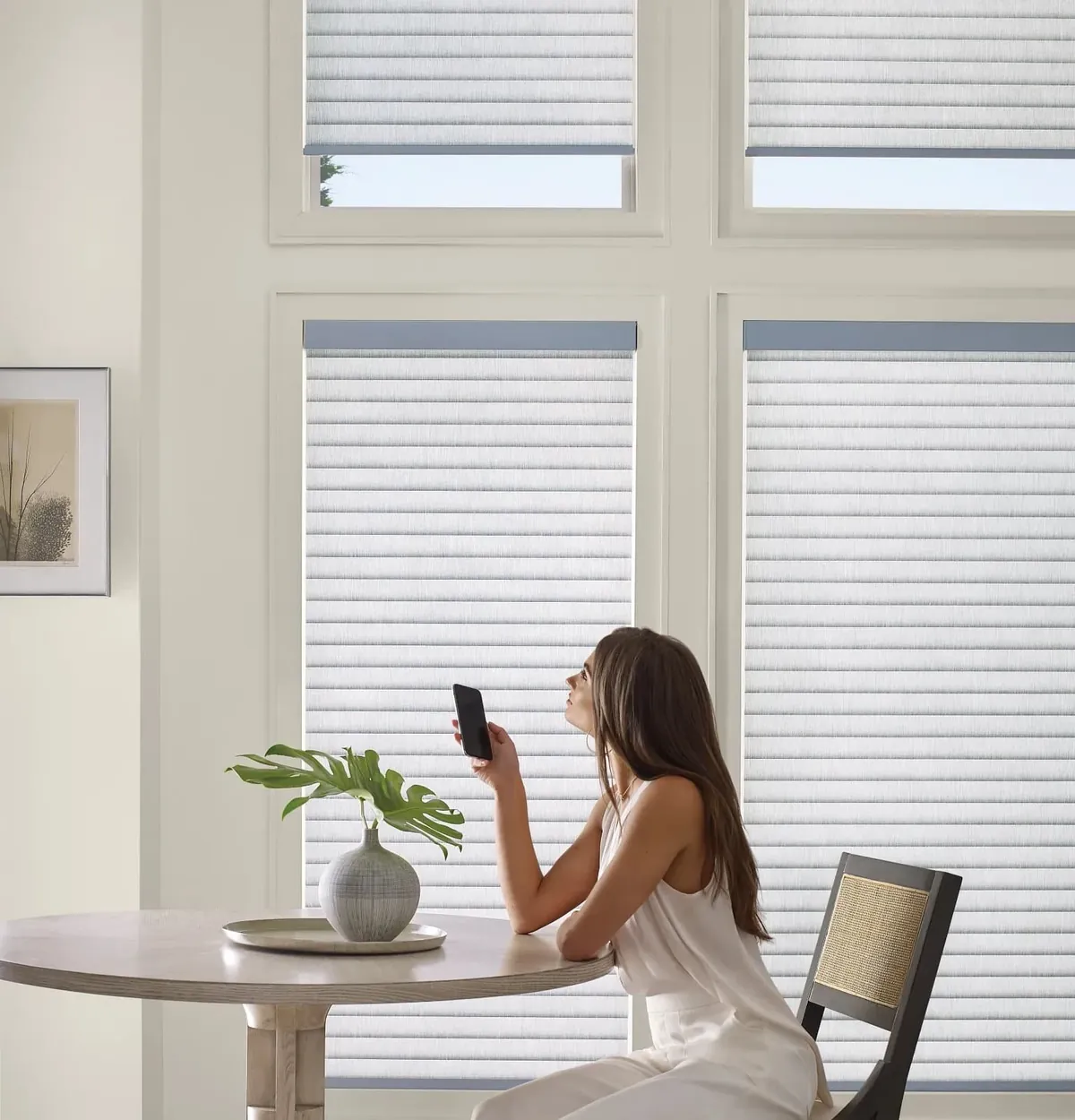
When the leaves come down
Tree cover changes a Westwood house twice a year. From late spring to autumn, the canopy screens the windows from the neighbors and from much of the sun. Then the leaves fall, and suddenly the house next door, invisible all summer, is in plain view through the bare trunks, and low winter sun streams into rooms that were shaded for months.
Shades have to work differently in each season. In winter, privacy matters on windows that never needed it in July, especially at night when lamps are on. A dusk timetable on those windows closes them as soon as it gets dark, which in December means early. In spring, once the canopy fills in, the same windows can stay open late into the evening, and a quick edit in the app moves the timetable back.
The winter sun can be welcome or not, depending on the room. In a living room, it is a gift on a cold afternoon, and the shades can stay up to let it in, then close as it sets to keep the warmth in. In a home office or a room with a television, the same low sun is glare, and a shade or blind lowered part way on a timetable takes care of it. Honeycomb shades are especially useful in winter, because the cells hold a layer of air between the glass and the room once the sun has gone.
Most Westwood households adjust their timetables in spring and autumn, much as they would a thermostat.
Post-war colonials
The post-war colonials found across much of Westwood are typically straightforward houses with well-proportioned, standard-size windows, a living room and dining room either side of the hall, and bedrooms upstairs. Many have been extended over the years with a family room, a sunroom or a screened porch at the back.
For these houses, motorization is often a whole-floor decision. The front rooms can be grouped so the facade opens and closes evenly, the family room at the back can follow its own timetable, and the bedrooms upstairs can stay dark until a set hour. Because the windows are standard sizes and the frames are square, inside mounts are nearly always possible, which keeps the headrails hidden within the frames.
Sunroom additions deserve their own plan. A room with glass on three sides takes far more sun than the rest of the house, even under trees, and can overheat on a summer afternoon. Motorized shades on a timetable lower before the heat builds and rise again in the evening, keeping the room usable through the warm months. For another look at these styles, see our cellular shades in Westwood and roller shades in Westwood pages.
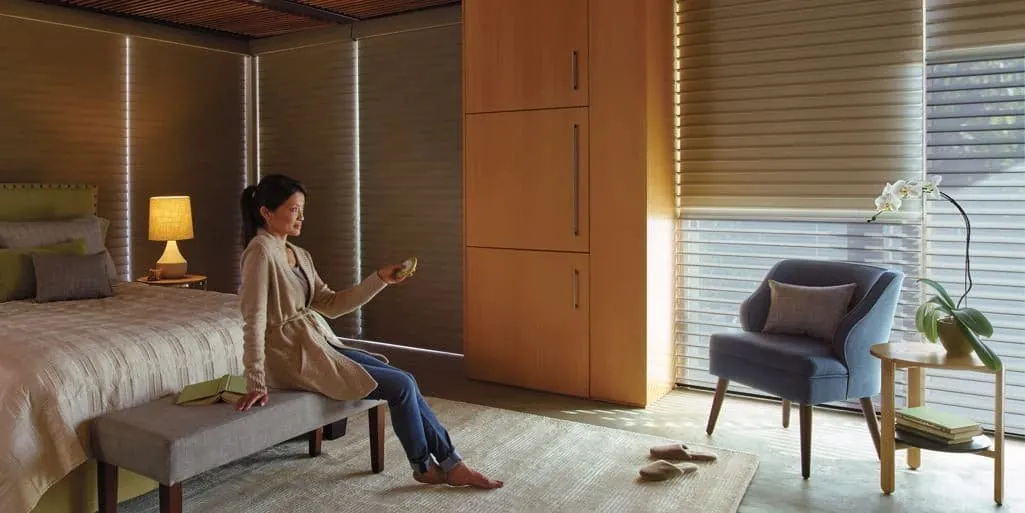
Larger houses on deep wooded lots
Westwood’s larger newer houses tend to have more glass and bigger rooms: a family room with a wall of windows to the back of the lot, a kitchen with a long run of windows and a door to the patio, a primary bedroom with windows on two or three sides, perhaps a lower-level media room.
Generous setbacks mean the street is rarely a privacy concern, so in these houses shades are mostly about light, temperature and comfort. Motorized shades shine here because there are so many of them. One scene can open the whole first floor in the morning; another can close every shade at bedtime. The kitchen can follow its own routine, and the media room can go dark with one press.
The primary bedroom is a common place to start. Windows on several sides mean several shades to close every night and open every morning, often reaching over furniture to do it. Room-darkening fabrics on a timetable take care of that entirely, and a remote on the nightstand covers the exceptions.
Big houses also have the high windows: transoms over the patio doors, clerestories in a family room, a tall window on the stair landing. Our certified installers fit these from proper staging and set their stopping points, so they join the system like any other shade.
Coming home up a long drive
On a deep wooded lot, the house can be a long way from the road, and arriving after dark in winter means pulling up to a house with every window either black and blank or brightly lit and wide open. The PowerView app helps with both. Close the shades from the car before you get out, or let the dusk timetable have done it already.
Timetables also keep the house looking lived in while you are away. The shades open in the morning, lower in the afternoon and close at night as usual, rather than staying in whatever position they were left. From the road, a house whose shades move looks occupied.
And if you have left for a weekend and remember that the sunroom shades are still up on a bright forecast, you can lower them from wherever you are. There is more on scenes and timetables on our window covering automation page.
Remote, app or timetable
Every PowerView shade can be moved three ways, and you never have to choose just one. The handheld remote is the simplest: up, down and stop, for one shade, a group or several rooms, with nothing to learn and no phone to unlock. The PowerView app on a phone or tablet does everything the remote does and more, letting you stop shades part way, gather them into groups, save scenes and write timetables. And the timetables themselves run in the background, moving shades at the times you set, every day, until you change them.
A few examples of how Westwood households put those together:
- A remote on the family room wall for everyday use, with the app for setting things up.
- A morning timetable that opens the kitchen and family room, and an evening one that closes the house.
- A “movie” scene that darkens the media room, and a “goodnight” scene that lowers every shade.
- A winter timetable for the windows that lose their leaf screen, replaced by a summer one in May.
Our guide to how motorized shades are controlled explains each option in plain terms.
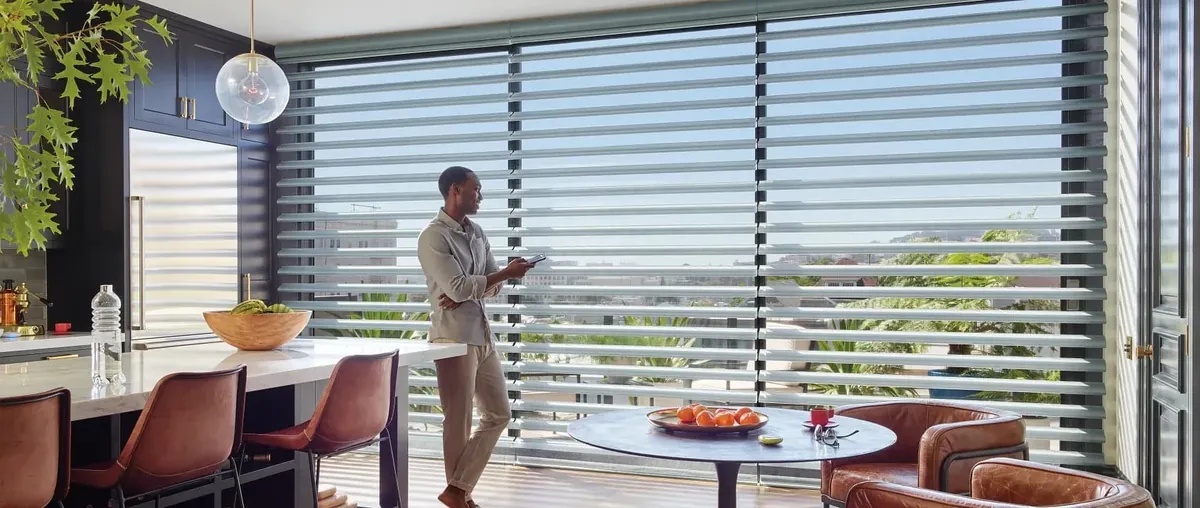
Kitchens that open onto the patio
In many Westwood houses, the kitchen is where the back of the house opens up: a long run of windows over the counter, a breakfast table in a bay and a glass door out to the patio or deck. Under the trees, it is also one of the brightest rooms in the house, and the one where shades get adjusted most often through the day.
Motorized blinds in Westwood kitchens tend to be planned as a group with a few exceptions. The windows over the counter and in the breakfast bay move together, so a single press opens the whole room in the morning. The shade on the patio door stays on its own, because a door shade has to be raised every time someone steps outside, and nobody wants the whole kitchen to go up and down with it. The remote handles that easily: one button for the windows, another for the door.
Over the sink, where reaching a shade means leaning across the counter, the motor is especially welcome. Blinds work well in this room, since tilted slats cut the glare off the counter while still letting you see out to the yard and the trees, and they are easy to wipe clean.
The in-home consultation, start to finish
For Westwood we lead with an in-home consultation, and our vans carry the samples, so we bring the showroom to you. In a tree-shaded house that is especially useful, because how a fabric looks depends heavily on the light it gets, and that light is unique to each room.
- Use Request a Consultation, or the call button, to choose a time for us to come.
- We arrive with the sample van and tour the house with you, room by room.
- You compare fabrics and styles at your own windows, and see how much glass each one leaves clear when raised.
- We agree which shades should move together and how you would like to run them.
- Each window is measured and its frame depth checked for the headrail.
- You receive a free estimate for the shades and installation you are considering.
- Once Hunter Douglas has made the shades, a certified Hunter Douglas installer fits them, programs their stopping points, pairs them with the remote and app, and sets up timetables with you.
Read more on our in-home consultations page. If you would also like to see a showroom, the Franklin showroom is our nearest.
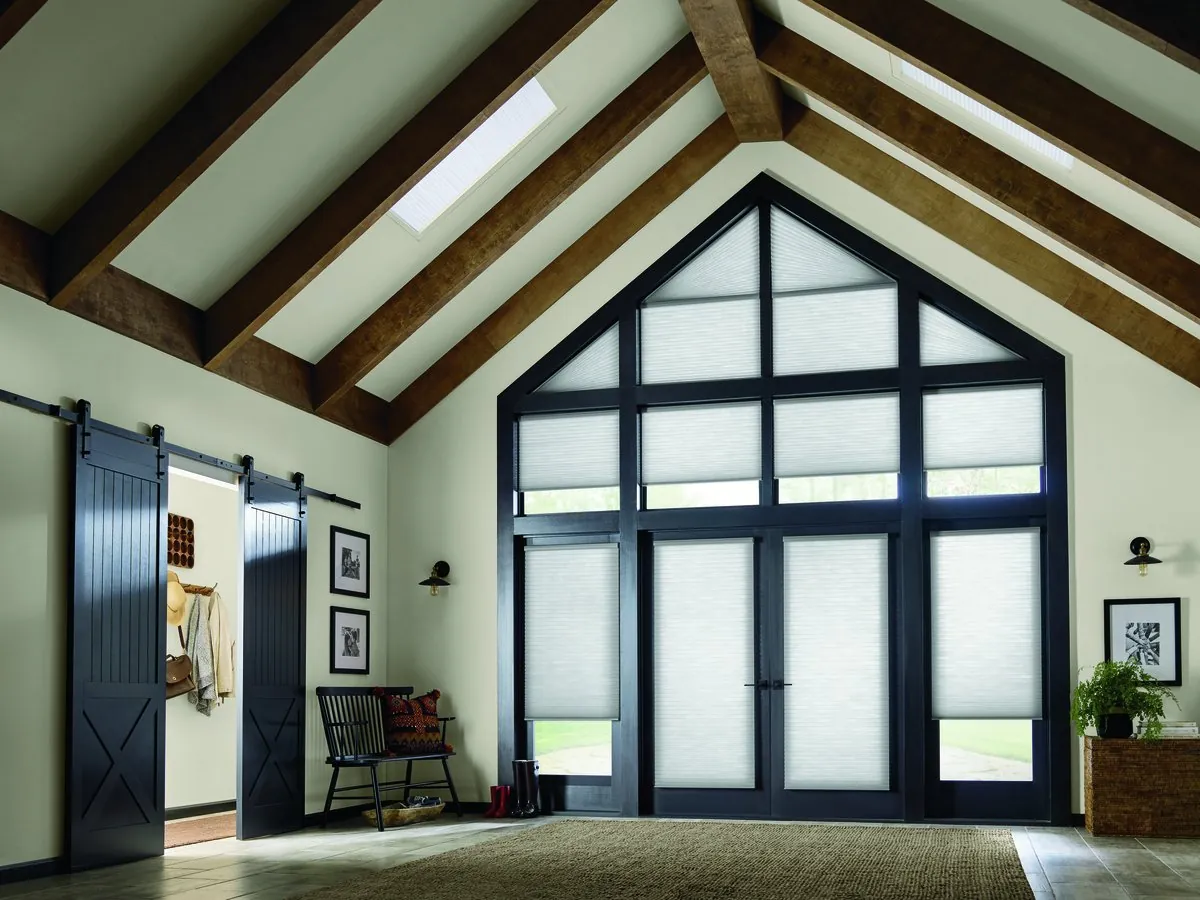
Upstairs rooms at treetop height
Climb to the second floor of a Westwood colonial and the view changes. The bedroom windows look straight into the branches, and on a breezy morning the light flickers as the leaves move. It is a lovely outlook, but it also means the early light reaches the bedrooms through gaps in the canopy, landing in shifting patches on the bed and the walls.
Room-darkening fabrics on motorized blinds in Westwood bedrooms keep the rooms calm until you are ready for the day. A timetable lowers them in the evening and raises them gently at the hour you choose, later on weekends, and a remote by the bed handles the exceptions. In winter, with the branches bare, the same windows may face a neighbor’s house, and the evening timetable takes care of that privacy as well.
Children’s rooms and guest rooms benefit in the same way. A guest never has to work out an unfamiliar cord, and a child’s room can be dark for an early bedtime on a light summer evening.
Safety and easy upkeep
With no cords at the window, motorized shades are safer for small children and pets, and the window looks cleaner. The motor lifts the shade evenly every time, so the fabric hangs straight and wears evenly. Day-to-day care is light: a soft brush or a vacuum with a brush attachment keeps dust off the fabric.
If a shade you already own needs attention, we offer blind and shade repair in Westwood, on motorized and manual window coverings alike.

What a Hunter Douglas Gallery dealer means for you
Blinds & Designs is a Hunter Douglas Gallery dealer, the designation Hunter Douglas gives to dealers who meet its standards. For motorized blinds in Westwood, that means PowerView is available across the whole range we carry, from honeycomb and sheer shades to roller, roman and blinds, so each room can have the right product on one system.
Our installers hold Hunter Douglas certification and test every motorized shade before they leave. We also offer interior design consultations, and estimates are always free. Browse the range on our motorized blinds and shades page, or see everything we do in town on our Westwood page.
Questions from Westwood
Our rooms are dim under the trees. Which shades keep the most light?
Shades that leave the glass clear when raised help most. Honeycomb shades fold into a slim stack under the headrail, roller shades roll away completely, and sheer shades let light through even when lowered. On a motor, they also get raised fully every day, which makes a real difference in a shaded room.
What do we do about privacy once the leaves fall?
Set a winter timetable that closes the exposed windows at dusk, then move it later in spring when the canopy fills in. A top-down shade saved at a partial position also lets light in from above while the lower glass stays covered.
Can the high windows in our family room be motorized?
Yes. Our certified installers fit transoms, clerestories and landing windows from safe staging and set each shade’s limits. After that they run from the remote, the app or a timetable with everything else.
Can I close the shades before I get home?
Yes. The PowerView app moves the shades from wherever you are, and timetables run on their own while the house is empty.
Is the estimate free?
Yes. After we measure during the consultation, you receive a free estimate for the shades and installation you are considering.
Next steps
- Request a consultation and tell us which rooms feel darkest or hardest to manage.
- We bring the samples to your house, measure and give you a free estimate.
- Choose your shades in your own time, and we fit and set them up for you.
Questions first? Use the call button and we will talk them through.