
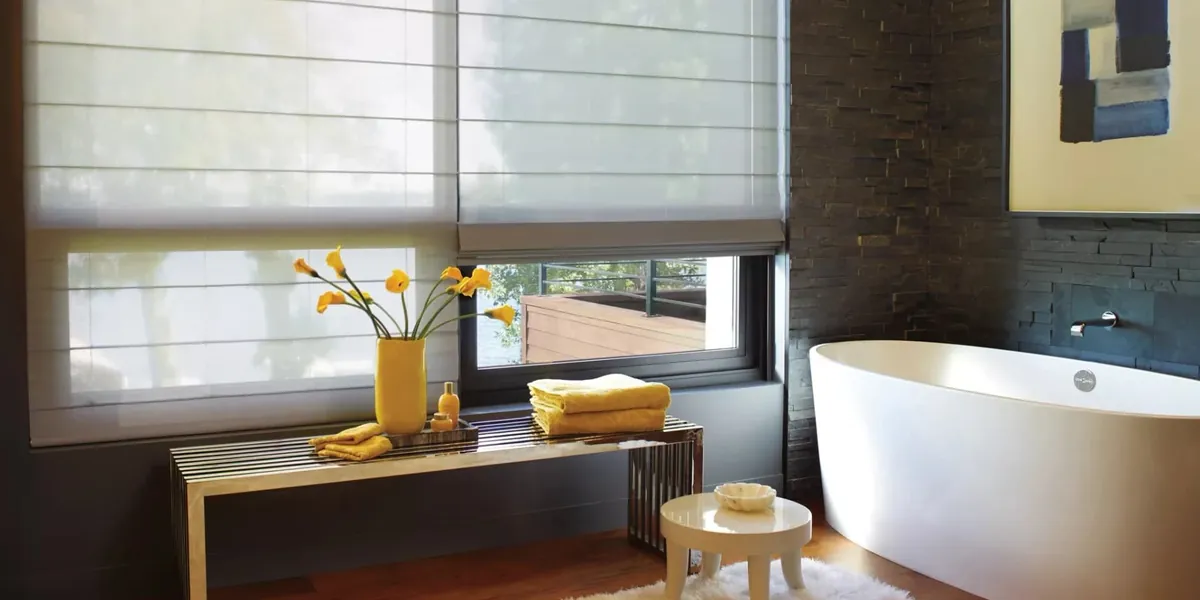
Small, deep openings in the old jewelry-era streets
The houses that went up near the center while the jewelry shops were busy were built tight to one another. Victorians and two-families stand a driveway apart, and many of their windows are small and set deep into thick walls. Those deep openings are a gift for roman shades in North Attleborough, MA: a fabric shade can sit right inside the frame, flush with the casing, and still leave the trim on show.
Being close-set also changes what a window needs. When the house next door is a few strides away, a bedroom or a bathroom window looks straight across at a neighbor’s. A soft fabric shade that can be lowered partway gives you cover where you need it while daylight still reaches the room above it.
Further out the stock turns to post-war ranches and newer colonials, with standard openings and more open rooms. Those houses ask different questions, mostly about style and light rather than fit, and we cover them further down.
Two Hunter Douglas lines, two ways to fold
Both lines are made to order for each opening, and the vans bring their fabrics to your house.
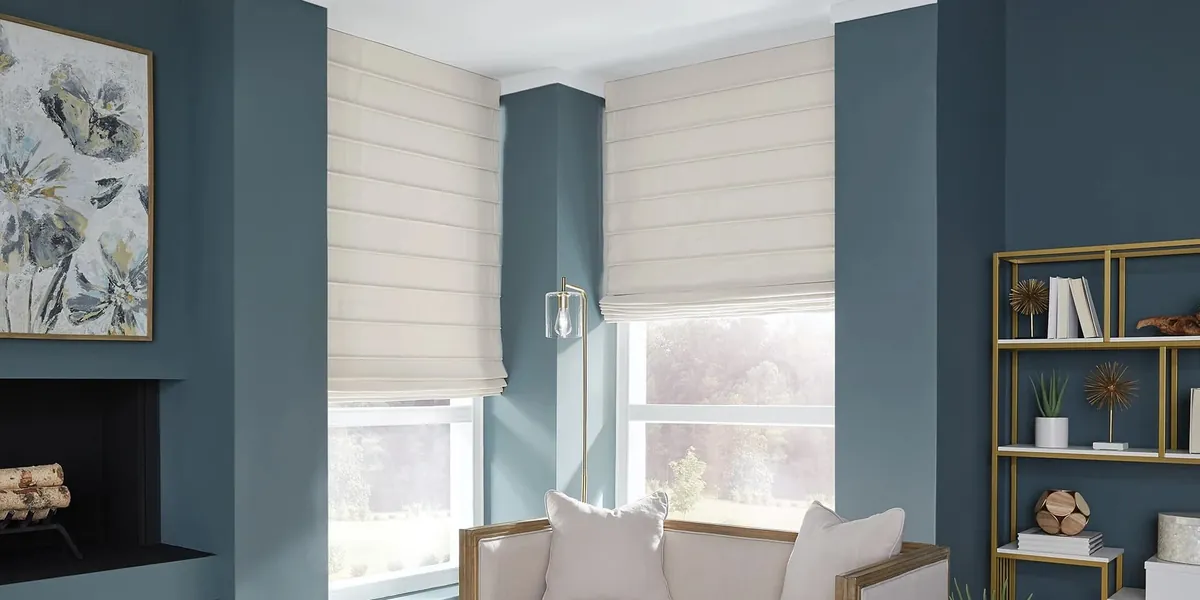
Carole Fabrics Roman Shades
Sewn to the size you need from decorator fabrics, in a flat style or a folded one. A natural partner for the parlor of a Victorian two-family.
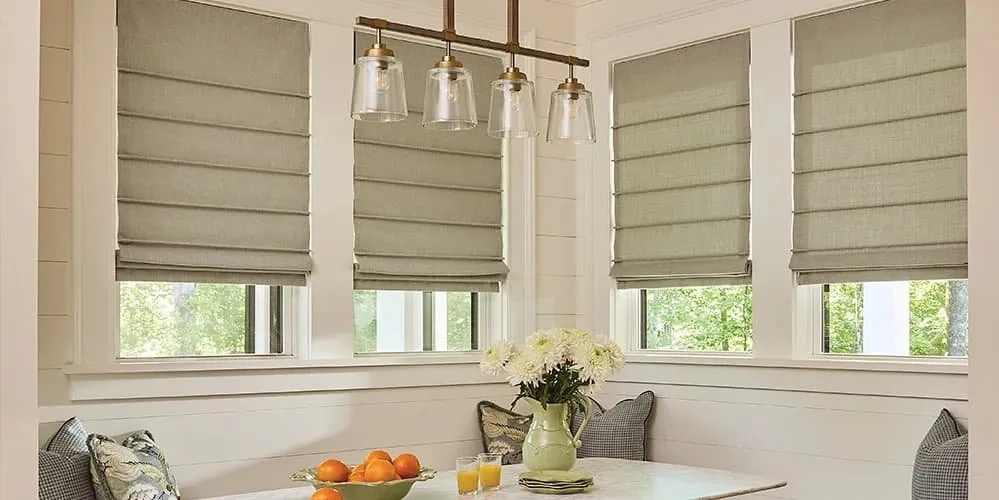
Vignette Modern Roman Shades
A cleaner, more modern roman look that suits a kitchen, a family room or a newer colonial out past the center.
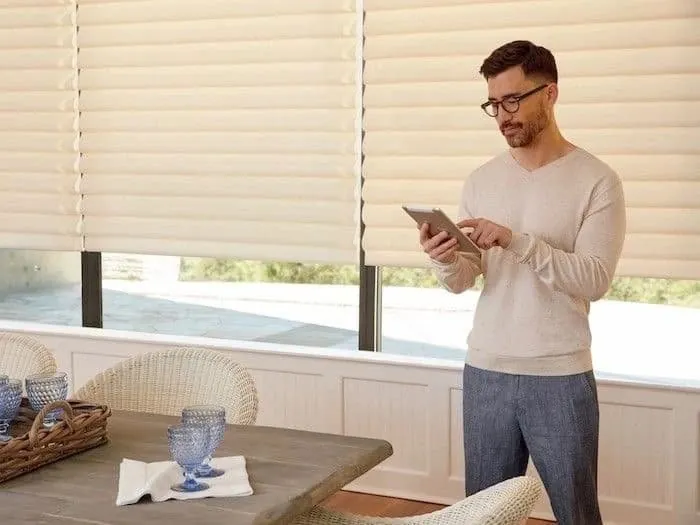
Motorized Blinds and Shades in North Attleborough
PowerView lets a roman shade rise and fall from a remote, the app or a schedule, handy over a stair or behind a deep sink.
What a deep frame lets a roman shade do
A window set back into a thick wall has a ledge of trim around it, the reveal, and the depth of that reveal decides how a shade can be hung. When there is room, the shade goes inside the frame. The headrail tucks up under the top of the opening, the fabric hangs within the casing, and the woodwork around the window stays fully visible. In a Victorian with original trim, that is usually the look you want.
Not every old frame cooperates. Some are deep but out of square, some have a sash lock or a crank that sits in the way, and a few have been painted so many times that the inside edges are no longer straight. We check each one rather than assuming the whole house is the same. When an inside mount would leave a gap or rub on the way down, the shade can go on the face of the casing instead, sized to cover the trim evenly.
The reason this matters for small openings is proportion. A small window can look smaller still if a heavy treatment crowds it. A roman shade mounted neatly within the frame keeps the window reading as a window, softens the glass and leaves the room around it uncluttered. Our guide to window measuring terms explains reveal, inside mount and outside mount in plain words.
Two-families, upstairs and down
A two-family near the center often holds two households with two sets of tastes, but the street sees one building. Some owners like the front windows on both floors to match from outside, even when the rooms behind them are dressed quite differently. A roman shade helps here because its back face is what the street sees. Two flats can choose different fabric colors for their own rooms and still keep a tidy, even look at the front of the house.
Where both floors are being done at once, it is worth measuring them on the same visit. The windows on a two-family were often built as stacked pairs, but they are rarely identical. An upper window may be a little shorter, or one sash may have been replaced along the way. Measuring both floors together means each shade is made to its own opening while the set still lines up when you stand on the pavement.
Landlords who live in one unit and let the other sometimes ask for something hard-wearing and plain in the rental and something more decorative in their own flat. Both lines cover that range, and we can show you the options side by side at the kitchen table.
The shared hall of a two-family is worth a thought as well. Its windows belong to both households, so a plain, neutral fabric that suits either flat usually works best there. Since the hall window often sits halfway up a stair, it is also a good candidate for a motorized shade that either household can lower without a stepladder.

Stair windows, bays and the odd shapes of a Victorian
The Victorians near the center rarely have one window size from top to bottom. A landing window halfway up the stairs may be taller and narrower than anything else in the house. A front parlor may push out into a shallow bay of three openings. An attic room under the roof may have a short window tucked into a gable. Each of these is made to order on its own measurements, so the odd ones are no harder to dress than the plain ones.
The landing window is often the one people leave bare, simply because it is awkward to reach over the stair. It is also the window that lets the most afternoon heat and glare into the hall. When we plan roman shades in North Attleborough Victorians, we usually suggest PowerView motorization for a landing window, so the shade can be lowered from a remote, from the app or on a schedule without anyone leaning over the banister. How each motor gets its power is something we plan at the visit.
A shallow bay works best with one shade per opening, all in the same fabric and style, mounted at the same height so the pleats line up as the shades rise. We measure the angle where each pair of windows meets, because two headrails meeting in a corner need a little room to clear each other.
Flat or folded: which suits which room
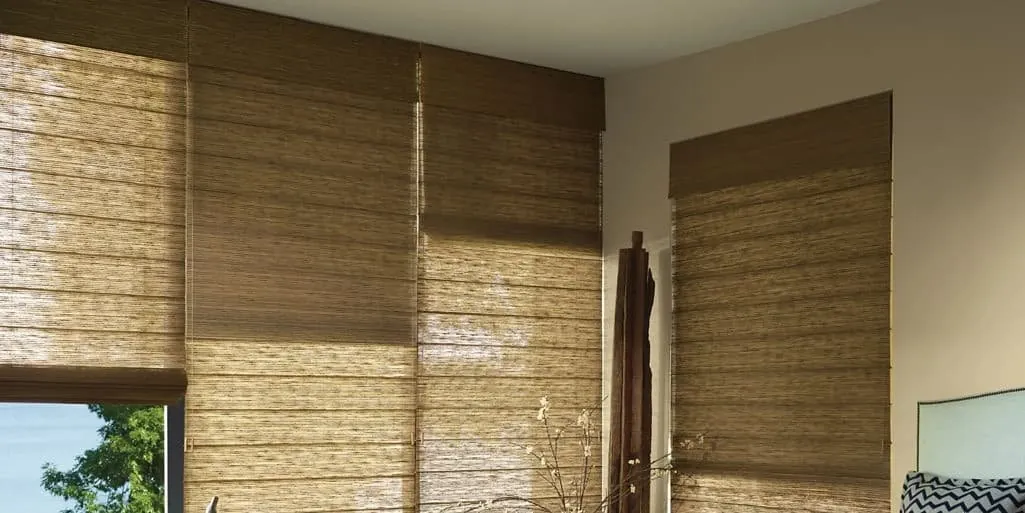
The flat style hangs as a smooth panel when lowered and gathers into neat horizontal pleats as it rises. It is tidy and tailored, and it shows a pattern well because nothing interrupts the fabric. In a small, deep window it keeps things crisp, which suits a dining room, a study or a front hall.
The folded style hangs in soft, overlapping loops even when fully down. It brings more texture and a gentler line, and it looks relaxed in a bedroom or a sitting room. Because the folds catch the light, a plain fabric in a folded style still has plenty of interest.
There is no rule that every room must match. Many houses use the flat style downstairs and the folded style in the bedrooms. What matters is that each choice suits the window it is on. A narrow, tall sash in a Victorian stairwell might take a flat panel to stress its height, while a wide ranch bedroom window might take a folded shade to soften a long, plain wall.
Light and privacy on a close-set street
On the streets near the center, the side windows of a house often face the side windows of the next one. Those are the windows where a shade does its hardest work: down in the evening, perhaps half down in the daytime, and rarely fully open. For them the fabric choice is a practical one. We hold samples up to the actual glass so you can see how much daylight comes through and how much of the room shows from outside.
Front windows facing the street have a different balance. Here many people want daylight and a view by day and cover after dark. A roman shade that stacks neatly at the top of a small window leaves most of the glass clear when raised, so the room stays bright.
If glare is the bigger concern on a south-facing wall, our guide to sun and glare compares the shade types side by side. A roman shade is one good answer among several, and we will tell you honestly when another product would serve a window better.
Ranches and newer colonials away from the center
Drive out from the center and the plots grow and the houses change. Post-war ranches sit low with a living room picture window and a row of bedroom windows down one side. Newer colonials have bigger rooms, a family room off the kitchen and windows in standard modern sizes.
These openings are easier to fit, so the conversation turns to how the house will look and live. In a ranch, the picture window is usually the widest piece of glass. Rather than one very wide shade, two or three matching shades side by side are often the better plan. Each is lighter to raise, the folds stay even, and you can lower one section for shade while leaving the others up.
In a newer colonial, the Vignette line often suits the kitchen and family room, where clean folds sit well with modern cabinets and plain walls. A Carole Fabrics flat style can then dress the dining room or a home office in a pattern. A window over the stairs or a high window in a two-story entry can be motorized so nobody has to reach it.
Because the windows out here are regular, a whole floor can often share one mount height and one back color, which keeps the outside of the house looking even. That makes roman shades for North Attleborough ranches a simple job to plan room by room, and many people do the main living space first and the bedrooms later.
For a house that needs more than roman shades, the same visit can cover other rooms too. Our page on cellular shades in North Attleborough covers the honeycomb shade many people choose for bedrooms.
Choosing fabric with the trim and walls in view
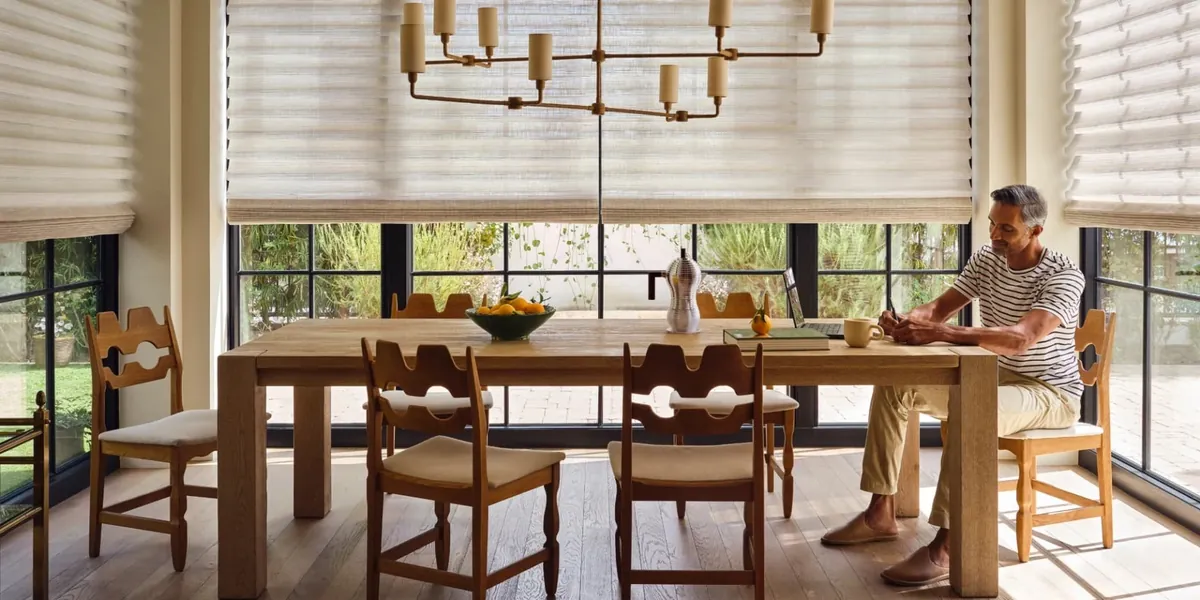
A fabric looks different under a shop light than it does against your own walls and woodwork. That is why we bring the samples to you. In an older Victorian with dark stained trim, a warm cream or a soft stripe can look rich, while the same fabric might look flat in a freshly painted colonial with white trim.
A few things to think about as you choose:
- The trim color: stained wood, painted white and painted color each pair differently with fabric.
- The view outside: a window that looks onto a neighbor’s wall can carry more pattern than one that frames a garden.
- The light through it: hold the sample to the glass at the time of day you use the room most.
- The rest of the house from the street: pick a consistent back color if a tidy outside view matters to you.
If you would like a second opinion on color and pattern, an interior design consultation can be part of the same appointment.
How a home visit runs
Small deep openings and close-set side windows are easiest to plan with a tape measure and the samples in the room. Most North Attleborough customers start at home.
- Book through Request a Consultation, or use the call button.
- We arrive with Vignette and Carole Fabrics samples in both styles.
- We walk the house with you and look at each window type: the deep frames, the side windows near the neighbors, the wide ranch picture window.
- You hold fabrics to the glass and see them beside your trim.
- We measure every opening, check depth and squareness, and agree each mount.
- You receive a free estimate to consider in your own time.
You can read more in what happens at an in-home consultation before we come.
Installation and after
When your shades arrive, a certified Hunter Douglas installer comes to fit them. In the older houses near the center that means working carefully around original trim, setting each headrail level even where the frame is not, and checking that every shade drops straight without catching on a lock or a sash lift. In the newer houses it means lining up a row of shades so their tops and bottoms match across the wall.
Before leaving, the installer runs each shade up and down with you and shows you how it works. If you chose motorization, the remote and the app are set up and tested in the room. You can read what happens on installation day in advance if you like to know what to expect.
Should a shade ever need attention later, a cord that frays or a mechanism that sticks, we repair blinds and shades, including ones we did not supply. Our blind and shade repair page explains how that works.
Why buy from a Hunter Douglas Gallery dealer
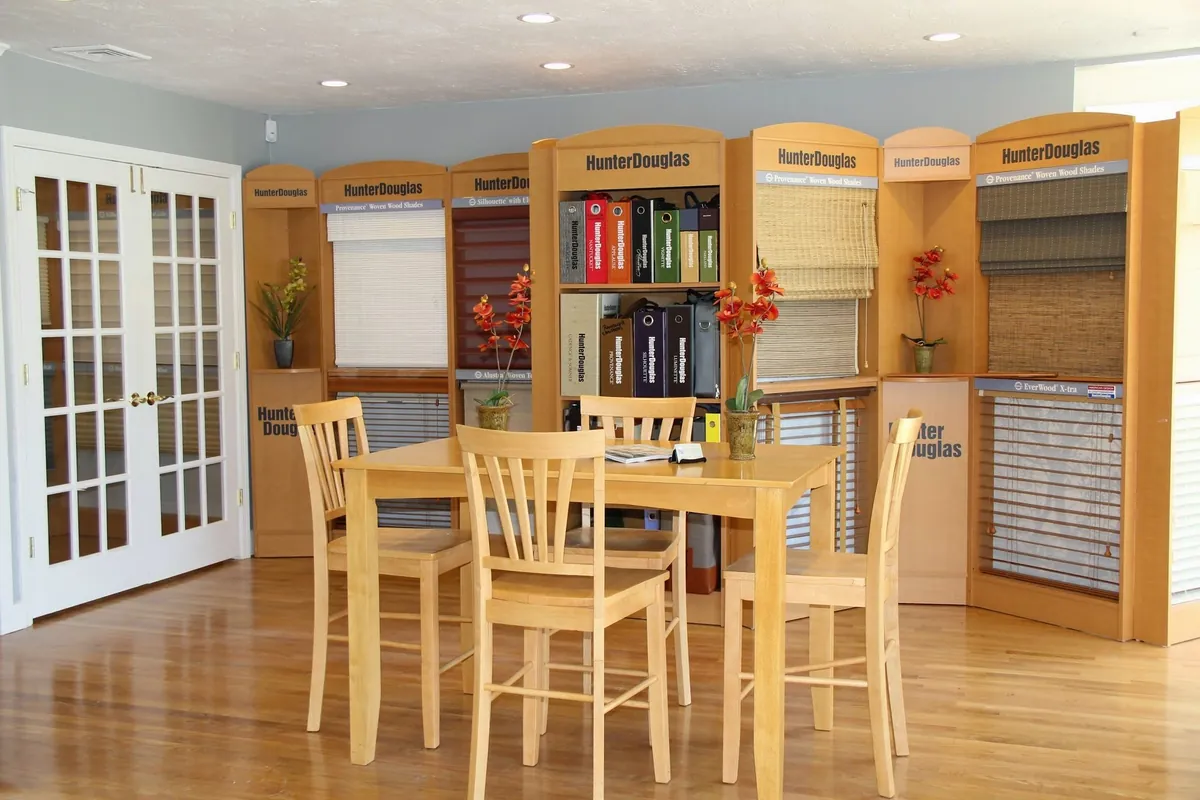
Blinds & Designs is a Hunter Douglas Gallery dealer, and that status shapes how we plan roman shades in North Attleborough homes. For you, it means the full Hunter Douglas roman range is open to choose from, along with the other shades, blinds and shutters in the same family, so one visit can cover every room.
Our installation is certified by Hunter Douglas. When your shades are ready, a certified installer fits each one, checks that it hangs straight in its frame and runs it up and down with you. We also repair blinds and shades if a lift ever needs attention later.
See the full roman shades range, or everything we offer on our North Attleborough page.
The nearest showroom is in Franklin
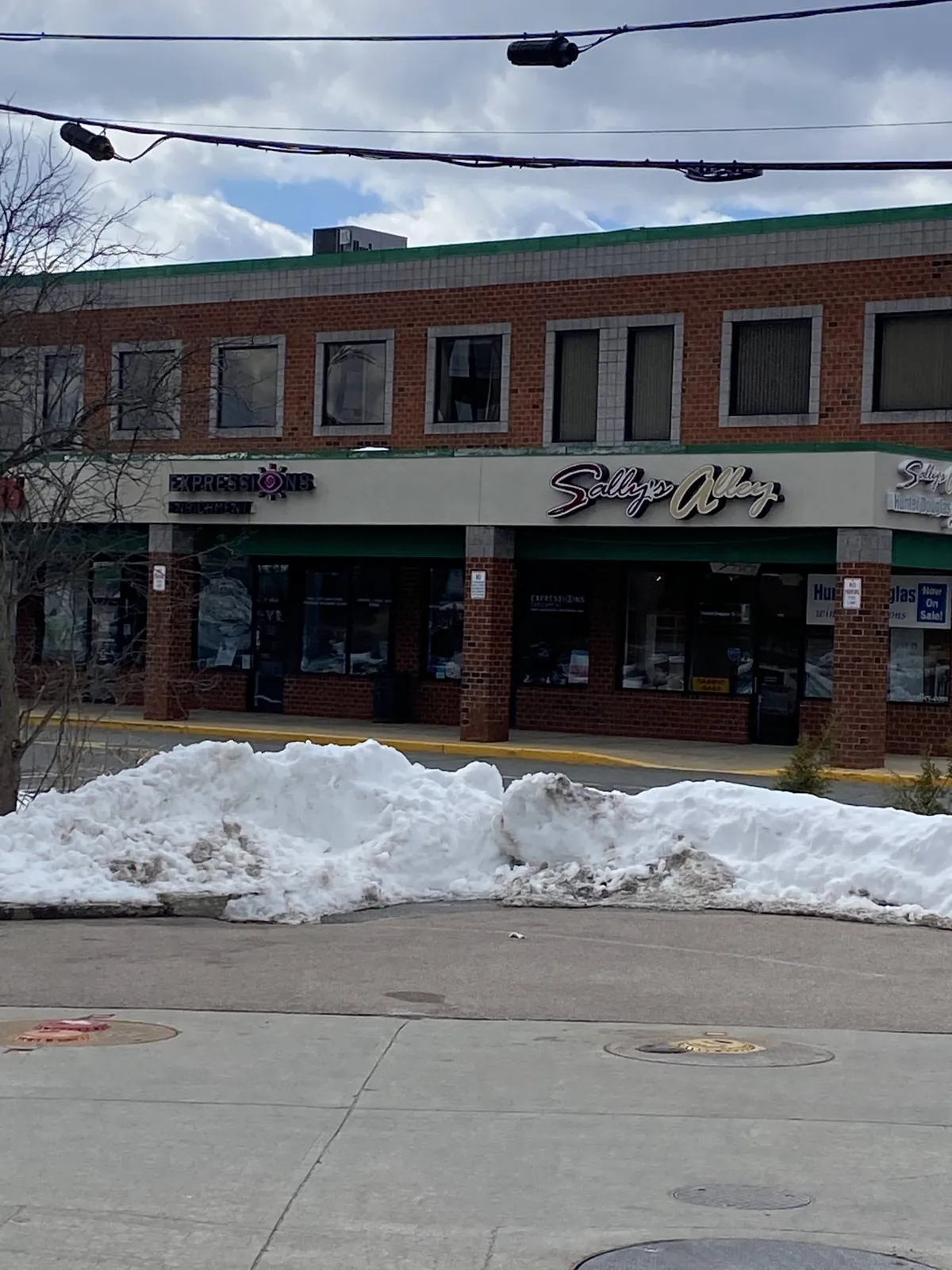
Franklin is our closest showroom to North Attleborough. You are welcome to call in while it is open if you would like to talk things over first. For deep, out-of-square frames, though, the measurements are what count, and they are taken at your house.
Questions from North Attleborough
Our windows are small and set deep in the wall. Will a roman shade fit inside them?
Usually, yes. A deep reveal is ideal for an inside mount, which keeps the trim visible. We check each frame for depth and squareness, and where one will not take an inside mount cleanly we fit the shade on the casing instead.
We own a two-family. Can the front windows match from the street?
Yes. Each flat can choose its own fabric for the room, and we can keep the side facing the street consistent. Measuring both floors on the same visit makes it easier to line the set up.
Which style is better for a small window, flat or folded?
Either works. The flat style looks crisp and shows pattern clearly. The folded style adds softness and texture. We bring both so you can see them at your own window.
Do ranch picture windows take one big shade?
Often two or three matching shades are the better choice. Each is easier to raise and the folds stay even across the window.
What does the estimate cost?
Nothing. We measure every window during the visit and give you a free estimate.
Your next step
The surest way to plan roman shades in North Attleborough, MA, is with the samples in your own rooms and every window measured. Request a consultation and we will bring them to you, or use the call button if you have a question first. If you would rather start in person, the Franklin showroom is the closest one to you.