
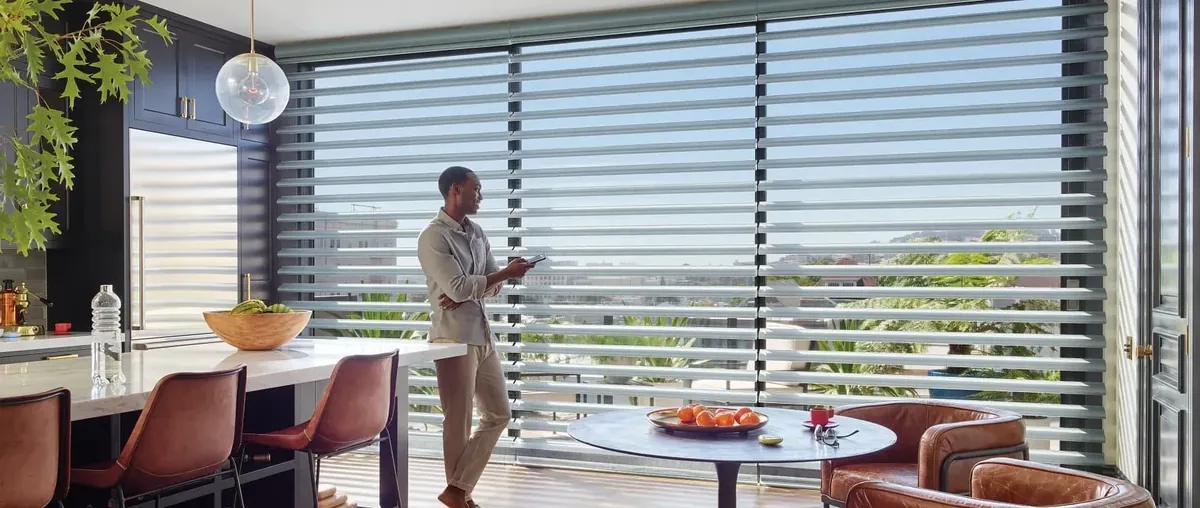
Medway’s tall foyers and tiny old windows
Medway’s houses come in two very different sizes, and both are hard on a window shade. Across the subdivisions off Holliston Street, the large newer colonials open into foyers that rise the full height of the house, with a tall window or a stack of panes over the front door. Near the village, the antique colonials have the opposite: very small sash set deep into thick walls, sometimes so deep that the sill is a shelf you have to reach across.
One window is too high to touch, the other too far in. Motorized blinds in Medway, MA, deal with both. The shade is made to fit the opening, the motor sits hidden in its headrail, and from then on it moves when you tell it to: from a remote, from the PowerView app or from a timetable you set once.
Nobody needs a ladder for the foyer or a long reach over a deep sill again, and the shades are never left at odd heights because one was too awkward to bother with.
Where a motor helps most in Medway
PowerView is an option on much of the Hunter Douglas range. You choose the shade that suits the room, and the motor comes with it. These are the combinations that come up most often in Medway houses.
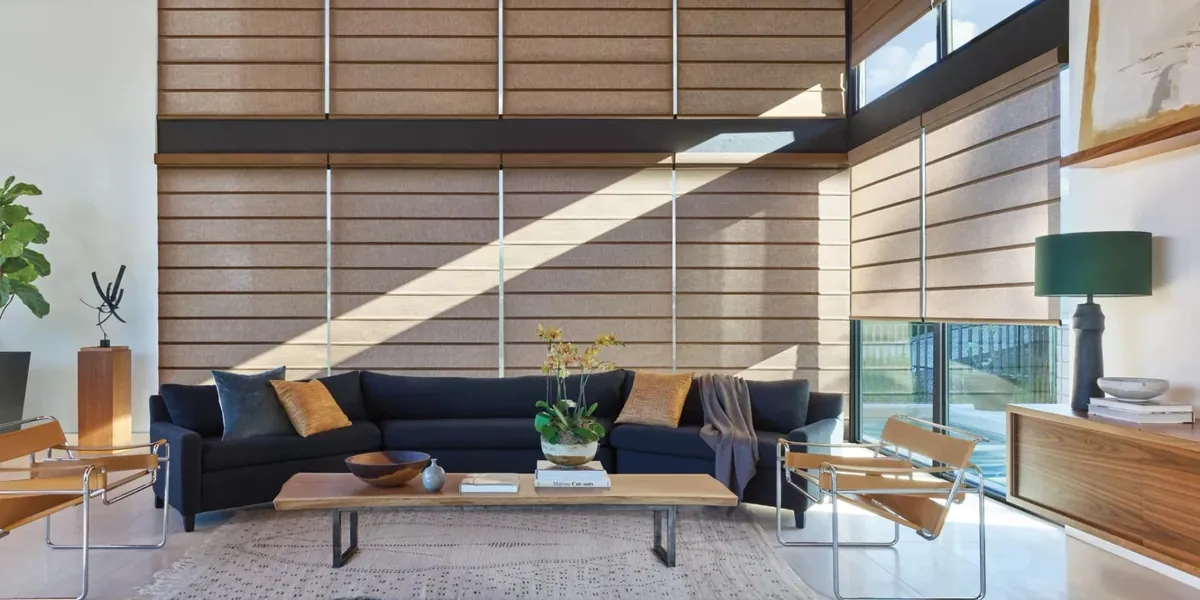
Banded or roller shades for the foyer
A tall wall of glass covered in one fabric, raised or lowered from the hall below with no pole and no ladder.
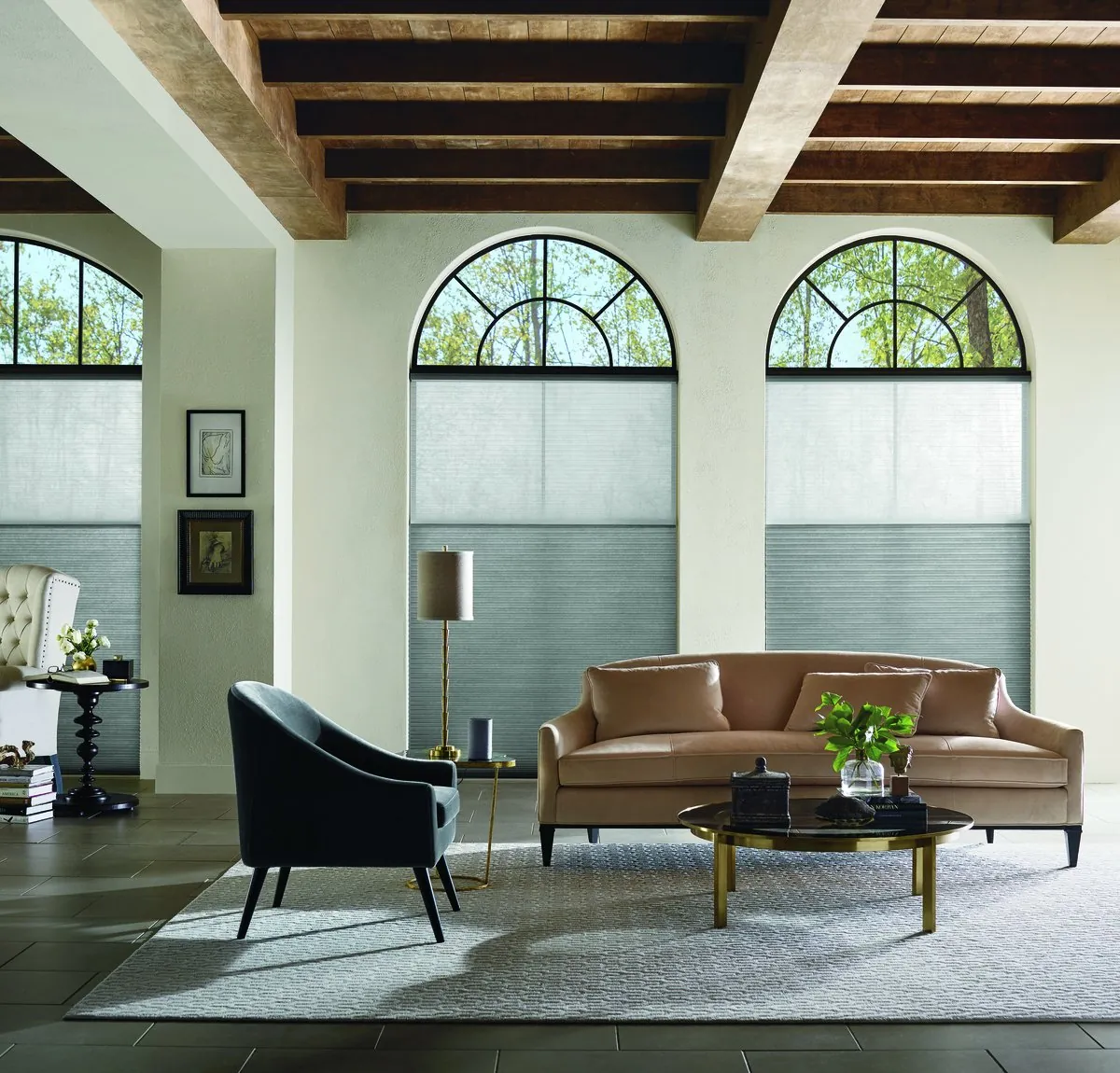
Top-down honeycomb under an arch
Lower the shade from the top and the arch stays open to the sky while the lower glass is covered.
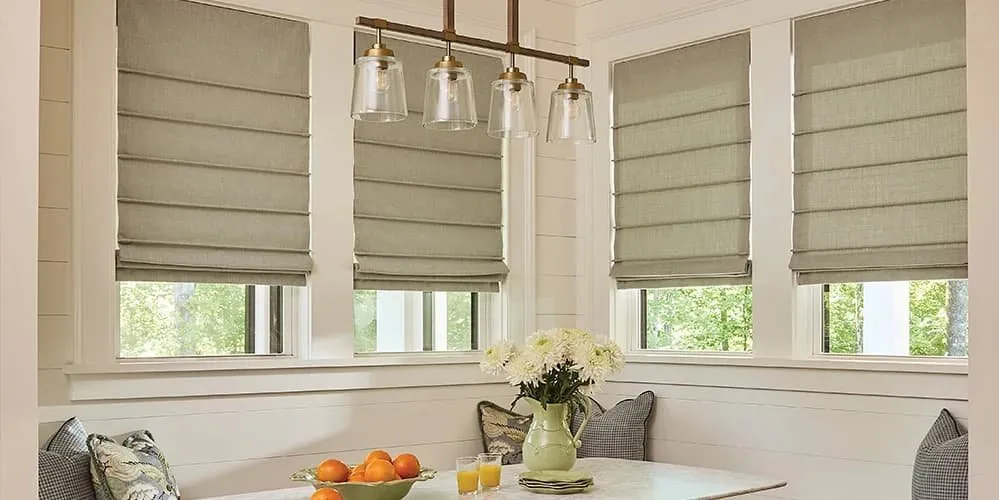
Flat roman shades in deep frames
Vignette flat folds tuck neatly inside a deep antique frame and suit the scale of a small window.
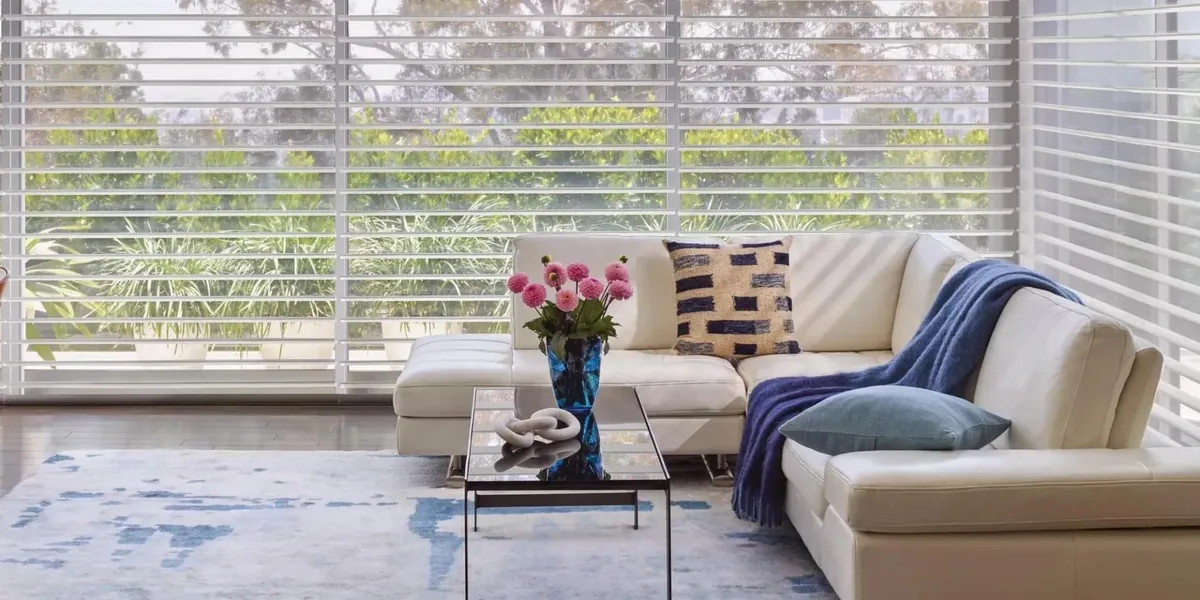
Sheer shades for the family room
Silhouette vanes tilt to soften the light on a big back wall of glass without shutting out the yard.
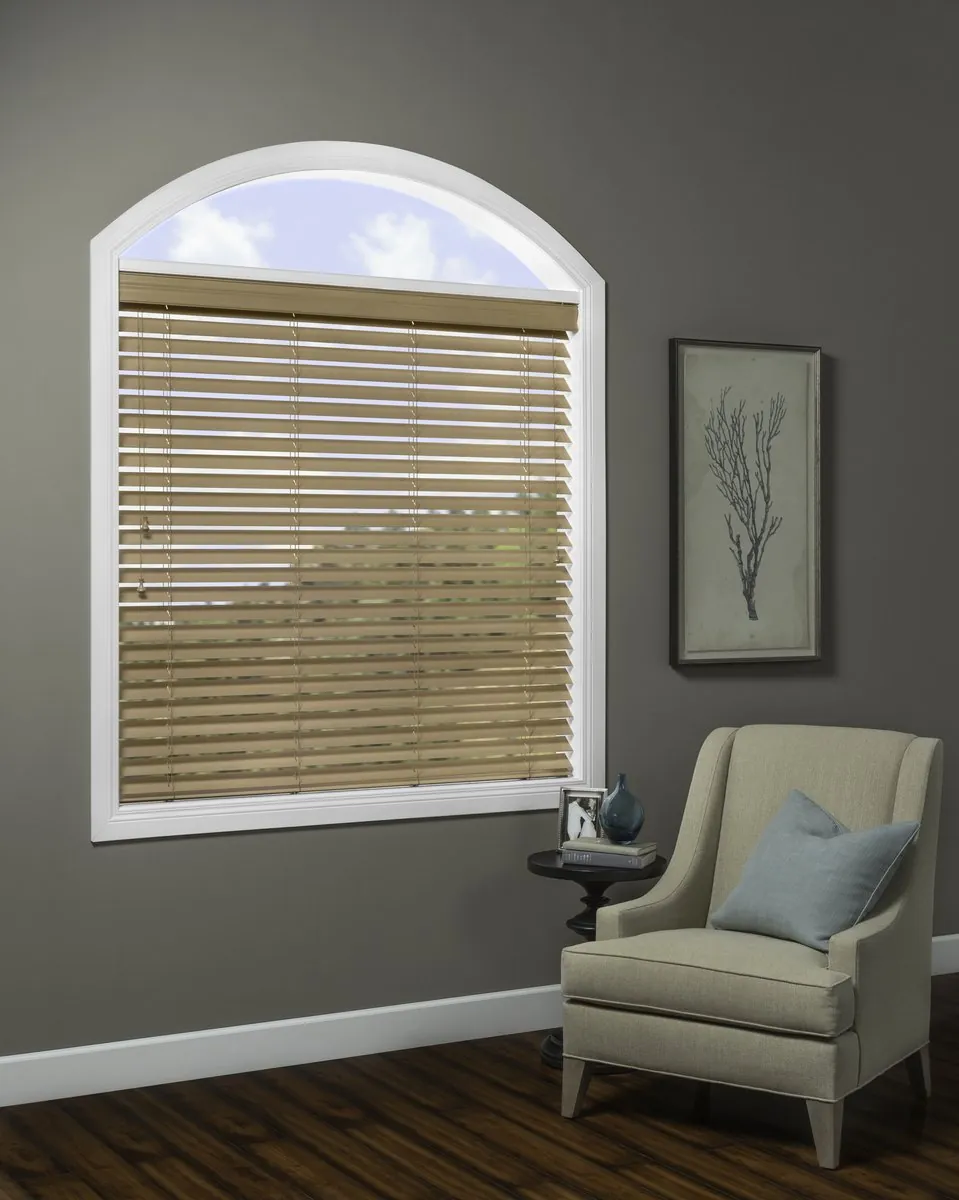
Wood blinds under a half-round
Slats for exact light control on a rectangular window, with the curved top left clear.
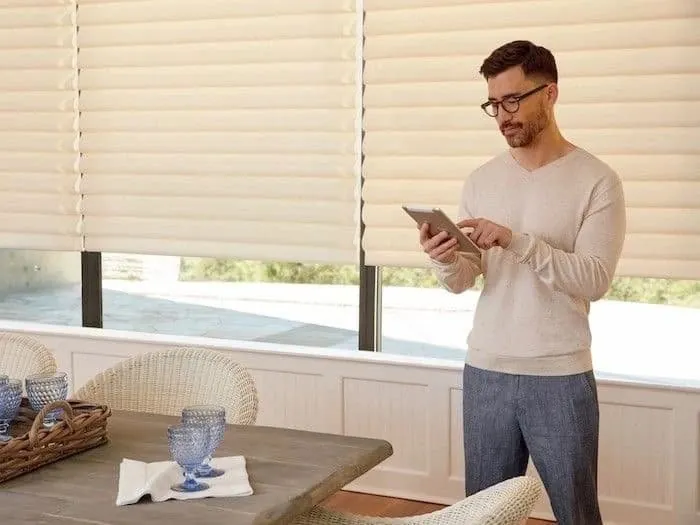
The PowerView app
Every shade in the house, grouped by room, on a phone or tablet.
The foyer window, and why a pole never really worked
For years the usual answer to a two-story foyer window was either to leave it bare or to fit a shade and a long pole to work it from below. Neither is satisfying. A bare foyer window floods the hall with sun at certain hours and turns the entry into a lit stage after dark, visible from every car that passes. A pole is awkward to store, hard to hook onto a small loop twelve or more feet up, and easy to leave in a corner where it falls over.
A motorized shade simply removes the problem. The installer fits it once, from proper staging, and sets the points where it should stop at the top and bottom. After that you lower it from the bottom of the stairs, from the kitchen, from the car on the way home, or on a timetable that does it every evening.
Medway’s newer colonials often pair the big foyer window with a landing window above the stairs and a transom or two over the door. Those can all join one group, so the whole entry closes with a single press. Or you can split them: transoms left open for daylight, the main window covered for privacy. That kind of flexibility is hard to manage by hand and easy with a motor.
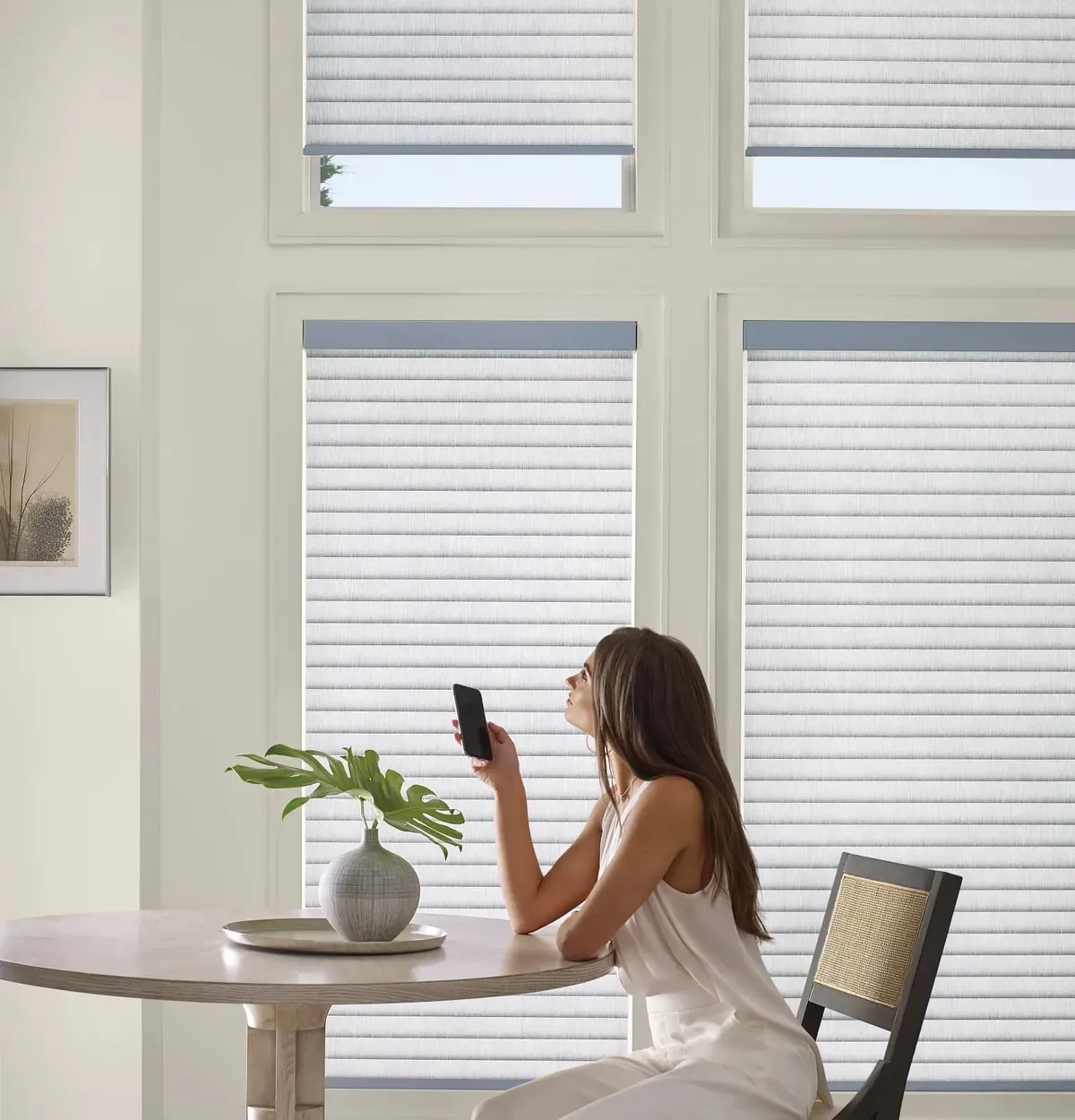
Deep-set sash in the village colonials
The oldest houses near Medway’s village were built with thick walls and small windows, and the result is a deep reveal: the glass sits well back from the room, with a wide sill in front. It is charming, and the deep frame is actually a gift for an inside-mounted shade, because there is plenty of depth for a headrail and its motor.
The challenge is width and reach. These windows are often very small, and a shade has to be made narrow to fit them. We check the exact width and height at several points, because a window that has settled over a long life is rarely square, and we confirm that the shade you like can be made and motorized at that size. Where a particular style is too wide for the opening, there is usually another that fits.
Reach is the reason to motorize at all. On a deep sill crowded with plants or ornaments, leaning in to lift a shade means moving everything first. On a motor, the shade rises over the sill without anyone touching it. Small windows also tend to come in numbers, so an antique colonial might have ten or a dozen across the front and sides. Grouped, they rise together in the morning and lower together at dusk, all to the same height, which keeps the front of an old house looking orderly.
A roman shade or a honeycomb shade sits especially well in a deep old frame. The folds of a flat roman suit the proportions of a small window, and a honeycomb adds a pocket of insulating air against glass that may be original and thin.
Choosing the control that fits your household
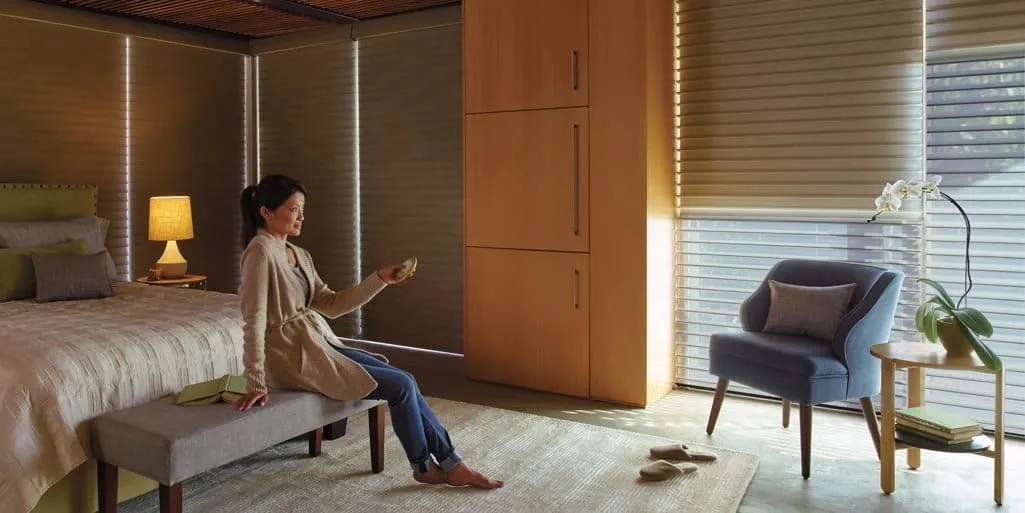
PowerView offers three ways to move a shade, and the right mix depends on who lives in the house.
For anyone who does not want to think about it, a schedule is the answer. The shades open and close at set times every day, and nobody has to touch a thing. This suits a foyer window perfectly.
For grandparents, guests or younger children, a remote is the friendliest option. It works like a television remote, with buttons for up, down and stop, and can hang on the wall in a bracket so it is always in the same place.
For whoever likes to fine-tune, the app on a phone or tablet does everything: individual shades, groups, partial positions, scenes and the timetables themselves. It also means you can lower the street-side shades from the office if you forgot that morning.
Most Medway households use a little of all three. Learn more in our guide to how motorized shades are controlled.
A day in a house with motorized shades
To picture it, follow a weekday in one of the bigger colonials off Holliston Street.
Before anyone is up, the bedroom shades stay down while the kitchen shades rise, so the first person downstairs walks into a bright room. Mid-morning, once the house has emptied, the foyer shade lowers part way to keep the sun off the wood floor in the hall. In the afternoon, the family room’s west-facing sheers tilt closed as the sun swings round, keeping the room cool and the television readable.
At dusk the street side of the house closes up on its own, so the rooms are private as soon as the lamps go on, even if everyone is still out. At bedtime one tap on a scene called “night” lowers every remaining shade at once. Nobody walked from window to window, and nothing was forgotten.
Weekends run on a different timetable, with the bedrooms left dark a little longer. And whenever the plan does not suit the moment, a press of the remote overrides it without changing the routine for tomorrow. Our window covering automation page goes into scenes and timetables more fully.
What we check when we measure a foyer
Tall windows leave little room for error, so the measuring visit on a two-story foyer is thorough. These are the things we look at:
- The width of each pane at the top, middle and bottom, and the height at both sides and the center.
- Whether the frame is deep enough for an inside mount, or whether the shade should sit on the trim.
- How stacked panes and transoms line up, so separate shades finish at matching heights.
- Any shaped top, such as a half-round, and whether it should be covered, left open or treated separately.
- Where the remote will live and which other windows should join the foyer’s group.
- How the installer will reach the window safely on the day.
Everything is confirmed with you before anything is ordered.
The visit itself
The process begins with a consultation in your house, because that is where the decisions get made. Our van carries the samples, so we bring the showroom to you. You see fabrics against your own walls and trim, in the actual light each room gets, and we talk about which windows matter most. After measuring, you receive a free estimate for the shades and installation you are considering, with no pressure to decide that day.
When the shades are made, a certified Hunter Douglas installer fits them, programs each one’s stopping points, pairs them with the remote and app and sets up any timetables you want. Read about what happens at an in-home consultation if you would like the details first.
It is worth walking the whole house with us, not just the foyer. Many people call about one tall window and then realize, once they see a motorized shade working, that the bathroom window over the tub, the kitchen window behind the sink and the bedrooms in the eaves would all be easier on a motor too. Looking at everything in one visit means the estimate covers the full picture, and you can decide which windows to do now and which to add later, knowing they will all run on the same system.
Pairing motors with a design plan
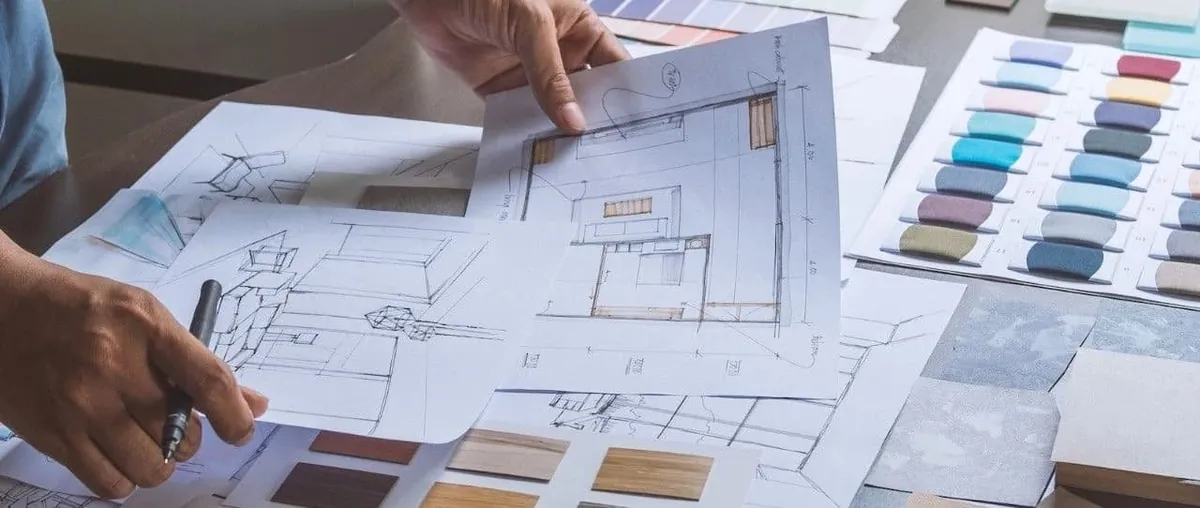
A big new colonial often has an open plan where the kitchen, breakfast area and family room share one long run of windows. Choosing a different shade for each window can leave that space looking patchy. We offer interior design consultations for exactly this kind of room, looking at fabric, color and how the windows read together with the furniture and floors.
Motorization fits naturally into that plan. The long run of windows can be one fabric on one group, so it moves together and looks like a single wall of shade. Or the breakfast windows can be separate from the family room, so you can keep the morning sun out of the kitchen without darkening the sofa.
In an antique house, the plan is more about respect for the architecture: shades that sit inside the original frames, fabrics that suit the period, and no cords hanging over restored trim. A motor helps by keeping the window clean.
Motorized blinds in Medway, MA, for the home office
Plenty of the bigger colonials now have a room set aside for work, often a front room off the foyer or a bedroom over the garage. Either way, the desk usually ends up beside or facing a window, and for an hour or two each day the sun lands right on the screen. Getting up to adjust a blind in the middle of a call is a small annoyance that adds up.
Blinds are especially good here. Tilted slats cut glare off a monitor while still letting you see out to the yard, and on a motor the tilt can change through the day without you leaving the chair. A timetable can angle them as the sun reaches the desk and open them again once it has moved on. If you would rather have a shade, a light-filtering roller fabric or a sheer shade with tilting vanes softens the light evenly across the room.
Motorized blinds in Medway’s home offices also help on video calls. Lower a shade behind you and the camera stops fighting the bright window, so your face is not lost in silhouette. Save that position as a scene and it is one tap away before every meeting.
In an older house near the village, the office is often a small front room with deep-set windows, where reaching over a desk and then a deep sill is doubly awkward. The same motorized approach works, with a narrow shade fitted inside the old frame.
Privacy between close neighbors
In some of Medway’s newer subdivisions the houses are generous but the side yards are not, and a side window can look straight into the neighbor’s. Those windows need covering for much of the day, which usually means they stay closed and the room loses its daylight.
A top-down shade is the neat answer: lower it from the top to let in sky and light while the lower half stays covered. On a motor, that position becomes a saved preset, so you can return to it with one press after closing the shade fully at night. Sheer shades work well too, since their vanes can be tilted to block the view in while still glowing with daylight.
For bedrooms on those sides, room-darkening honeycomb fabrics on a timetable keep the rooms private and dark until morning. See also our cellular shades in Medway and roman shades in Medway pages for more on those styles.
Cords gone for good
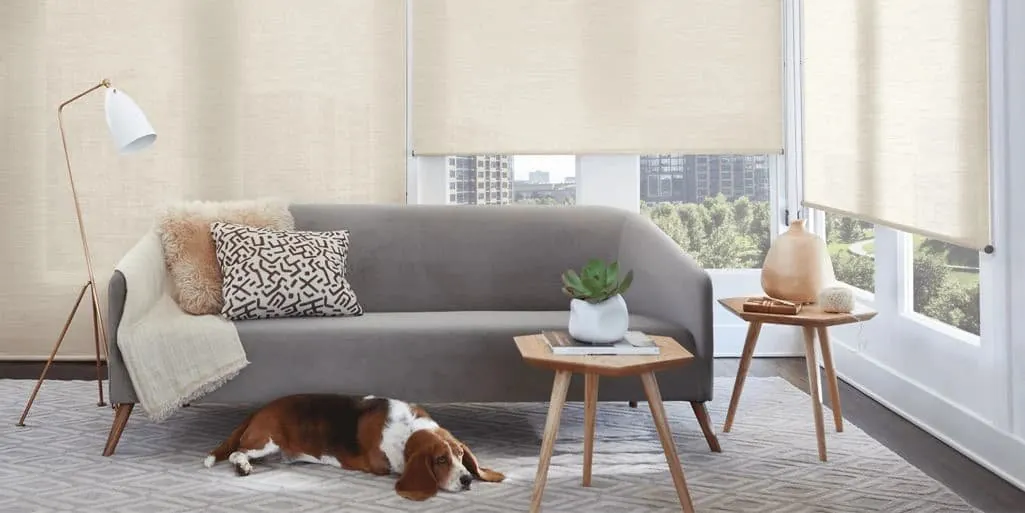
Motorized shades have nothing hanging at the window. In a family house that keeps cords away from small children and pets, and in an antique colonial it keeps the trim uncluttered. It also saves the shade itself: a motor lifts the fabric straight and evenly every time, where a cord pulled at an angle wears it unevenly over the years. Pets in particular appreciate it: a cat that likes the deep sill of an antique window no longer tangles itself in a loop, and the shade can be set to stop a hand’s width above the sill so the window seat stays theirs. If a shade you already own is worn or stuck, ask about blind and shade repair in Medway.
What a Hunter Douglas Gallery dealer brings to motorization
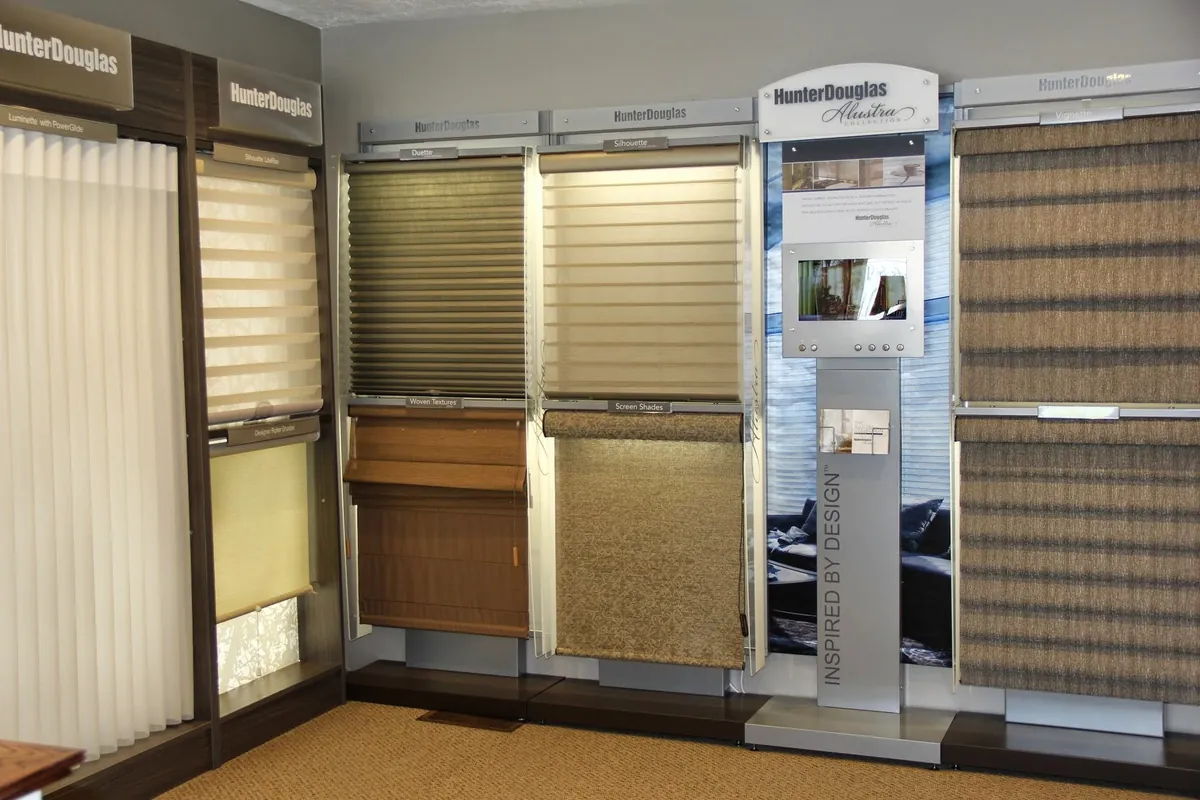
Hunter Douglas names dealers who meet its standards Gallery dealers, and Blinds & Designs is one. For motorized blinds in Medway, that means the motor never narrows your choices: PowerView is available across the honeycomb, sheer, roller, roman and blind lines we carry, so the foyer, the family room and the antique front parlor can each have the shade that suits it.
Installation is done by installers certified by Hunter Douglas, who fit, program and test every motorized shade before they leave. We offer interior design consultations and free estimates, and the same business that fits your shades looks after them afterwards.
The full range is on our motorized blinds and shades page, and our Medway page gathers every service we offer in town.
Questions from Medway
Can you reach our two-story foyer window safely?
Yes. Our installers work from proper staging on tall foyers and stairwells. Once the shade is up and its limits are set, you never need to reach it again: it runs from the remote, the app or a timetable.
Our antique windows are tiny. Can they still be motorized?
In most cases, yes. The deep frames of older Medway houses usually leave plenty of room for a headrail. The limit is width, so we measure each window and confirm the shade you choose can be made and motorized at that size, or suggest one that can.
Can the transoms stay open while the main window closes?
Yes. Each pane can have its own shade, and they can be grouped or controlled separately. Many households leave the upper glass open for daylight and cover the lower glass for privacy.
Will the shades still work on a timetable if we go away?
Yes. The timetable keeps running whether or not anyone is home, so the house carries on opening and closing as usual.
What does an estimate cost?
Nothing. After we measure, you get a free estimate for your motorized blinds in Medway, covering the shades and installation you are considering.
Your Medway shortlist
Before we visit, it helps to jot down a few things:
- The windows you can never reach, starting with the foyer and the landing.
- The rooms that get too much sun, and roughly when.
- Who in the house will use a remote, and who would rather use the app.
- Any rooms where you would welcome design help as well.
Bring that list to your consultation and we will plan the visit around it. The Franklin showroom is one town over if you would rather start there, or call it with the call button.