
River mills below, capes on the hill
Blackstone comes in two layers. Down by the river sits the mill-era housing, close-set and still fitted in many cases with its original narrow window openings. Climb the steep streets and the houses change to post-war capes and ranches spread across the hillsides. When we plan cellular shades in Blackstone, MA, the first thing we ask is which layer your house belongs to, because the windows differ so much between the two.
What the two have in common is cold glass. The mill houses have thin old sash in slim openings, and the hillside houses catch the wind on their exposed side. A honeycomb shade holds still air in its cells, and that layer of air is what keeps the warmth of the room from draining out through the window on a winter evening.
The slopes add something a flat town does not have. On a steep street, one house often looks down into the next, and a front window can sit just above or just below the sidewalk. Privacy has to be planned window by window here, not by rule of thumb.
What we bring for Blackstone windows
Three choices come up on nearly every visit in town. All three arrive as samples, so you can try them at your own windows.
Narrow, tall Duette shades
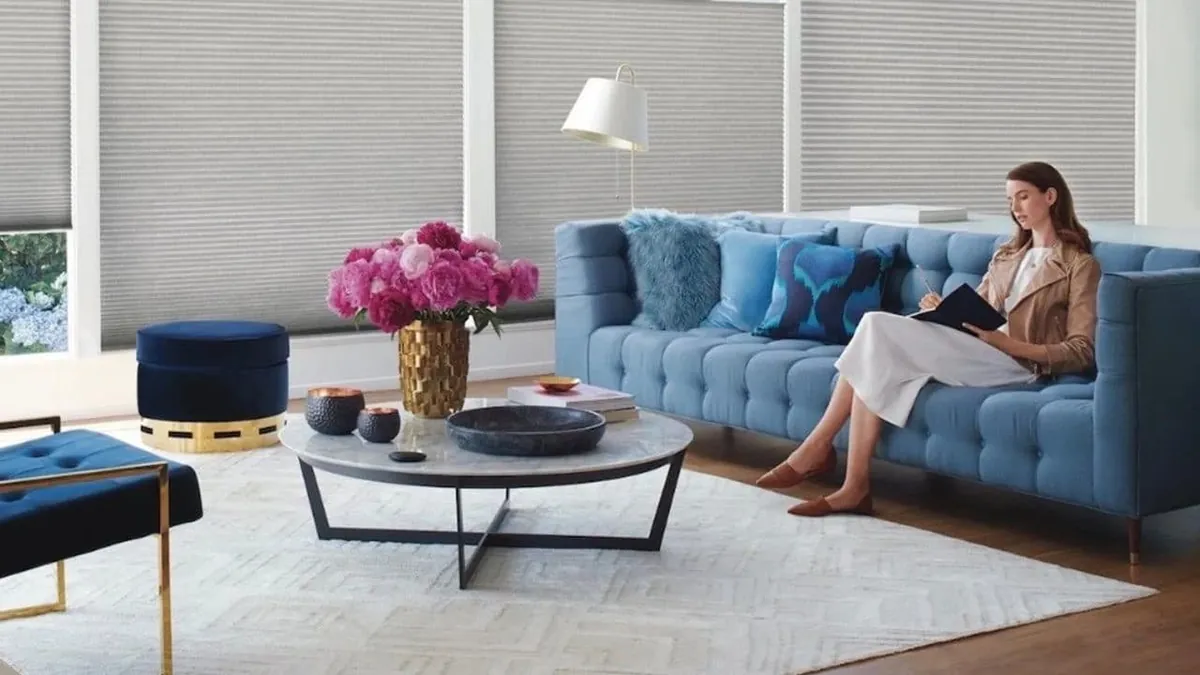
Duette can be made slim enough for the original openings in the river houses, so each shade fits its own frame neatly.
Fabrics for picture windows
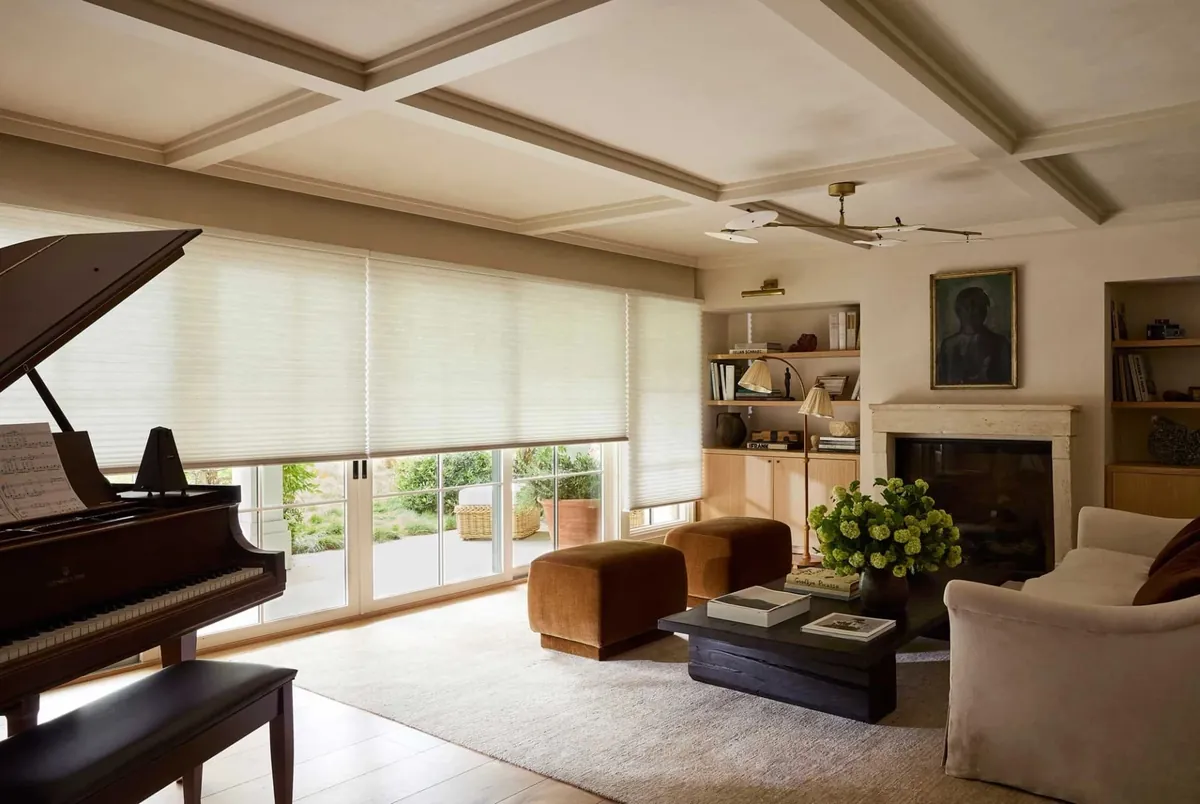
Light-filtering Applause and Duette fabrics that keep a ranch living room bright while taking the edge off afternoon sun.
PowerView for awkward glass
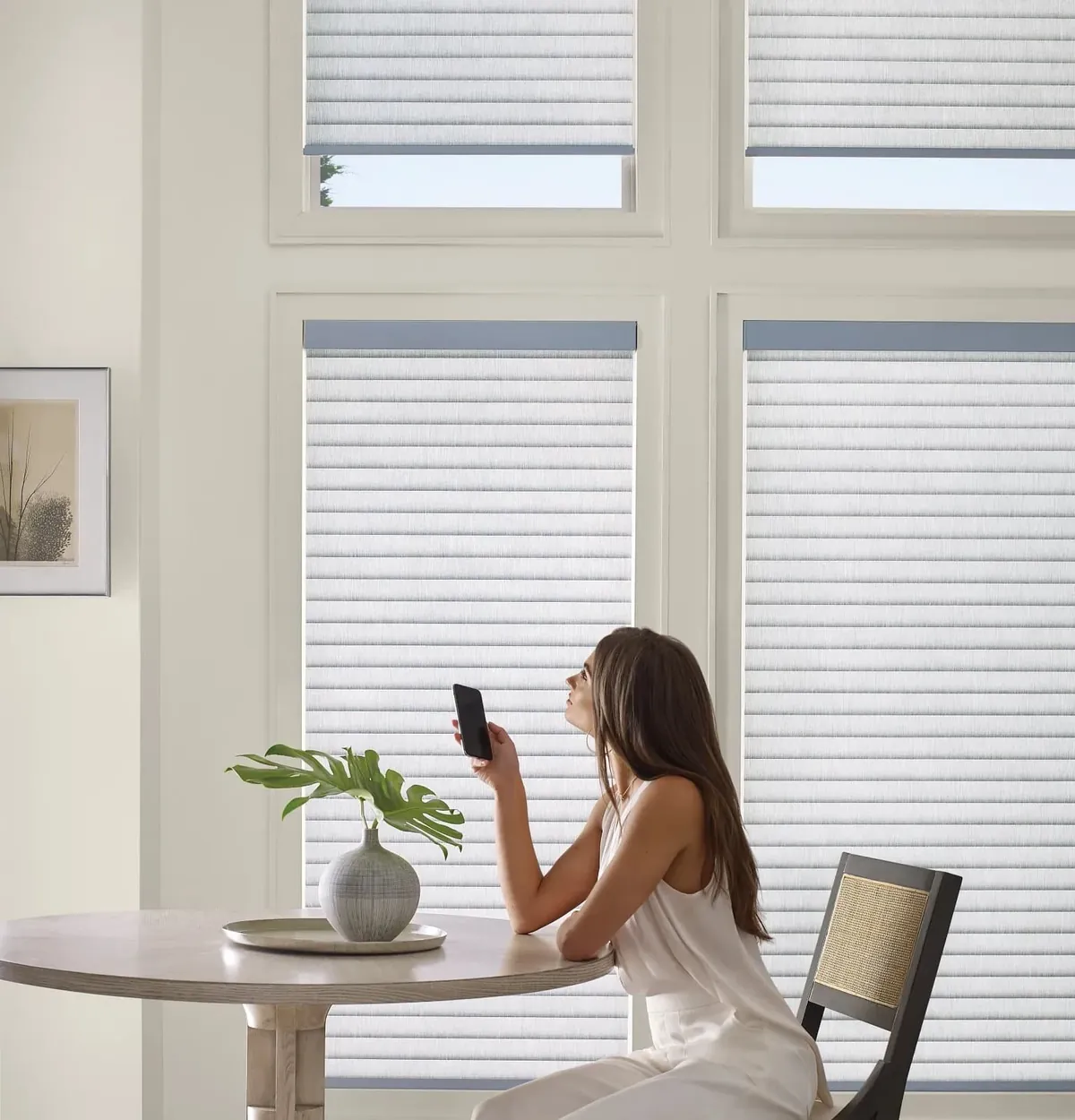
Dormer windows tucked under a cape roof and stairwell glass you cannot reach can be raised and lowered from a phone or a remote.
How a honeycomb keeps a room warm
The shade is made of pleated fabric folded into a column of hollow cells. When you lower it, the cells open out and each one holds a slice of air. Because that air is trapped, it barely moves, and air that does not move is slow to pass heat along. The result is a soft barrier between the glass and the room.
You notice it most beside the window. Sit next to bare single glass on a January night and you feel the chill coming off it; lower a honeycomb shade and that cold patch beside the window shrinks. In summer the same barrier slows the heat coming in through sunny glass, which matters on a hillside house where nothing shades the south wall.
There are single-cell and double-cell fabrics, and some Duette fabrics have a cell within a cell. More layers of trapped air mean a more effective barrier. We carry examples of each so you can see and feel them at the window and choose how much light you want the fabric to let through.
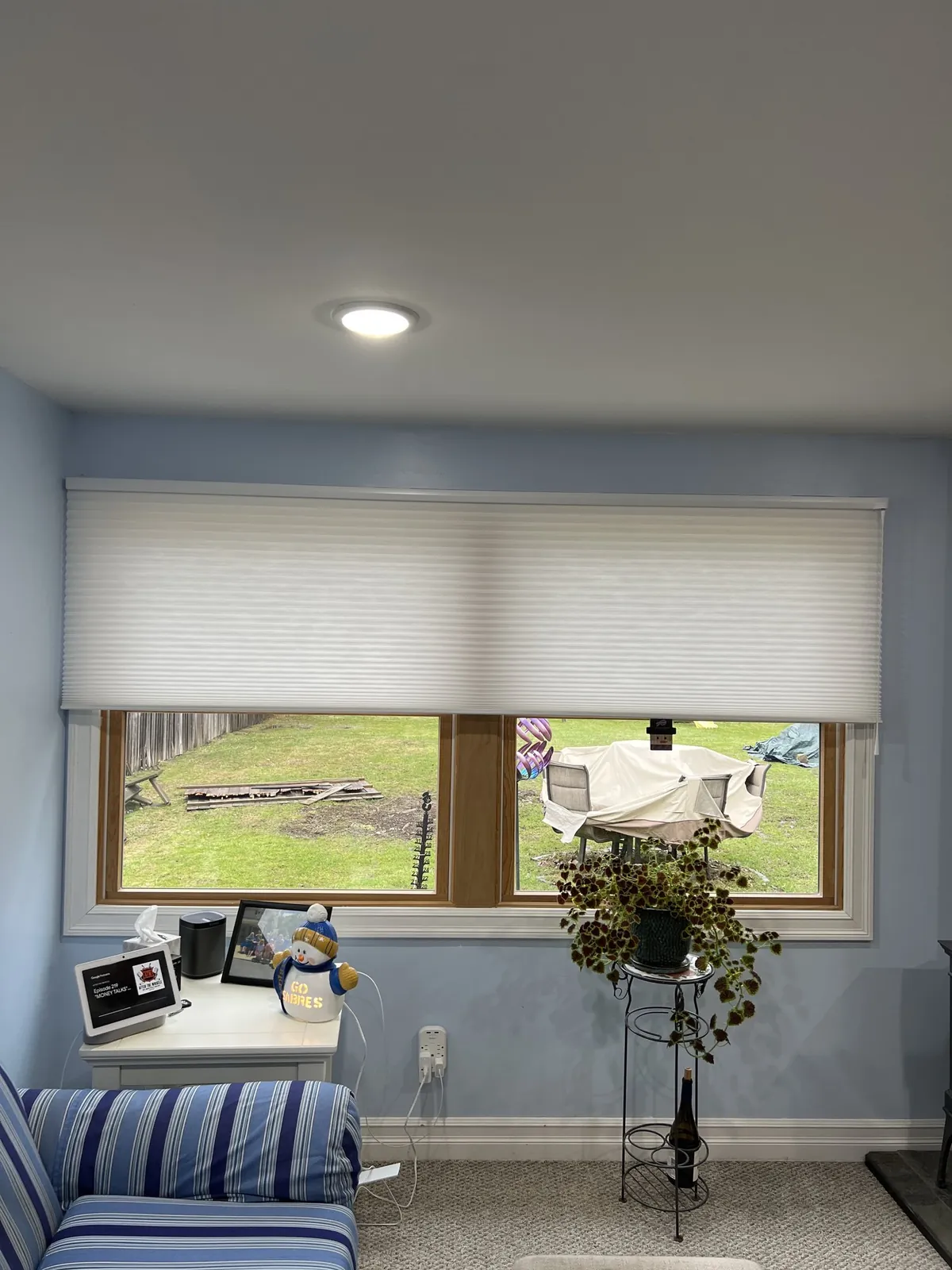
Down by the river: mill-era houses
The houses near the river were built for the people who worked the mills, and they were built close together to fit as many as possible near the water. Many keep their original narrow openings, and some keep the original sash as well, with old glass, wooden stops and the weights hidden in the frame.
Those windows are part of what makes the houses worth keeping, but they are thin, and the gap between one house and the next is small. A side window can look straight at the neighbor’s wall a few steps away, and the cold that comes off a north side window with no sun on it is real.
A honeycomb shade fits that kind of window well, provided the measuring is careful. An inside mount, with the headrail inside the frame, is the tidiest look, but old frames have hardware near the top and are seldom perfectly square. We check the depth at several points and the width at the top, middle and bottom. Where an inside mount would bind, a slim outside mount on the casing covers the opening and a little more, which also helps cut the draught round the edges.
Replacement units in old openings
Not every river house still has its first sash. Over the years many have had replacement windows fitted into the original narrow openings, and some have a mix, with old sash at the front and newer units at the back or upstairs. That mix is common enough that we plan for it on almost every visit.
A replacement window is usually square and consistent, but it can be shallower than the old frame it replaced, because the new unit sits within the original opening with its own frame inside. That sometimes leaves less depth for a headrail than you would expect. We measure it rather than assume. Where both kinds of window share a room, we keep the fabric and the bottom rail height the same, so the room reads as one even though the windows underneath are different ages. That is the detail that makes cellular shades in Blackstone, MA, look as though they belong in an old house rather than being added to it.
Steep streets and who can see in
On a hillside street, privacy works in three dimensions. The house uphill may look down into your living room, the one below may have a view up into your bedroom, and your own front window can sit at eye level with people walking up the pavement. A shade that simply comes down from the top does not always solve that.
Top-down, bottom-up honeycomb shades are useful here because you can choose which part of the window to cover. If the view in is from the street, cover the lower glass and open the top for daylight. If it is from a house higher up, the reverse can work, with the top covered and the lower part open to a garden. We stand at each window with you and look out before deciding.
Fabric choice matters too. A light-filtering fabric gives privacy by day while the room stays bright, but after dark, with lamps on, the room inside becomes easier to make out. For windows that face another house closely, a heavier fabric or a room-darkening fabric in the bedrooms keeps things private around the clock.

Up the hill: post-war capes
A cape on the hillside has a familiar layout: a front door in the middle, living rooms either side, and bedrooms upstairs under a sloped roof with dormer windows. Downstairs the windows are usually standard double-hung units, often replacements by now. Upstairs the dormers are smaller and set into the roof.
Dormer bedrooms in a cape are known for running cold in winter and warm in summer, because they sit right under the roof. Honeycomb shades suit them on both counts. A room-darkening fabric also helps when a dormer faces east and catches first light, and a cordless lift keeps a small window free of hanging cords. For a dormer that is hard to reach over a bed or a built-in, PowerView lets you move the shade without climbing over anything.
Downstairs, a cape living room benefits from the same approach as the rest of the house. Matching fabric across the front windows keeps the house looking tidy from the street, which counts for more when the street is steep and everyone sees your front windows from above or below.
The stairs in a cape often climb past a single window on the landing, set high in the wall where it is awkward to reach from either floor. It is an easy window to forget and an easy one to lose heat through. A honeycomb shade there, on a cordless lift if you can reach the rail or on PowerView if you cannot, finishes the house so that every opening is covered the same way.
Booking a visit and what happens
Most Blackstone customers prefer the samples to come to them, because fabric looks different in every light and on every hillside. Our vans carry the honeycomb range, so we bring the showroom to your house. The visit usually follows this order.
- Use Request a Consultation or the call button to choose a day and time.
- We arrive with honeycomb samples in a range of colors, cell sizes and light levels.
- Together we look at each room and how it is used, starting with the ones that feel coldest or most overlooked.
- Samples go up at your windows so you see each fabric against your own trim and daylight, and judge privacy from inside.
- We measure each opening and note its depth and any quirks in the frame.
- You receive a free estimate, with time to think it over.
Our page on what happens at an in-home consultation covers the visit in more depth. If you are redecorating at the same time, ask about interior design consultations and we can talk through colors and furnishings while we are there.
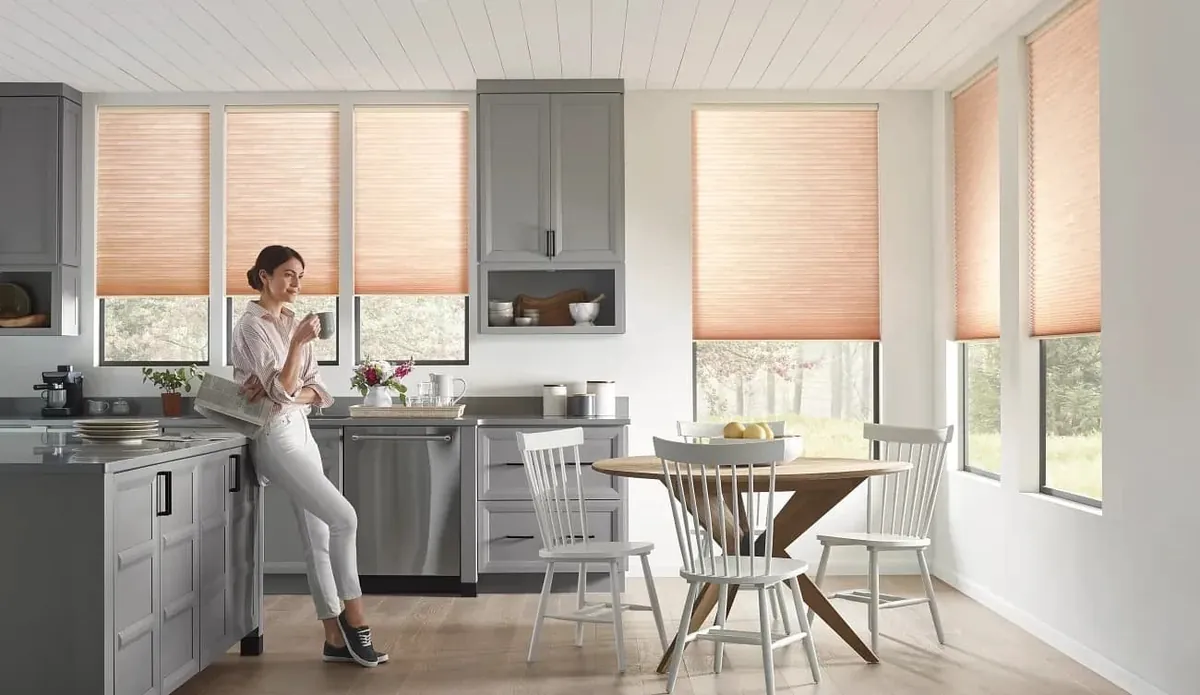
Cellular shades in Blackstone, MA, for hillside ranches
The ranches on the slopes were built for a simpler, single-floor life: a living room with a broad front window, a kitchen at the back, bedrooms along one side. Many have a slider out to a deck or back yard, and with the hillside falling away, some look out over the valley.
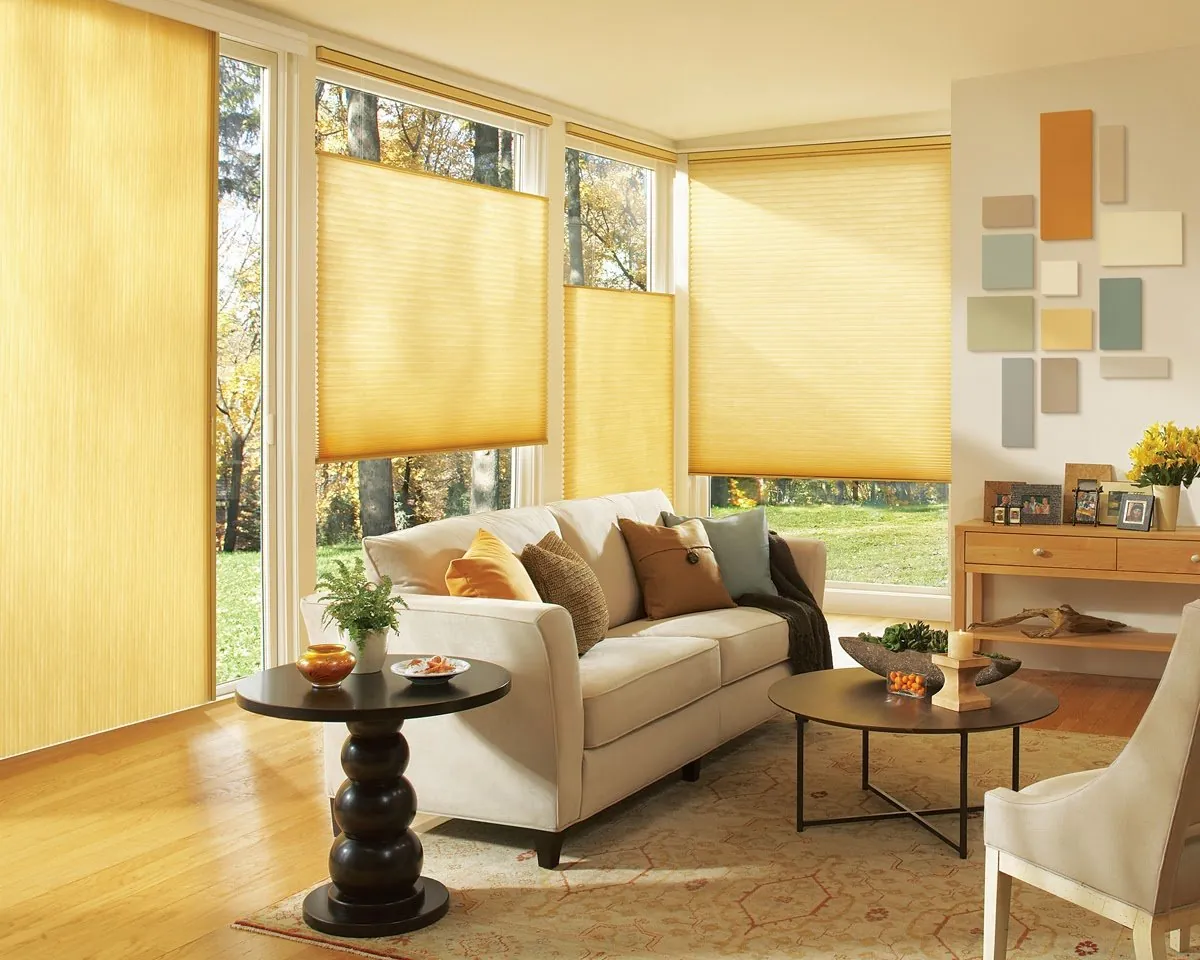
That front window is the biggest piece of glass in the house and the one that loses the most heat. A single honeycomb shade can be made wide, or two or three can share a headrail and lift together. Either way, a light-filtering fabric keeps the view and the daylight while softening the glare. The slider takes a vertical honeycomb shade, drawn across like a curtain and gathered at one side when you want to go out.
Ranches are also where we most often fit a whole house in one go, because every room is on one floor and the windows tend to be similar sizes. Ordering cellular shades in Blackstone, MA, for the whole of a ranch means the same fabric, headrail and lift throughout, so the house looks uniform inside and from the road.
Choosing between Duette and Applause
Hunter Douglas makes honeycomb shades under two names, Duette and Applause, and the trapped-air principle is identical in both. What separates them is what you can pick: fabric families, textures, cell builds and lifts. Duette goes wider, with very slim sizes for narrow mill openings and a side-drawing version for doors. Applause brings a separate palette suited to the standard units in a cape or ranch.
In the river houses Duette is usually the starting point, because of the narrow openings. On the hill, Applause often covers the main windows and Duette the dormers or slider. Both lines come in the sample case, so the decision can be made one room at a time, and our cellular shades overview lays out everything Hunter Douglas offers.
Lifts, cords and motors
How you raise and lower a shade matters most on the windows you use every day. Cordless shades are worked straight from the bottom rail: lift, lower, let go, and the fabric holds its place. With no loop dangling by the frame, they are the natural pick for bedrooms, kitchens and households with small children or pets.
Top-down, bottom-up shades have two rails, so you can move the top and bottom independently, which is what makes them so useful on a steep street. For dormers, stairwells and high windows, PowerView motorization lets you control shades by phone, remote or schedule. How each motor gets its power is something we work out with you at the visit. For the controls themselves, see how motorized shades are controlled.
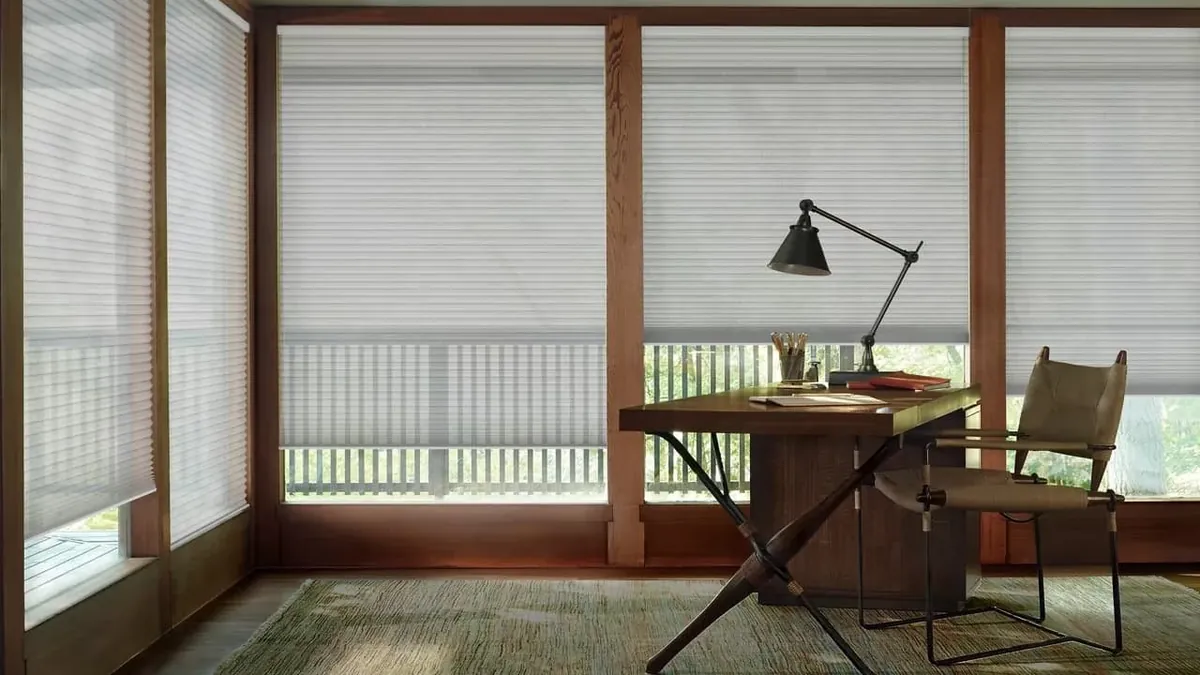
Fitting day
Once the shades are made to your measurements, our certified Hunter Douglas installers come to hang them. The order of work is simple.
- Brackets go into solid wood in the frame or casing, not plaster alone, so the shade stays level on a window you open often.
- Each headrail is clipped in and checked with a level, which matters in an old house where the frame itself may lean.
- Every shade is run up and down, and top-down rails and motors are tested.
- You are shown how each lift works, and any PowerView shades are set up with you.
A shade cut to the opening sits with only a narrow gap at each side, which looks better and keeps more of the cold at the glass.
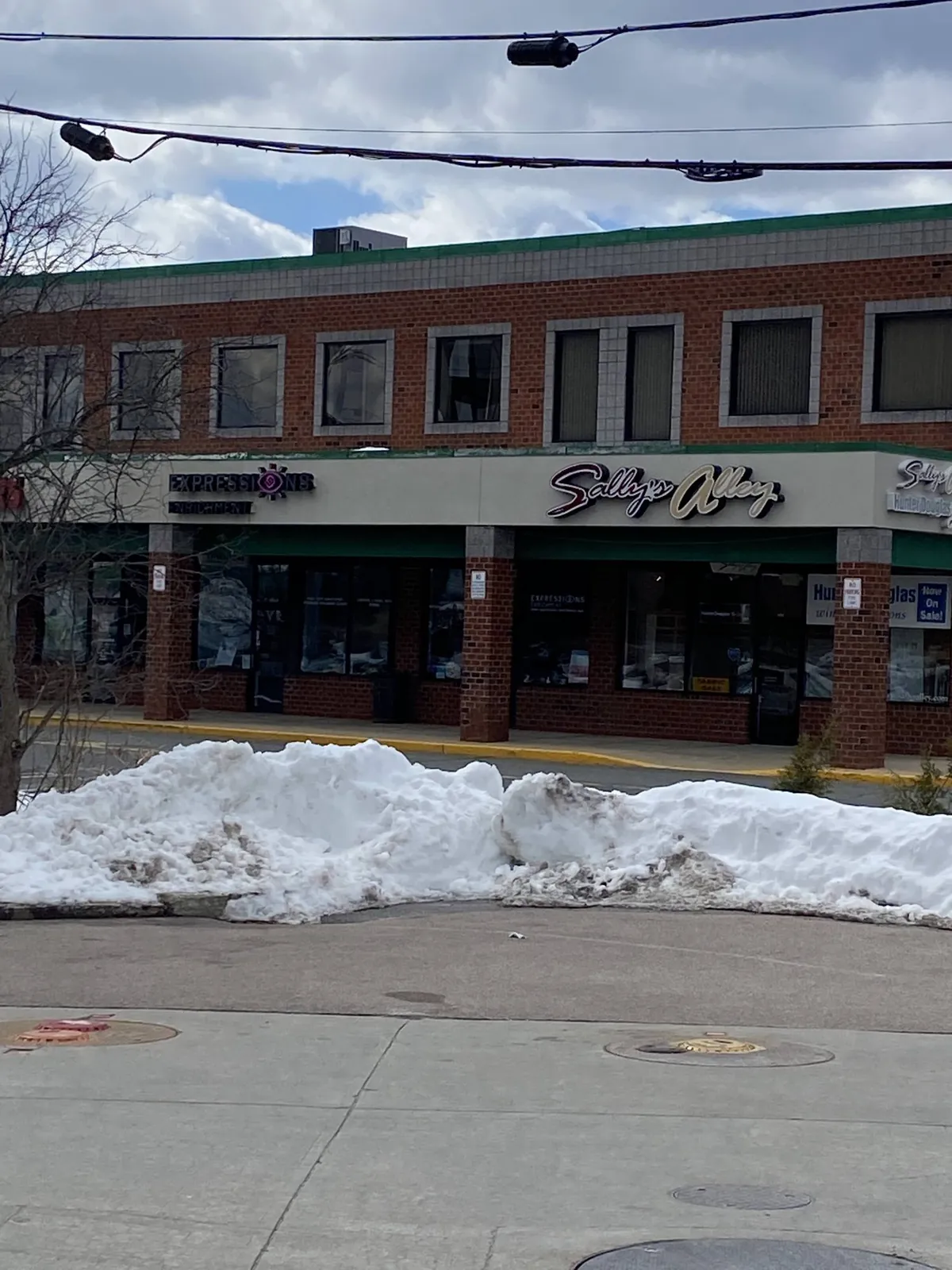
The Franklin showroom is nearest
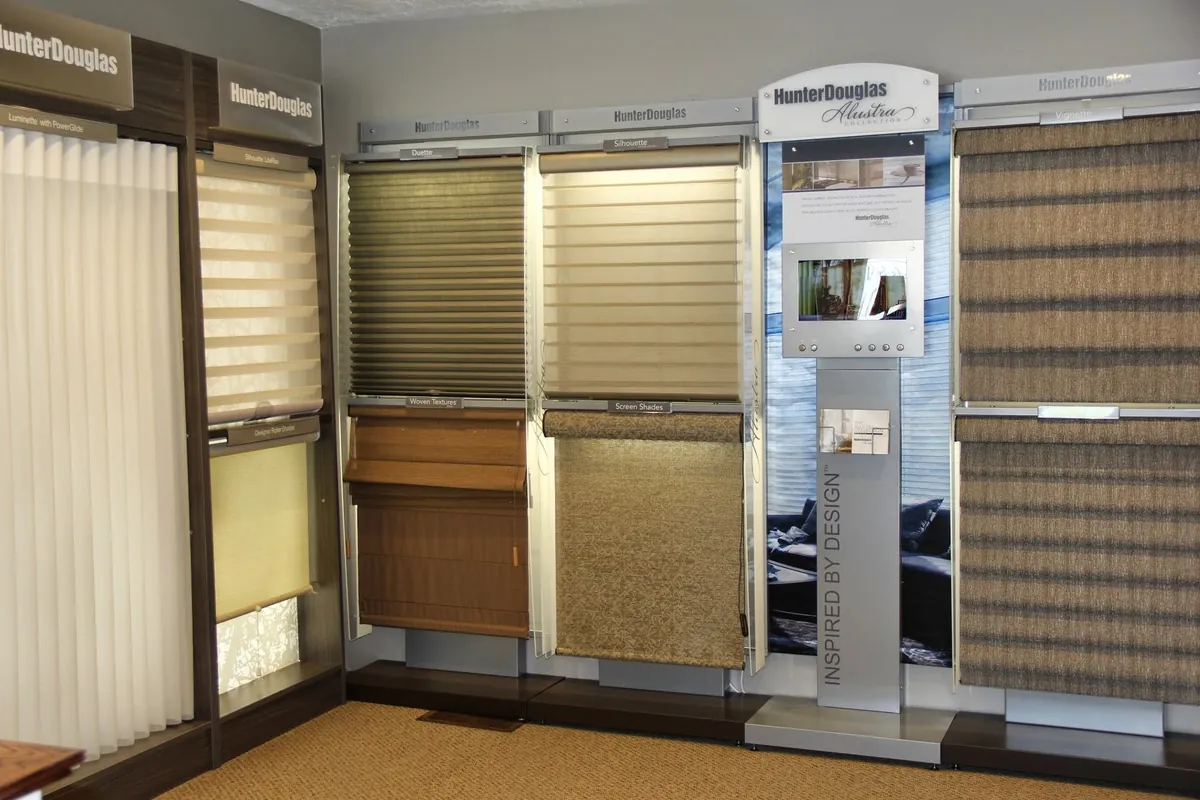
The Franklin showroom is the closest Blinds & Designs location to Blackstone. If you would like to look at honeycomb shades before booking a home visit, start there, and bring photos of your windows if you can.
For most houses in town, especially the older ones by the river and the hillside houses with tricky sight lines, the home visit is where the real choices are made. It is the only way to judge privacy from your own rooms, and it includes the measuring and the free estimate.
A Gallery dealer, start to finish
Blinds & Designs is a Hunter Douglas Gallery dealer, a designation Hunter Douglas gives dealers who meet its standards. That means the whole honeycomb range is available to you through us, from the narrowest Duette for a mill window to wide Applause shades for a ranch, along with PowerView.
Installation is by installers certified by Hunter Douglas. If any shade or blind in the house, ours or not, needs fixing later, we offer blind and shade repair too.
For the rest of the house we carry Hunter Douglas blinds, shutters, roller and roman shades. See roller shades in Blackstone or plantation shutters in Blackstone, or everything we offer in town on our Blackstone page.
Questions from Blackstone
Will cellular shades fit the dormer windows in my cape?
Yes. Dormers are usually small standard openings, and honeycomb shades are made to each one. A room-darkening fabric is a common choice for dormer bedrooms, and a cordless lift keeps cords off a small window. If the dormer is hard to reach, PowerView can handle it.
My house sits below the street and people can see in. What helps?
A top-down, bottom-up shade lets you cover exactly the part of the window that faces the street while leaving the rest open for daylight. We look out of each window with you at the visit to decide which part needs covering.
Can my old mill-house windows take an inside mount?
Often, but not always. Old frames have stops and hardware near the top and are seldom square, so we check depth and width at several points. If the headrail would bind inside, mounting it on the face of the casing is the better answer, and it covers the edges of the glass too.
What is the best option for a wide ranch picture window?
A single wide honeycomb shade or two or three shades on one headrail, in a light-filtering fabric that keeps the view and the daylight while softening the glare.
How much does the estimate cost?
Nothing at all. Measuring and the written estimate are both part of the visit, and there is no charge for either. Pick a time through Request a Consultation.
Your next step
A sample pressed against your own glass, seen from your own side of the slope, settles more than any brochure can. Choose Request a Consultation and a van full of honeycomb fabrics heads your way; the openings get measured on the spot and the estimate is free. The call button works if a conversation comes first, and the Franklin showroom is the nearest place to start looking at cellular shades in Blackstone, MA.