
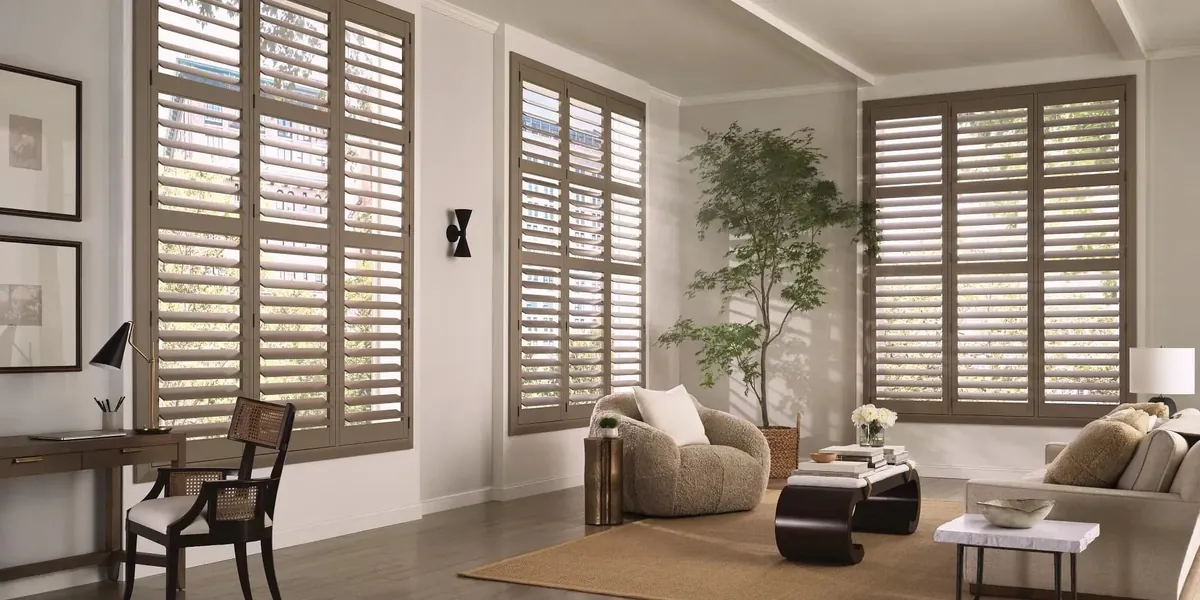
Houses under the trees
Much of Westwood sits under a canopy. Post-war colonials and larger newer houses stand back from the road on wooded lots, with generous setbacks and tall trees all around. It is a beautiful setting, and it shapes the light in every room. When we plan plantation shutters in Westwood, MA, the first question is usually not privacy but how to make the most of the daylight the trees let through.
The windows themselves are straightforward. Most houses here have standard modern openings, which makes for clean, consistent shutters from the front hall to the back bedroom. What changes from house to house is how much sun reaches each side, and how that shifts between full leaf in summer and bare branches in winter.
A shutter is well suited to that. Tilt the louvers open flat and the room gets nearly all the light the window offers. Swing the panels back and the glass is clear. Angle them against the low winter sun when it finally gets through, and close them for a dark bedroom at night.
Plantation shutters in Westwood, MA: the three collections
Hunter Douglas makes three shutter collections, and most Westwood houses use two of them. Each card links to more detail.
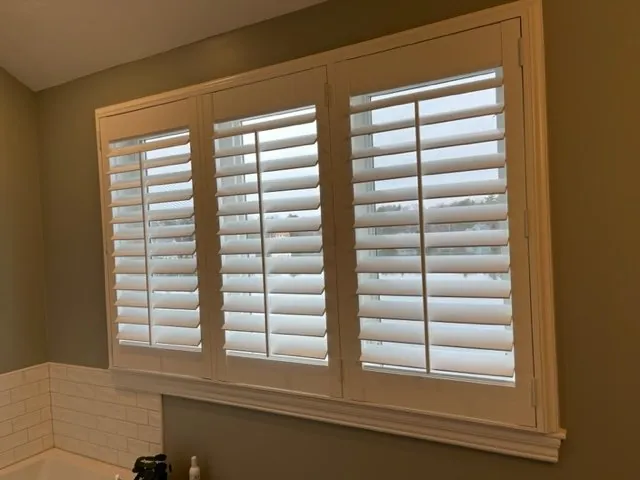
Palm Beach
Polysatin with no wood inside, for bathrooms, the laundry, the mudroom and the kitchen sink window, anywhere water and steam are part of the day.
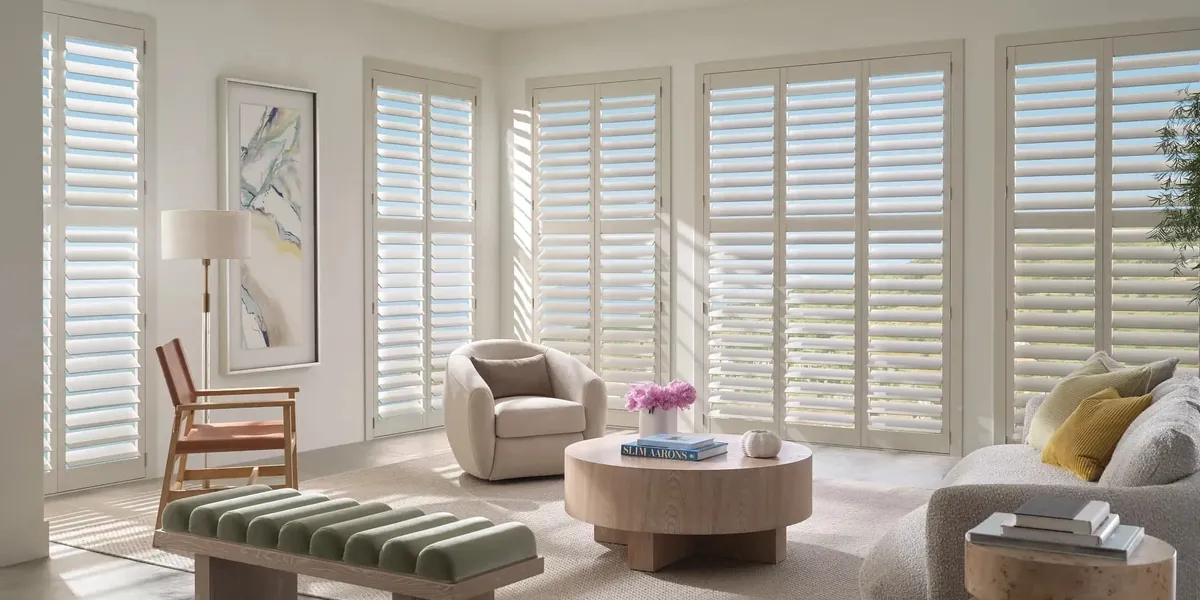
NewStyle
A hybrid with the look of painted wood that handles wide panels well. The everyday choice for bedrooms, family rooms and offices.
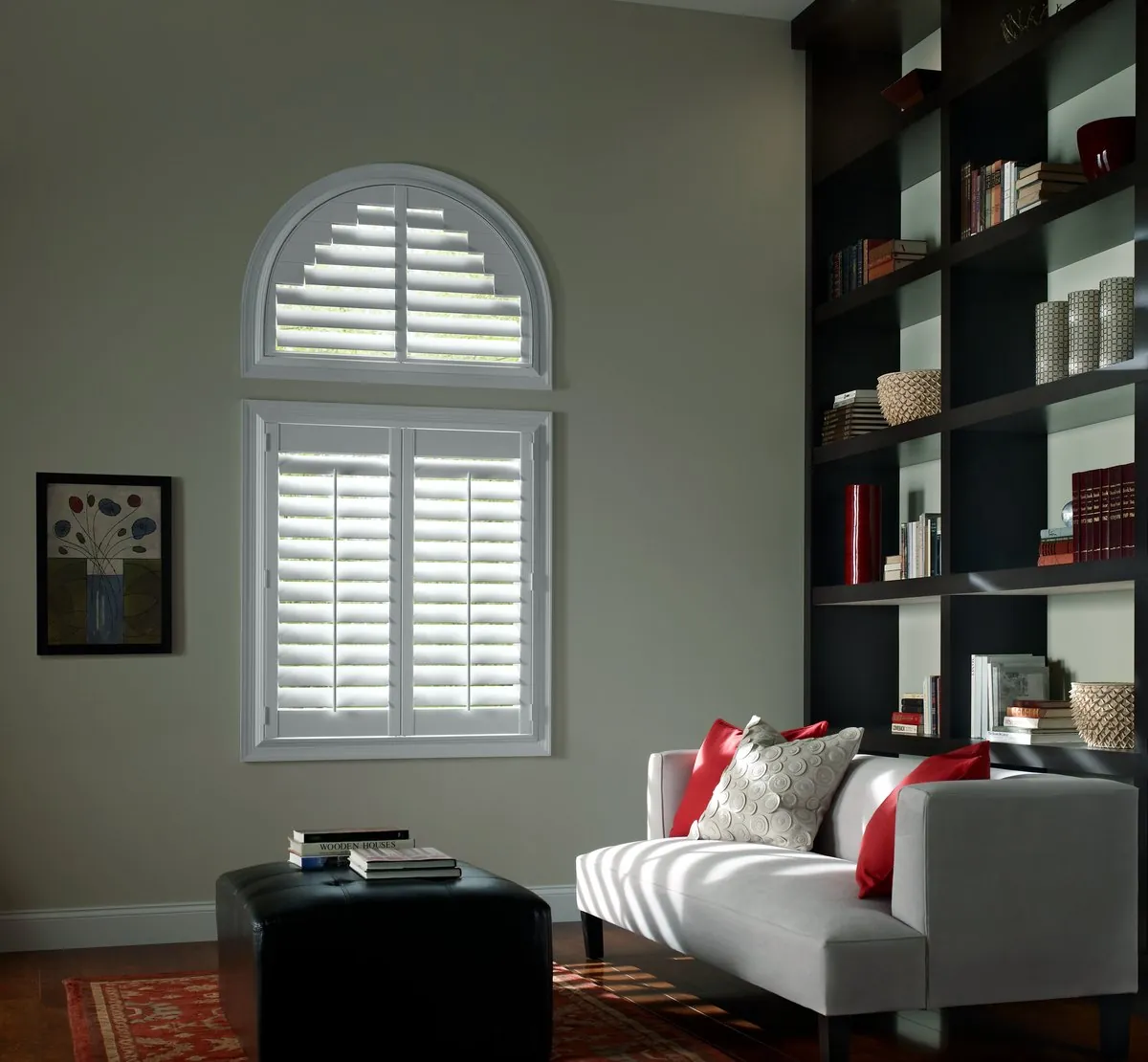
Heritance
Real hardwood, painted or stained, with the widest choice of finishes. Often chosen for a front living room or a study.
Begin with a home visit
Westwood is in the area we cover from Canton, where everything is shop at home. So the first step is a visit to your house, with a van full of shutter samples. Our shop at home page explains how it works.
Under heavy tree cover, choosing at home is especially worthwhile, because the light in a shaded room is nothing like the light in a store. Here is what to expect when we come:
- We go through the rooms you want to treat, usually starting with the darkest or the one you use most.
- You compare Palm Beach, NewStyle and Heritance against your own trim, and try slim, medium and wide louvers at the window.
- We look at finishes in the actual light each room gets, which is often greener and softer than people expect.
- We measure every window you are considering and check how each will be mounted.
- You get a free estimate before we leave, and you decide when you are ready.
If you would like help with color or the rest of a room, ask about our interior design consultations. You can also read what happens at an in-home consultation.

Post-war colonials and their even rows of windows
Many of Westwood’s older streets are lined with post-war colonials. They are orderly houses: a front door in the middle or to one side, windows set evenly across the front on both floors, a living room on one side of the hall and a dining room on the other, bedrooms upstairs.
That regularity is a gift for shutters. The windows on the front are usually the same size, so the shutters can match exactly, with divider rails at the same height and louvers that line up from one window to the next. Seen from the end of a long driveway, a row of identical shutters gives the house a crisp, finished face.
Inside, the rooms are a comfortable size with ordinary ceiling heights, and a medium louver suits most of them. Bedrooms upstairs take a pair of panels per window. The living room often has a bigger window or a pair of windows on the end wall, and a fireplace between them, so the shutters on each side are made to match.
Many of these houses have had their original windows replaced. The new units are standard sizes, but often a little shallower than the old wood frames, so we check the depth at every window before choosing a frame that sits inside the opening.
Shade from the canopy: wide louvers and light finishes
Under tall trees, a room can feel dim even at midday. The light that reaches the window has already been filtered through leaves, and it arrives soft and green. Any covering that takes away more of it makes the room feel darker still.
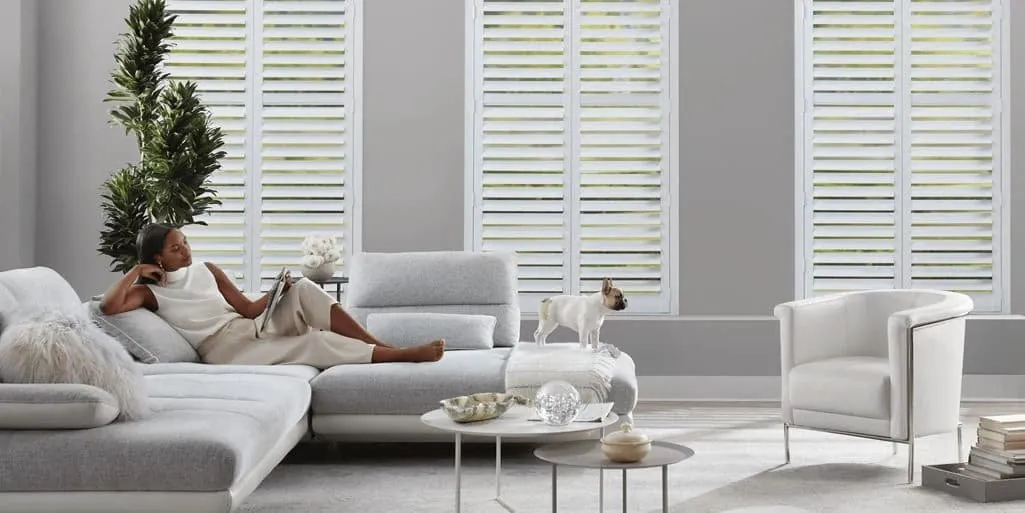
Shutters can be planned to give back as much light as possible. Wider louvers mean fewer blades across the glass, so when they are open flat, more daylight and more of the view come through. A white or soft white finish reflects light back into the room rather than absorbing it. And a hidden tilt, which works from the edge of the panel instead of a rod down the middle, leaves the face of the shutter clean.
On the brightest rooms, where the trees open up, louvers tilted upward throw the sun onto the ceiling and spread it around. On the darkest, you can simply swing the panels back against the wall during the day and close them at night.
Deep setbacks and what the shutters are for
On a generous wooded lot, the house is often far enough from the road, and screened enough by trees, that nobody can see in. So it is fair to ask whether shutters are worth having without a privacy problem to solve. On these lots they are chosen for other reasons.
The first is control over light that is always changing. A shade is either up or down; a shutter lets you fine-tune a room by a few degrees of louver tilt, as the sun moves through the branches during the day.
The second is the look. A fitted shutter frame finishes a plain modern window and gives every room a consistent, architectural feel, and from the end of the drive the house looks tidy and complete.
The third is the night. Even on a secluded lot, an uncovered window at night is a black mirror, and many people simply prefer a room that feels closed in after dark. Closed louvers do that without the bulk of heavy curtains.
Full leaf in summer, bare branches in winter
The trees change the light through the year, and a room that is shaded all summer can take bright, low sun once the leaves fall. A south-facing family room that feels cool and green in July may have sun straight across the floor in January.
This is where shutters earn their keep. You do not need a different covering for each season, only a different angle on the louvers. In summer, open them flat to catch what light the canopy allows. In winter, tilt them against the low sun to keep the glare off a screen or a sofa while the room stays bright. On a dark winter evening, close them and the panels sit snug in their frame across the glass.
We talk through which way each room faces during the visit, because it changes the louver size and tilt style we suggest.
Larger newer houses: family rooms, offices and suites
Westwood’s larger newer houses tend to have more of everything: a family room with a run of windows or a slider to the yard, a home office, a primary suite with its own bath, several bedrooms, and a mudroom and laundry near the garage. The openings are standard modern sizes, but there are a lot of them.
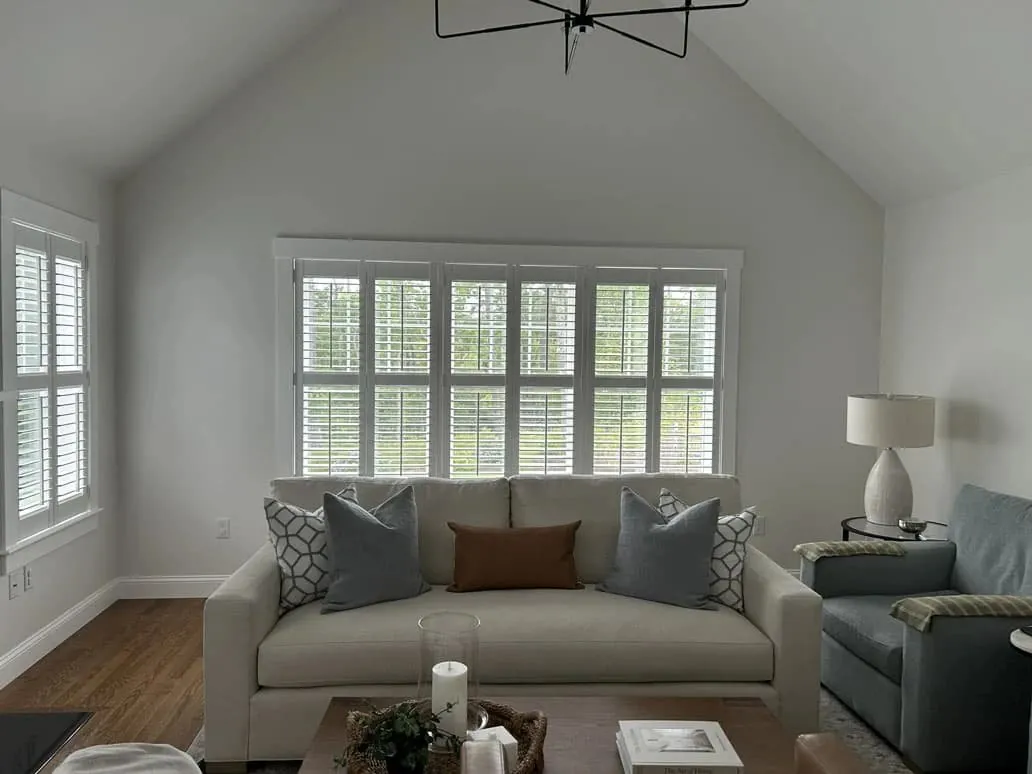
A whole-house plan makes sense in these houses. We choose a louver size and finish that suits the main rooms, then carry it through every window so the house reads as one. The family room usually gets wide louvers for the view into the trees, with slim posts joining the shutters across a run of windows. A slider takes panels on a track; French doors take shutters mounted on the doors themselves.
The home office is worth special thought. A screen near a window needs glare control without darkness, and louvers tilted just enough to cut the direct light do that well. In the primary bedroom, closed louvers darken the room for sleep; a divider rail lets you open the upper half for daylight in the morning while the lower half stays shut.
Stairs, landings and the front hall
Both kinds of house in town tend to have a stair window. In a post-war colonial it is usually a modest double-hung on the landing, halfway up. In the larger newer houses it can be a tall window in a two-story front hall, sometimes with a half-round or arched top.
A landing window you can reach takes a simple pair of panels, matched to the rest of the house. A tall hall window is divided into stacked tiers, so the lower panels work from the floor and the upper ones are either hinged or set with their louvers at one angle. An arched top gets a shaped panel that follows the curve. Under the trees, these windows are often the main source of light for the stairs, so we lean toward wide louvers and a white finish to keep the hall bright.
If the top of a tall hall window needs to open and close and nobody can reach it, a Hunter Douglas shade with PowerView motorization can cover that part while plantation shutters in Westwood, MA, cover the glass below. The two sit together well when the colors are matched.
Standard modern openings, measured one by one
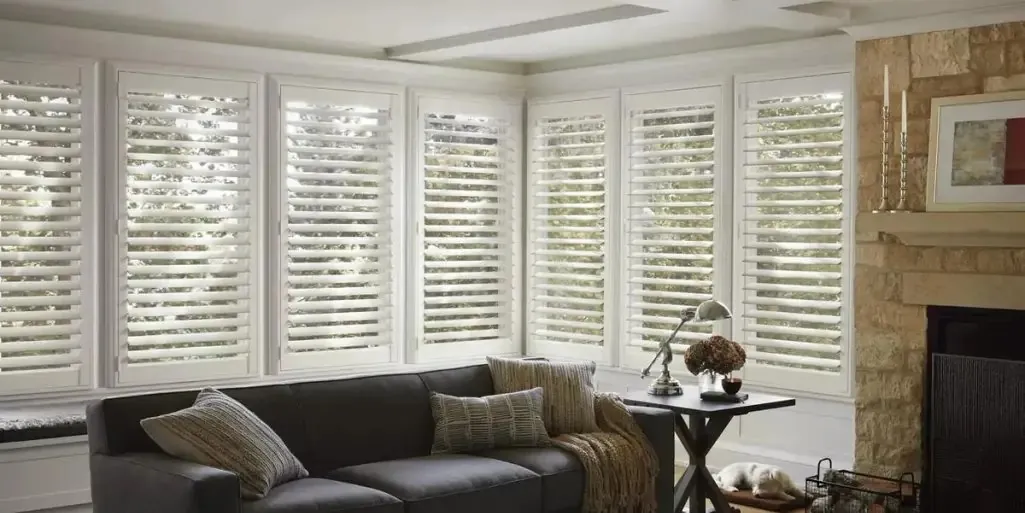
Most of the windows in town are standard modern sizes, and that makes shutters here very clean to plan. Inside frames fit most openings, layouts repeat from room to room, and nothing needs to be specially shaped. Still, every window is measured on its own, because shutters are made to the opening and windows of the same nominal size can differ by enough to matter.
- We measure each opening’s width at the top, middle and bottom, and its height at the left, center and right.
- We check the depth where the frame will sit and note any crank, lock or sensor the louvers must clear.
- We confirm the collection, louver size, frame and tilt for each window with you.
- When the shutters arrive, our certified Hunter Douglas installers set each frame square, hang the panels and adjust them until every pair meets cleanly and every louver closes flush.
- Before they leave, they show you how to work the tilt and open the panels for cleaning.
That care is what lets plantation shutters in Westwood, MA, look built in, with the narrowest possible gap at the edges.
Frames, rails and tilt
- Inside frame. Sits within the window opening, leaving the trim fully visible. It suits most standard openings with enough depth.
- Outside frame. Mounts on the casing or the wall. It solves a shallow window or one with hardware in the way, and can make a modest window look larger.
- Decorative frame. Adds a profile around the edge, useful where a newer house has very plain trim.
- Divider rail. A horizontal rail that splits a tall panel’s louvers into two banks that tilt separately.
- Classic tilt rod. Runs down the front of the panel and moves all the louvers at once. A traditional look for a colonial.
- Hidden tilt. Moves the louvers from the edge, leaving the face clear. A good match for wide louvers in a shaded room.
Baths, the mudroom and the laundry
The larger houses in town often have several wet rooms: a primary bath with a big window over the tub, a hall bath, a powder room off the front hall, a laundry and a mudroom by the garage. Post-war colonials usually have a bath upstairs and a half bath downstairs.
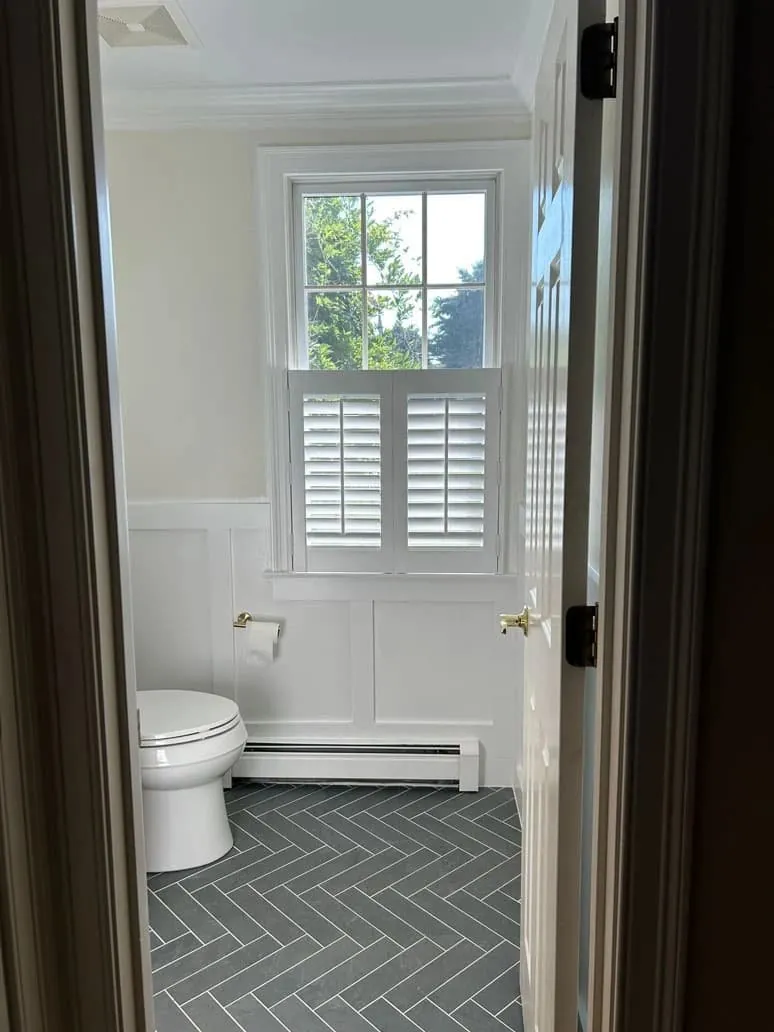
In every one of them, the material matters. Palm Beach is polysatin with no wood inside, so it keeps its shape in a humid room and wipes clean. Painted to match the NewStyle or Heritance in the rest of the house, it looks like part of the same set.
A powder room on the front of the house is a good spot for a cafe layout, with panels on the lower sash only, so the room is private and still gets the daylight from above.
Day to day with shutters
Shutters ask very little of you once they are up. There are no cords to tangle or wear, nothing to lower and raise each morning, and no fabric to fade. You tilt the louvers with a touch, and the panels swing open on their hinges when you want to clean the glass or open the window wide on a warm day.
Cleaning is simple: a duster or a soft cloth along the louvers now and then. On a wooded lot, where pollen and fine debris drift in through open windows each spring, that quick wipe keeps them looking new. Palm Beach in the bathrooms and laundry can be wiped with a damp cloth.
If a hinge loosens or a louver gets knocked out of line years from now, we repair blinds and shades as well as fitting them, so you are not left to sort it out alone.
Choosing a finish in shaded rooms
White is the most popular choice in Westwood, and the trees are part of the reason. A white or soft white shutter reflects the filtered light back into the room and keeps a shaded space feeling fresh. In rooms that get more sun, off-whites and soft grays work well, and a stained Heritance finish suits a study or a front room with natural wood trim.
Color looks different under a canopy than anywhere else, so we hold finish samples against your trim in the rooms themselves. When choosing plantation shutters in Westwood, MA, it is worth seeing the samples in both the brightest and the darkest rooms of the house before settling on one finish for all of them.
A Gallery dealer that comes to you
Blinds & Designs is a Hunter Douglas Gallery dealer, the brand’s own title for dealers who meet its standards. For shutters that means every collection, louver size, frame and finish, brought to your house as samples and planned with you room by room.
Our installers are certified by Hunter Douglas. We also carry Hunter Douglas shades, blinds and drapery, handle PowerView motorization, and repair blinds and shades you already own.
For other rooms, see our cellular shades in Westwood or motorized blinds in Westwood, the main plantation shutters page, or everything we offer on our Westwood page.
Questions from Westwood
Will shutters make my shaded rooms darker?
They can be planned to do the opposite. Wide louvers opened flat let through nearly all the light the window offers, a white finish reflects it back into the room, and the panels swing fully open on dark days.
Can I adjust shutters for the seasons?
Yes, and that is one of their strengths. Open the louvers flat in summer under the leaves, tilt them against the low winter sun once the trees are bare, and close them at night.
Do I need the same louver size in every room?
Not necessarily. Most houses share one size for a consistent look, but a wider louver in the family room and a medium one in the bedrooms works well if the finish matches.
Is there a showroom near Westwood?
Westwood is in our shop-at-home area, so we bring the samples to you. If you would also like to visit a showroom, the Franklin showroom is the nearest.
What does the estimate cost?
Nothing. After we measure your windows, we give you a free estimate with no obligation.
Book a time that suits you
Request a consultation and we will bring shutter samples to your house, look at the light in each room, measure and leave you with a free estimate. If you would like to talk first, use the call button.