
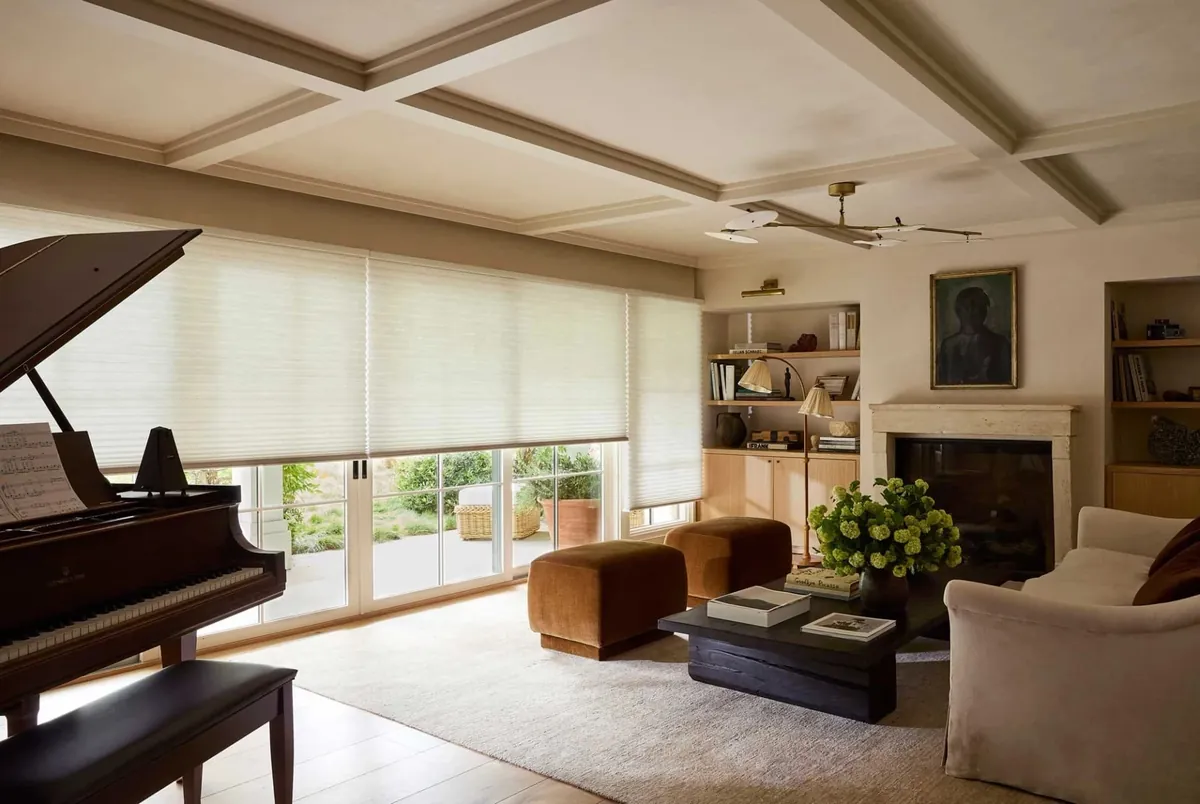
Long glass, low sills and heavy shade
Around Lake Massapoag, Sharon’s houses sit on wooded lots well back from the road. Many are colonials; a good number are mid-century contemporaries, built to open the rooms to the woods with long runs of glass and sills set close to the floor. Then the trees grew. Under that heavy canopy, rooms are often darker than their window area suggests, even with a whole wall of glass. Choosing cellular shades in Sharon, MA, is mostly about working with that light, not fighting it.
A honeycomb shade is well suited to the job. In a pale light-filtering fabric it glows when lowered, so a shaded room keeps what daylight it has. Its cells hold a still layer of air against the glass, which matters on a house with so much of it: long runs of glass lose a lot of warmth on a winter night and let in plenty of heat when the afternoon sun breaks through the leaves.
The way to choose is in the room itself, and that is how we work in Sharon. Our consultations come to you, with the samples in the van.
Cellular shades in Sharon, MA, for wooded lots
Three choices that come up again and again in Sharon’s contemporaries and colonials.
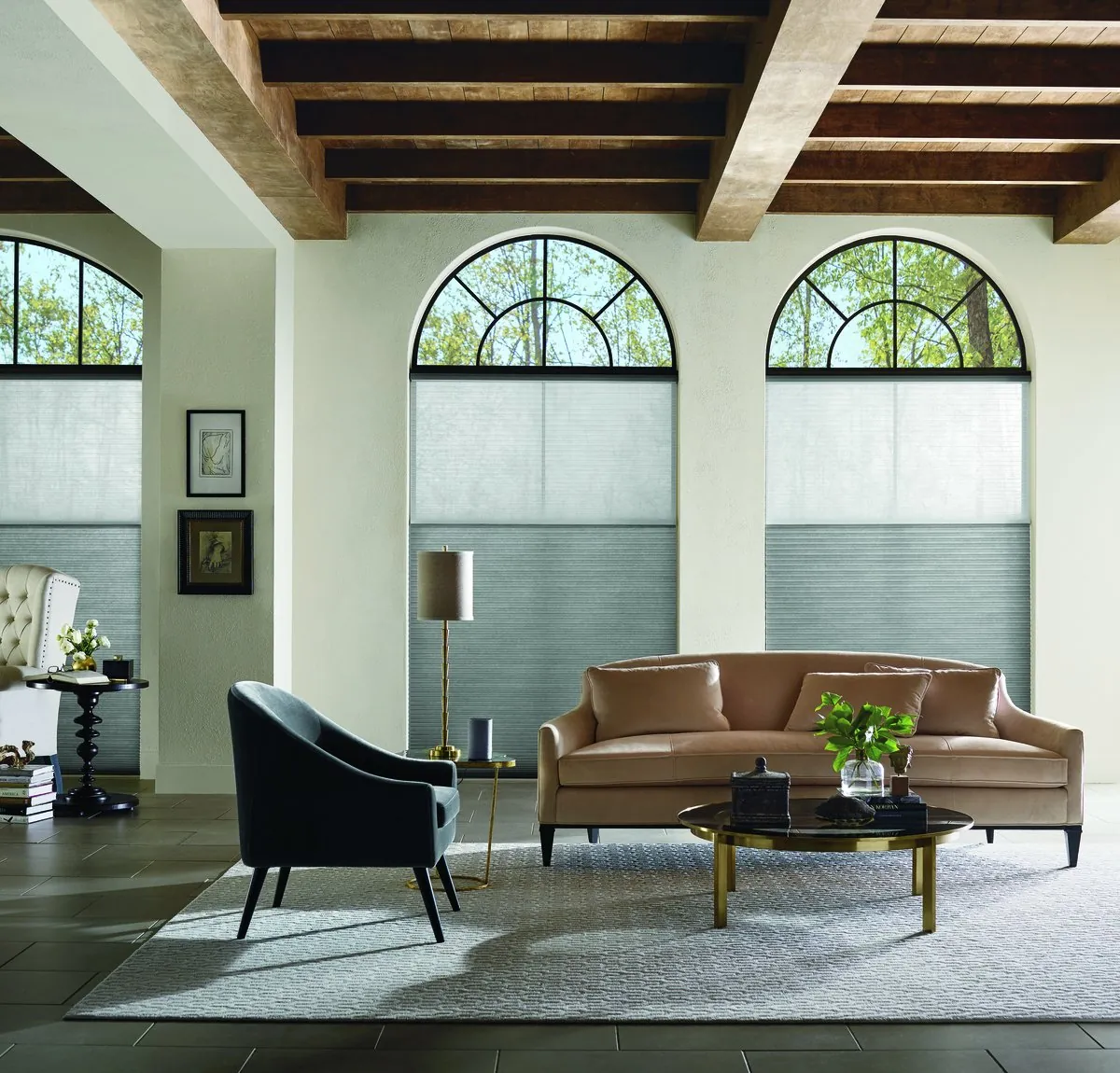
Top-down, bottom-up for dim rooms
Lower the shade from the top to let in the brightest part of the sky over the trees, while the lower glass stays covered.
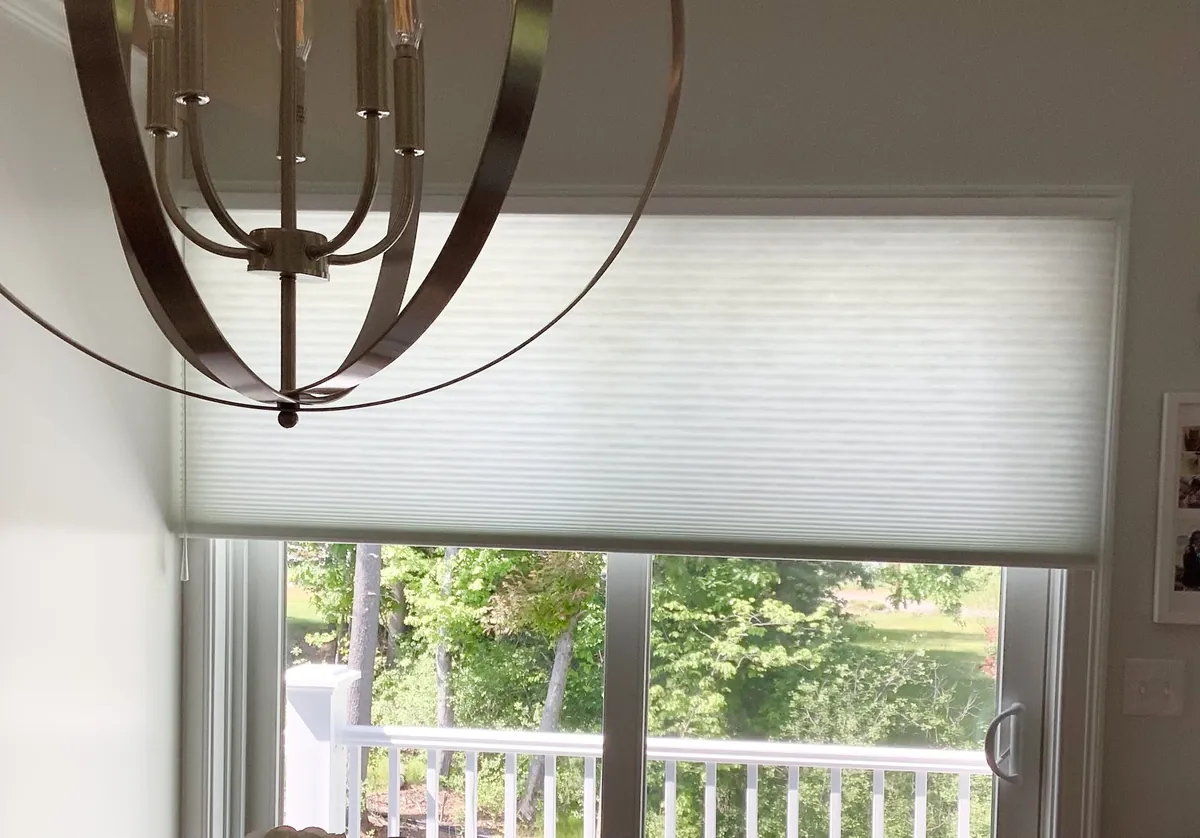
Vertical honeycomb on sliders
For the doors that open a contemporary onto its deck, a honeycomb that draws aside and leaves the doorway clear.
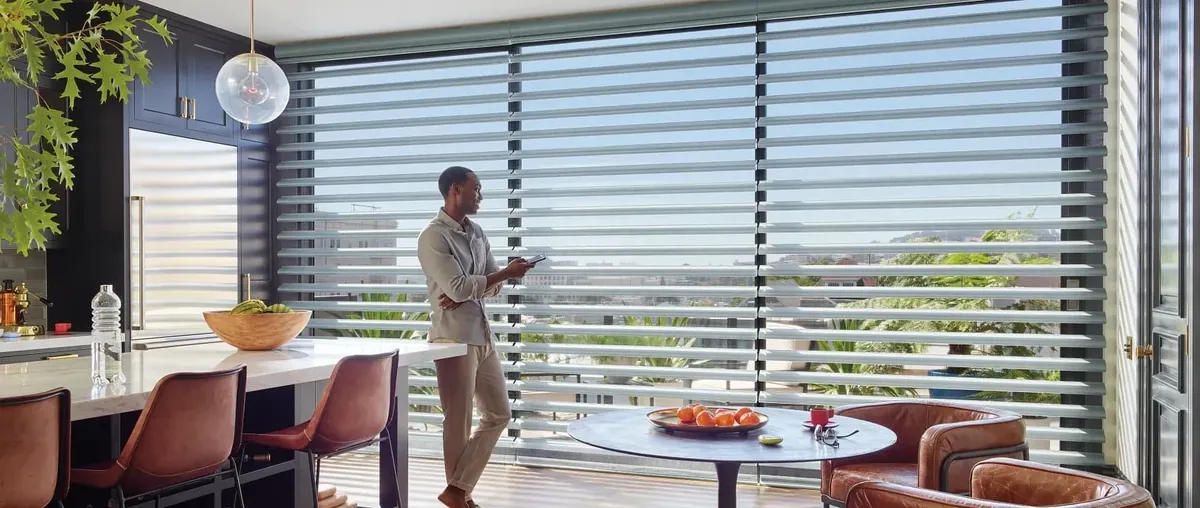
PowerView on long runs
Move a whole wall of shades together from a phone, a remote or a schedule, rather than one at a time.

Shop at home, with the samples at your door
Sharon is served from our shop-at-home territory, so the consultation happens in your house rather than at a counter. Our vans carry the honeycomb range, which means the samples arrive at your windows: you see each fabric under your own trees, against your own walls, at the time of day the room is used.
That is the right way to choose for a house like this. A fabric that looks bright in a shop can look gray under a heavy canopy, and a run of glass across a contemporary living room needs to be seen as a whole. Our Canton shop-at-home page explains how the service works across the area.
If you would like to see shades in person before the visit, the nearest of our showrooms is the Franklin showroom. It is entirely optional; most Sharon projects are chosen and measured at home from start to finish, and the estimate is free either way.
Mid-century contemporaries and their glass
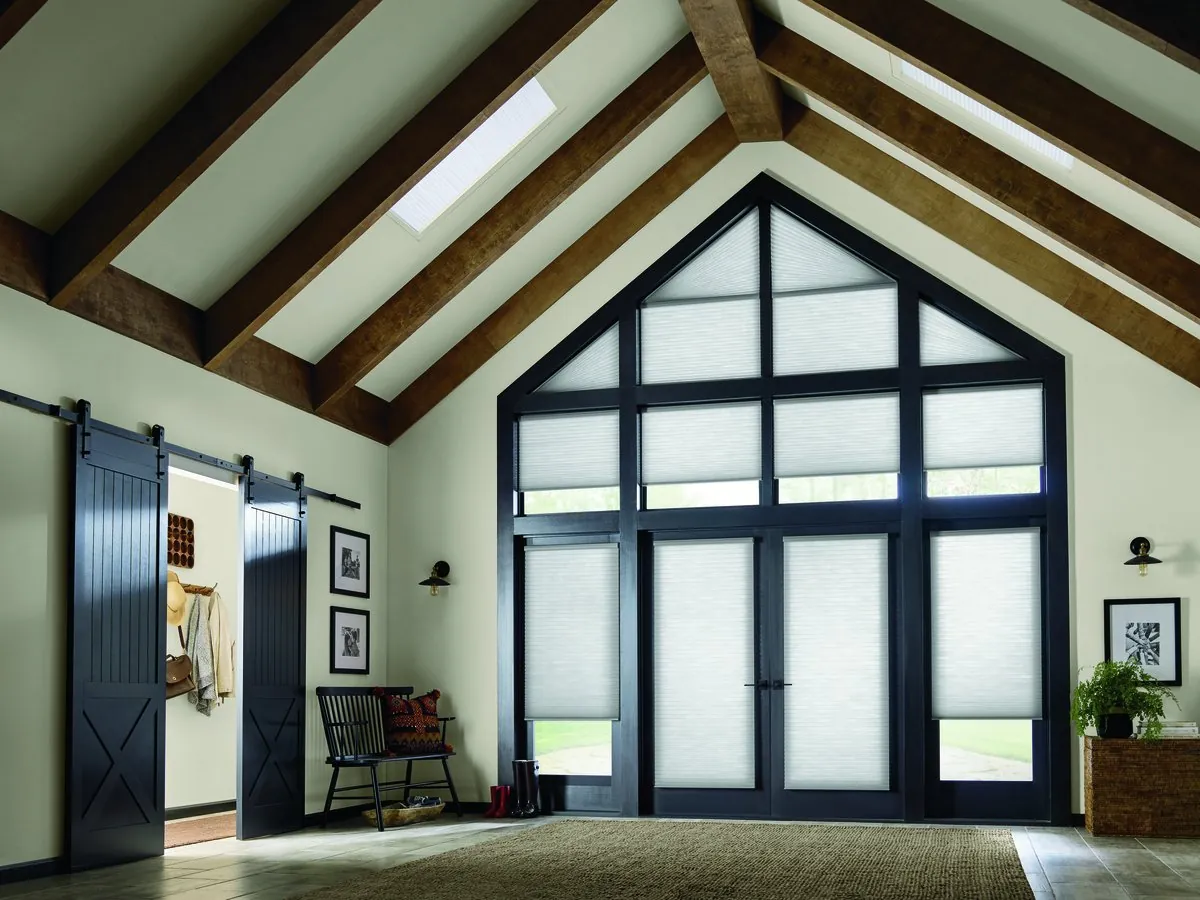
The contemporaries around the lake were designed around the view. Living rooms often have a long, uninterrupted run of windows, sometimes from wall to wall, with sliders leading to a deck. The architecture depends on that glass reading as one continuous surface.
A honeycomb shade respects that. On a long run, each window gets its own shade, made to its own opening, and the headrails are set to one line so the shades rise and fall as a single band. Lowered together, the run reads as one soft wall of light. Raised, the shades fold into slim stacks and the glass returns to the woods.
Where the run is too long to lift by hand comfortably, PowerView lets you group every shade in the room and move them all at once. A schedule can lower the sunny side at the hour the sun reaches it and raise it again later, which on a house with this much glass is often the most useful feature of all. We plan how each motor is powered at the visit, once we have seen the wall.
Low sills and what they change
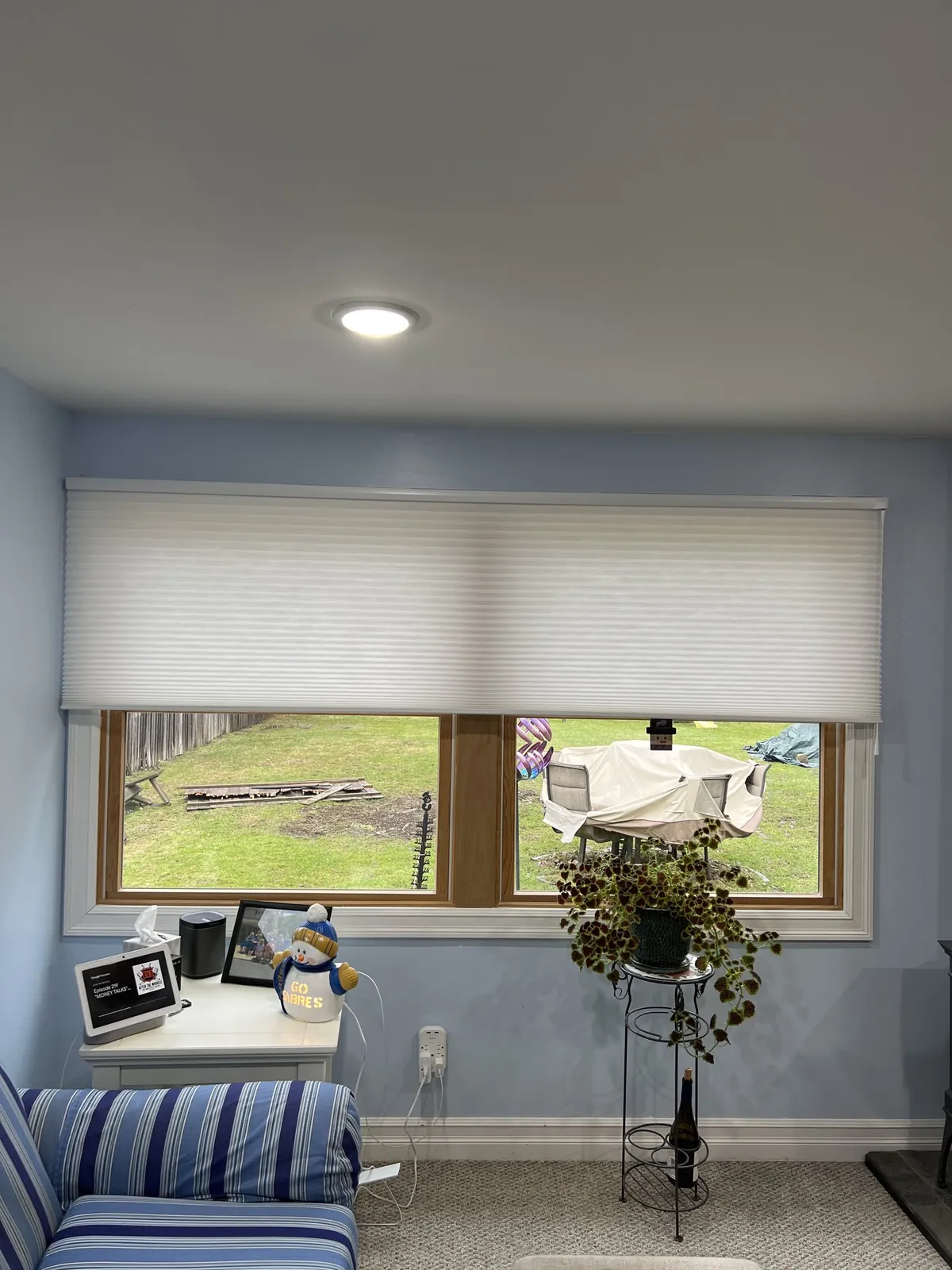
Many of these houses have sills set unusually close to the floor, so the glass begins near your knees rather than at your waist. It is a lovely way to bring the woods into the room, and it changes how a shade sits. A lowered shade comes down almost to the floor, furniture often sits right in front of it, and the bottom rail is in easy reach of everyone in the house.
We plan for that. Each shade is measured to stop just above its sill, so it hangs cleanly rather than resting on anything below. Where a sofa or a bench sits against low glass, we talk through how you will reach the shade, and whether a top-down, bottom-up shade or PowerView would make it easier to use day to day. On a low window facing the deck, a light-filtering fabric gives privacy at seated height while still letting the room glow.
Rooms that are darker than they look
The deep setbacks and heavy tree cover around Sharon create a particular kind of room: one with plenty of glass and not much light. The canopy filters the sun before it reaches the house, the north side gets very little direct light at all, and in summer, when the leaves are full, even a wall of windows can leave a room feeling dim.
For those rooms the priority is to protect the light. A pale light-filtering honeycomb fabric is usually the starting point, because it spreads whatever daylight reaches it evenly across the room. A top-down, bottom-up shade lets you drop the top rail and admit the brightest part of the sky over the trees while keeping the lower glass covered from the deck. Heavy, dark fabrics are best kept for the bedrooms, where darkness is the goal.
In winter the picture changes. With the leaves down, low sun can reach far into the house. The same light-filtering shades soften that sun when it arrives, so one choice serves both seasons.
Decks, sliders and the back of the house
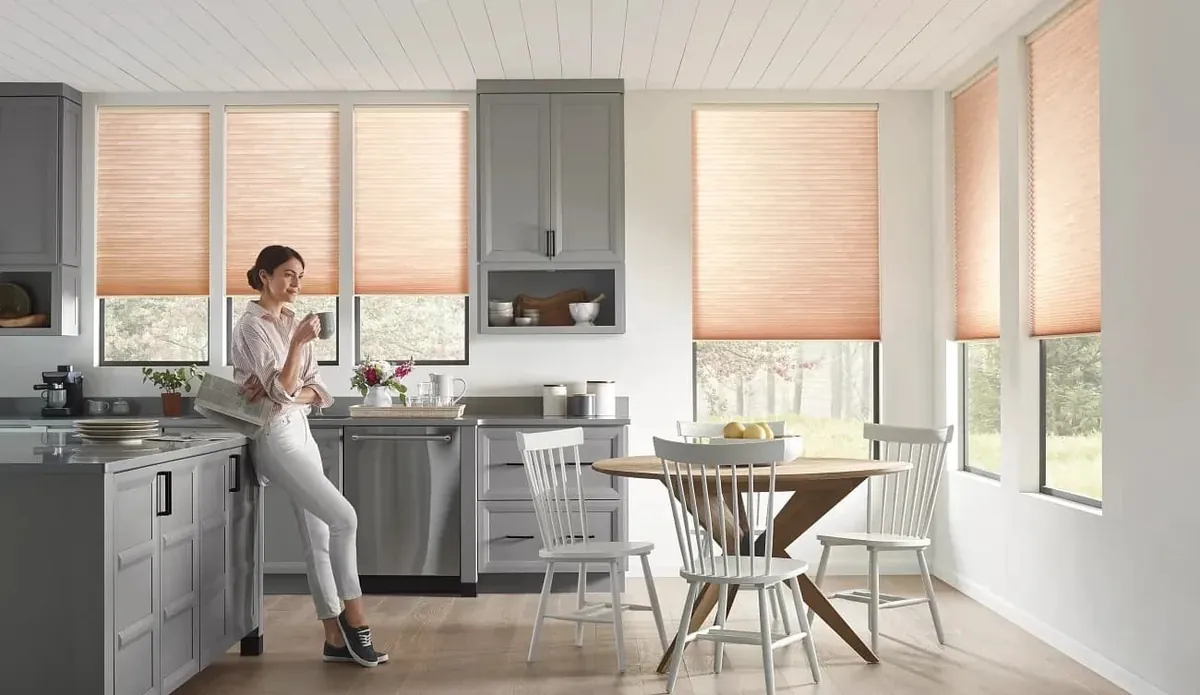
On most Sharon houses the back elevation faces the woods, and that is where the glass is concentrated: a slider or two onto the deck, wide kitchen windows, sometimes a breakfast area with windows on three sides. It is the part of the house that gets used most, and the part where the light changes most through the day as the sun moves behind and through the trees.
Sliders take a vertical honeycomb shade that draws to one side, so the door opens without anything to lift, and the fabric matches the windows on either side. On a wall that mixes a slider with long windows, we set the windows and the door to one line and one color so the back of the room reads as a single surface. With the deck just outside, a light-filtering fabric gives privacy from the yard after dark while keeping the room bright by day.
Light off Lake Massapoag
Houses that face Lake Massapoag have a different light problem from the rest of town. On a bright day the water reflects the sun back up into the rooms, and the glare can make a screen or a page hard to read even when the sun itself is out of the window.
A light-filtering fabric lowered fully softens that reflected glare while still showing the shoreline in outline. A top-down, bottom-up shade gives more control: lower it from the top until the glare stops and keep the lower glass open to the water. On a long run of lake-facing windows, PowerView can lower the shades together at the hour the reflection is strongest.
Colonials on the wooded lots
Not every Sharon house is a contemporary. Colonials on the wooded lots have more conventional windows: standard modern openings, paired windows in the bedrooms, a slider at the back. They share the tree cover and the setbacks, though, so the same fabric thinking applies. Light-filtering fabrics in the main rooms keep them bright under the canopy. Room-darkening fabrics in the bedrooms handle the early sun that breaks through in summer.
A colonial’s front elevation is usually symmetrical, with matching windows either side of the door on both floors. Even set far back from the road behind trees, it looks best with every front shade in one outward color and stopping at one height. Inside, the rooms behind those windows can still take different opacities, a light-filtering fabric in the living room and a room-darkening one in the bedroom above it, without the front of the house looking uneven from the drive.
Standard openings make colonials simple to measure and fit, and easy to finish in stages. Many households with cellular shades in Sharon start with the bedrooms and the coldest rooms, then return for the living spaces.
Fabric and opacity for a shaded house
A short guide to the choices we make most often in Sharon.
- Contemporary living rooms with long glass: a pale light-filtering fabric, the same across the whole run, often on PowerView.
- North-facing and heavily shaded rooms: the lightest light-filtering fabric you like, sometimes on a top-down, bottom-up shade.
- Bedrooms: room-darkening fabric, because summer sun through the leaves arrives early.
- Lake-facing rooms: light-filtering fabric or top-down shades to soften reflected glare without hiding the water.
- Kitchens: an Applause fabric that keeps the room cheerful under the trees.
Winter on a house with walls of glass
A long run of glass is a pleasure in summer and a challenge in January. Every pane gives up warmth to the cold outside, and with so many panes in one room, the effect adds up. The air near the glass cools and drifts across the floor, and the far side of a contemporary living room can feel draughty on a still night.
Lowering a run of honeycomb shades at dusk changes that room. The pocket of air in each cell keeps the warm air in the room away from the cold glass, and the draught along the floor fades. Because the shades line up across the run, the room looks finished with them down, not shut up. With PowerView, the whole run can lower itself at sunset on winter days.
Bedrooms under the canopy
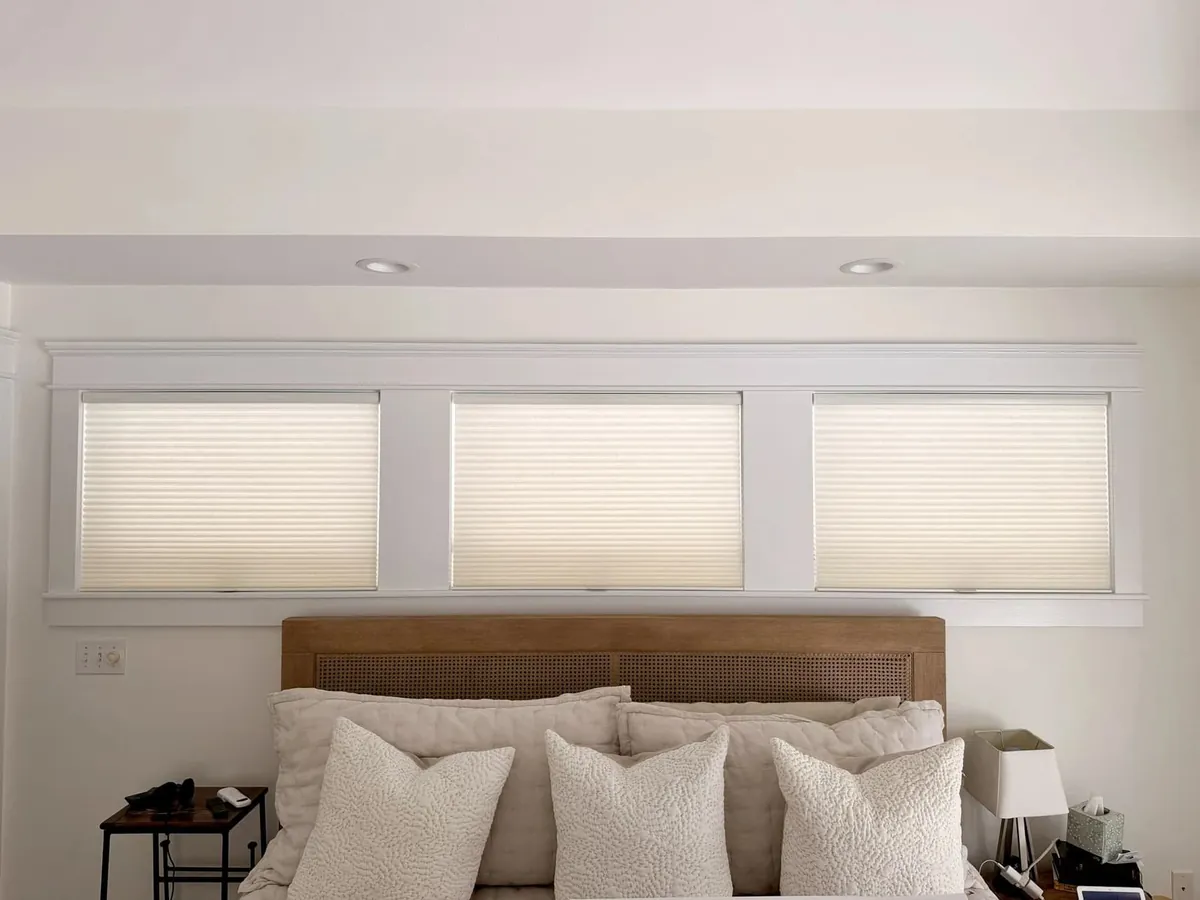
Bedrooms are the one place in a shaded house where darkness is welcome. Even under heavy tree cover, summer sunrise finds its way through the leaves, and a bedroom with a long window or a low sill can be bright far earlier than anyone wants to be awake. In winter, with the leaves down, the morning light arrives unfiltered.
A room-darkening honeycomb fabric deals with both. Set inside the frame, it leaves only a slim gap at the edges, and the cells still do their work against the cold glass on winter nights. Many households planning cellular shades in Sharon start with the bedrooms for exactly that reason, then move to the living spaces where the aim swings back to keeping the light.
Measuring a long run of windows
A run of glass looks finished only when every shade along it lines up, and that depends on how it is measured.
- Each window in the run is measured on its own, width and height at several points.
- The run is then measured as a whole, so the headrails can be set to one line even if the frames vary slightly.
- Sill heights are checked along the run, since low sills are not always level with each other.
- Any furniture in front of low glass is noted, so each shade stops cleanly above its sill.
- Fabric, opacity and any PowerView grouping are confirmed with you before ordering.
Duette and Applause in a Sharon house
Both are Hunter Douglas honeycomb shades, and their cells work the same way. Duette offers the broader collection, including the vertical shade for sliders and the sizes a long contemporary run can need. Applause has its own palette and suits the standard windows of a colonial.
A contemporary might take Duette across its living room glass and on the deck sliders, with Applause in the bedrooms. A colonial might use Applause through most of the house and Duette on the slider. Our Duette honeycomb shades and Applause honeycomb shades pages go into each line, and the main cellular shades page shows the full range.
From the first visit to fitted shades
Here is how a Sharon project usually runs, from booking to the last shade.
- You book through Request a Consultation, or use the call button.
- A consultant arrives with the honeycomb samples, and we start at the room with the most glass or the least light.
- Fabrics are compared against your own windows, across the whole run where there is one.
- Every opening is measured, low sills included, and each long run is measured as a set.
- PowerView is discussed for long runs and any glass that is awkward to reach.
- You receive a free estimate and decide when you are ready.
- Our certified Hunter Douglas installers fit the shades, line up each run and show you the controls.
You can read about what happens at an in-home consultation and what happens on installation day. If you are redoing a room, our interior design consultations can look at color and fabric alongside the shades.

A Gallery dealer for a house full of glass
Blinds & Designs is a Hunter Douglas Gallery dealer, a title Hunter Douglas gives dealers who meet its standards. For a Sharon contemporary with a long run of glass and sliders to the deck, that means the whole honeycomb collection, motorization included, at one consultation.
Our installers are certified by Hunter Douglas, and we also repair blinds and shades you already own. For other rooms we offer shutters, blinds, roller shades and roman shades. See roller shades in Sharon, motorized blinds in Sharon, or our Sharon page for everything we do in town.
Questions from Sharon
Our living room has a long wall of glass. How do you handle it?
Each window gets its own shade, made to its opening, with the headrails set to one line so the run moves as a single band. PowerView can group them so the whole wall rises and falls together.
Our sills are very low. Will the shades get in the way?
We measure each shade to stop just above its sill and plan around furniture that sits in front of low glass. A top-down, bottom-up shade or PowerView can make low windows easier to use.
The trees already make our rooms dark. Won’t shades make it worse?
Not with a pale light-filtering fabric, which glows when lowered and spreads the daylight evenly. A top-down shade can also let in the brightest part of the sky while covering the lower glass.
Do I need to visit a showroom to choose?
No. Sharon is served by our shop-at-home service, so the samples come to your house. If you want to look first, the Franklin showroom is the nearest.
Is the estimate free?
Yes. After measuring, you receive a free estimate for the shades you chose, with no obligation.
See the fabrics under your own trees
The clearest way to choose cellular shades in Sharon, MA, is to stand at your own long run of glass, under your own canopy, with the samples in hand. Request a consultation and we will bring the honeycomb range to the house, measure every window, low sills and long runs alike, and leave you with a free estimate.