
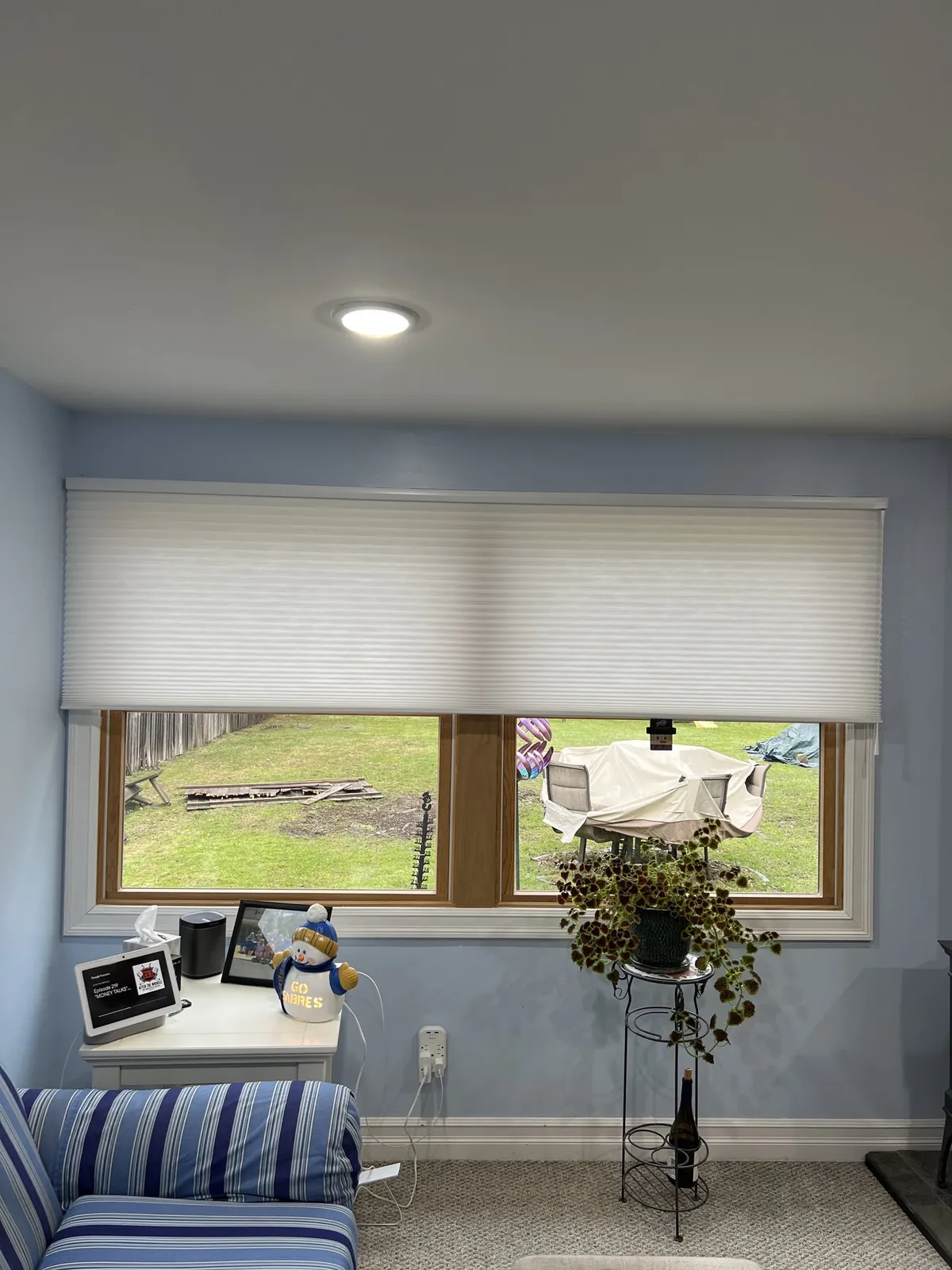
Small old sash on Washington Street, walls of glass on Powder Point
Duxbury asks two opposite things of a window covering. Along Washington Street and down by the Nook, antique capes and Federal houses still have their original openings, and some of them are very small: a few panes of old glass set into a thick frame, often with a casing that is far older than anyone living in the house. Out on Powder Point it goes the other way. The rooms that face the water are glazed heavily, with big panes and doors chosen to bring the bay inside. Planning cellular shades in Duxbury, MA, means getting both of those right, and often in the same week.
The reason honeycomb shades suit both is the cell. Each pleat folds into a hollow pocket, and when the shade is lowered those pockets hold air that hardly moves. That layer sits between the cold glass and the room. In a small antique window it softens the chill that a thin pane lets through. In a water-facing room with glass on two walls it takes the edge off a winter evening and slows the heat of a summer afternoon.
Inland, on the wooded lots, the newer houses are larger and their windows are taller, with transoms, two-story entries and sliders to the deck. They have their own list of questions, and we cover those further down.
Three ways honeycomb shades fit a Duxbury house
We bring the Hunter Douglas honeycomb range to your home, so you can choose with the samples in your own light. Most Duxbury orders lean on these three.
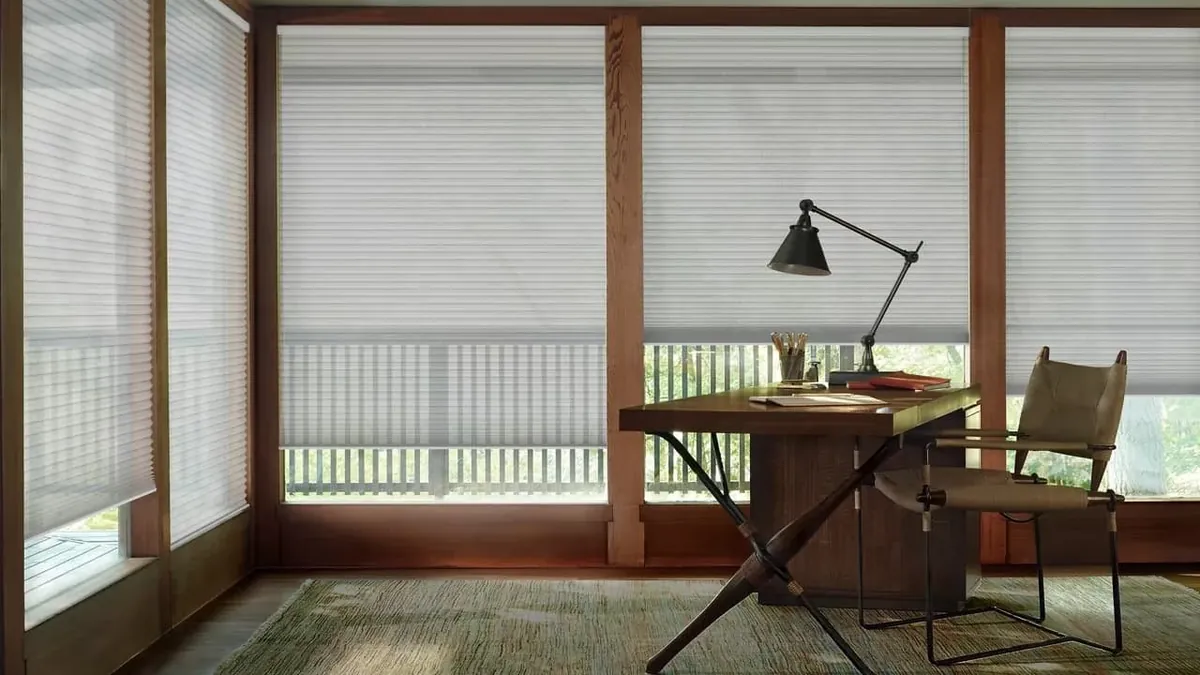
Duette in a small antique opening
Duette can be built narrow and short, and its compact stack all but disappears into the top of an old window when raised.
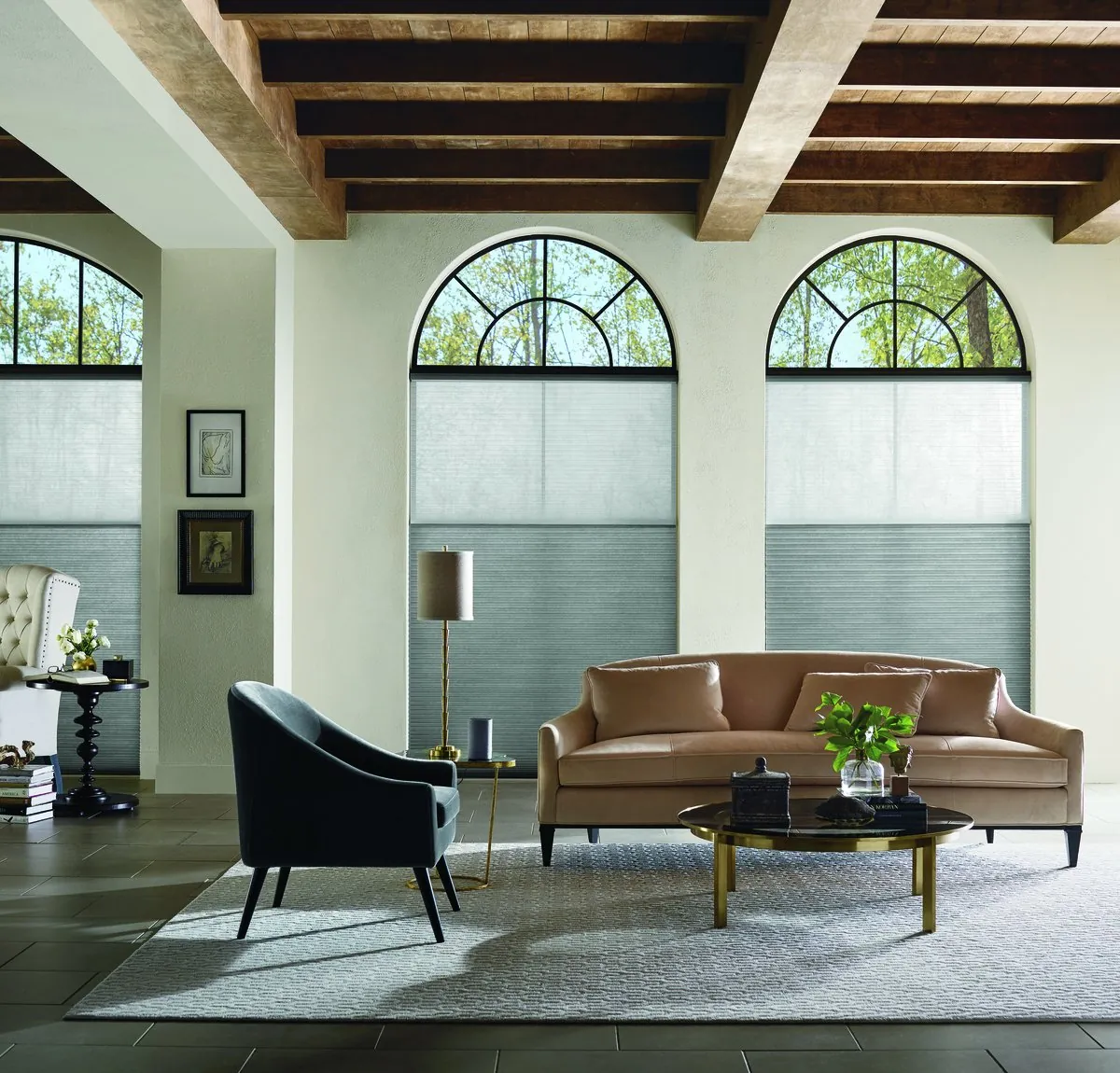
Top-down for the water rooms
Drop the shade from the top to keep the sky and the bay in view while the lower glass stays covered against glare.
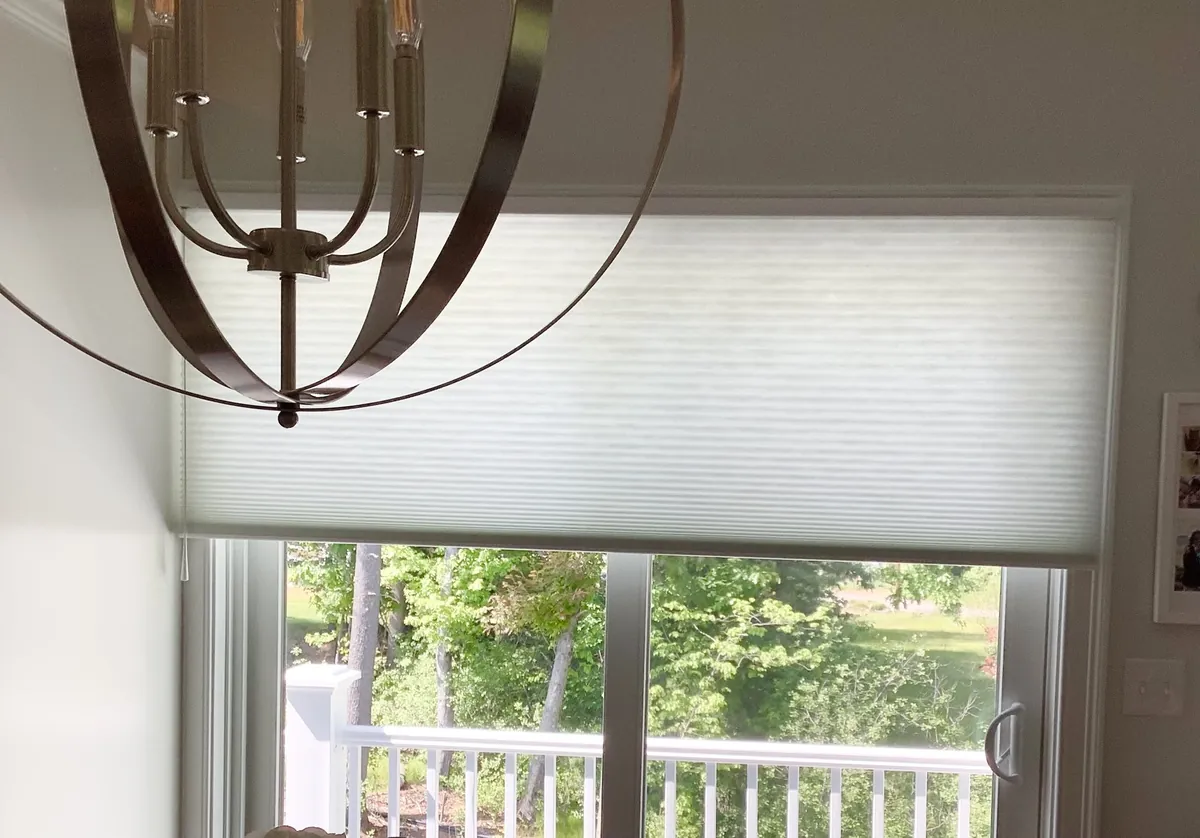
Vertical honeycomb for big sliders
A shade that travels sideways across a slider, so the door to the deck holds warmth like the windows beside it.
Antique capes and Federal houses near the Nook
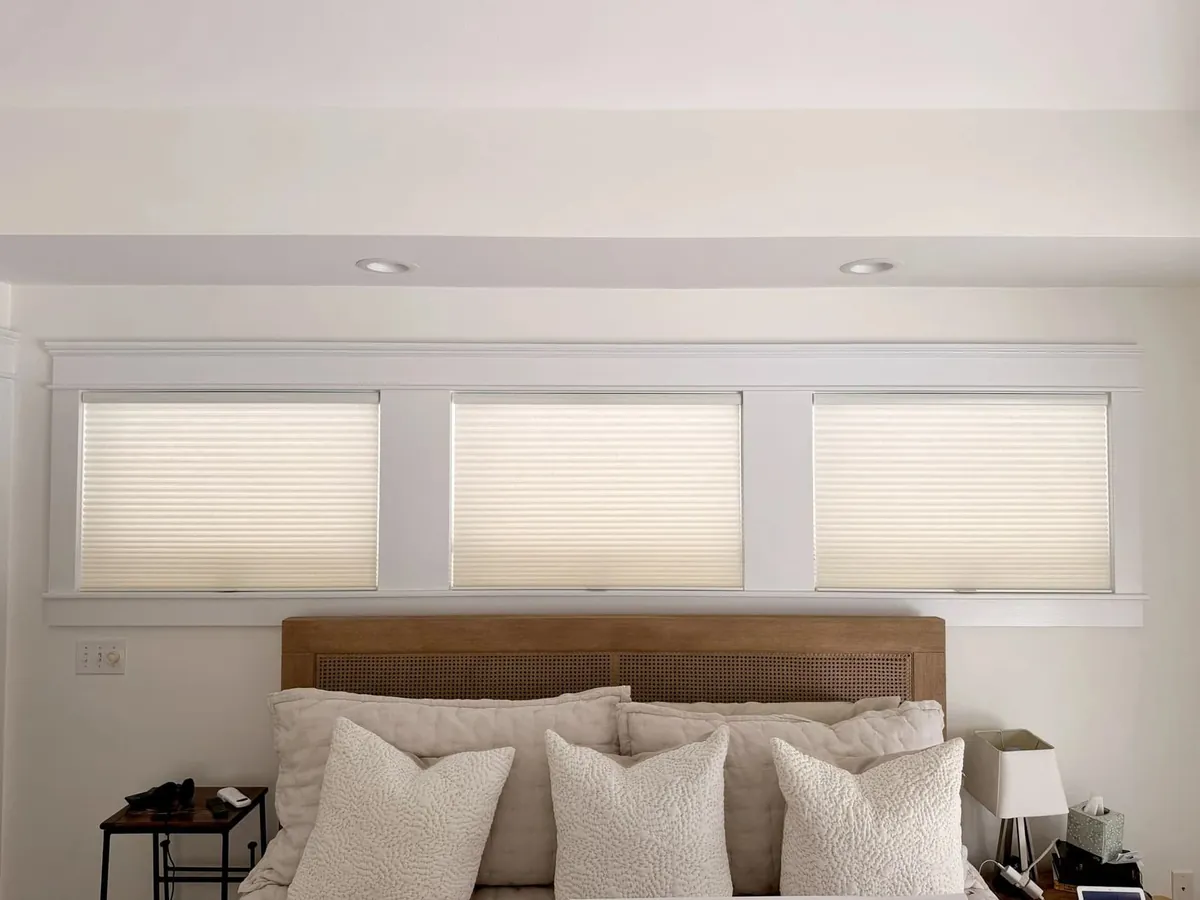
The oldest houses in town were built when glass was expensive and windows were kept small. A cape on Washington Street may have openings so modest that a standard shade would look clumsy in them, and a Federal house nearby often has deep window reveals with original trim that the owners have no intention of covering. A shade for these windows has to be neat, narrow and quiet.
An inside mount usually suits them best. The headrail sits inside the opening, the casing stays fully on show, and when the shade is raised the stack is tucked up under the head of the frame. Duette is the line we reach for first in these rooms because it can be made to fit small openings and still look proportioned.
The catch with old frames is that they are rarely square. A long life of settling can leave a window a little wider at the bottom than at the top, or a little out of level. We measure each opening at several points across its width and height and check the depth where the headrail will sit, because an old sash with its stops and parting beads can leave less room than you would expect. Where an inside mount would pinch, mounting on the face of the casing is the better answer, and we will say so at the window rather than after the order.
Why a small window still matters
It is easy to think a tiny window cannot make much difference to how a room feels. In an antique house the opposite is often true. Those windows tend to have original or early glass, single panes in old sash, and a room with three or four of them can lose a surprising amount of warmth on a January night. Upstairs bedrooms under the roof feel it most.
Honeycomb shades give those windows a second layer without changing a thing about how the house looks from the street. From outside you see the old sash. From inside you see a soft fabric that holds the warmth in the room. Single-cell and double-cell versions are both available, and we bring both so you can compare the weight and feel of the fabric in your own bedroom.
For the smallest openings we often suggest a cordless lift. There is no cord to hang down a short window, and you simply raise or lower the bottom rail by hand.
Powder Point and rooms built around the water
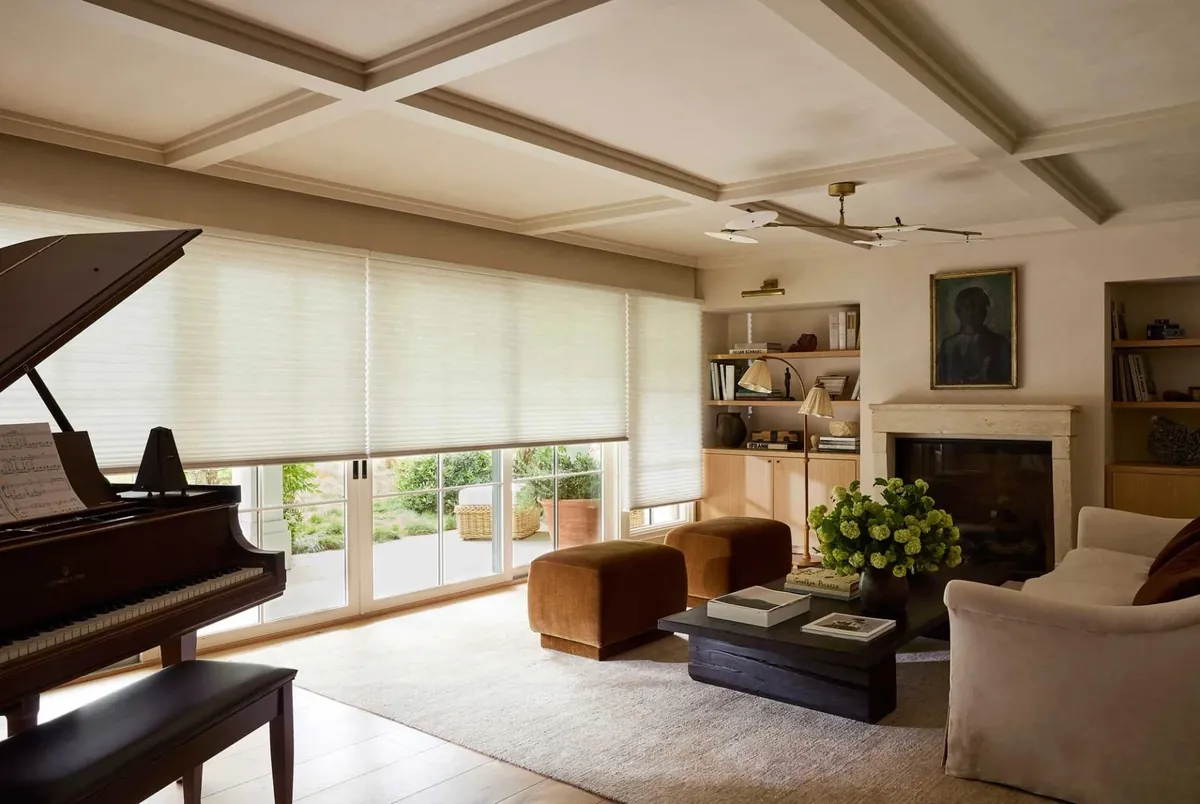
On Powder Point the problem flips. These rooms were designed to look at the water, and they are glazed heavily: wide picture windows, French doors, corner glass and sometimes clerestory panes up near the ceiling. That much glass brings in a lot of light, and with it a lot of glare off the bay, especially on a bright winter morning or a late summer afternoon.
Nobody wants to cover a view like that, so the shade has to earn its place. A top-down, bottom-up honeycomb lets you lower the shade from the top just far enough to cut the sun while the lower part of the window stays clear, or the reverse, covering the bottom for privacy while the sky stays open. A light-filtering fabric keeps the room bright and calms the glare without making it dim.
For corner windows we line up the headrails so the shades meet cleanly and move together. For a run of tall panes we can build several shades on one headrail, or keep them separate so you can treat one end of the room differently from the other.
Fabric and color in a room full of reflected light
Light bouncing off the water is stronger than light coming over a garden, and a room on Powder Point gets it from more than one direction. That affects which fabric you will be happy with in a few years’ time. Pale, neutral fabrics handle strong daily sun gracefully, while deep colors on a south or west window facing the bay show the sun’s effect sooner. Choosing cellular shades in Duxbury for a water room is mostly a question of how bright you want the room to stay and how the fabric looks from outside, since a shade on that much glass is part of the house’s face toward the water.
We bring light-filtering, semi-opaque and room-darkening samples so you can stand in the room and compare them at the glass. Light-filtering fabric turns the glare into a soft, even glow. Semi-opaque gives a little more privacy for a room seen from the beach or the road. Room-darkening suits a bedroom with water views that wakes you too early in June.
Larger newer houses on the wooded lots inland
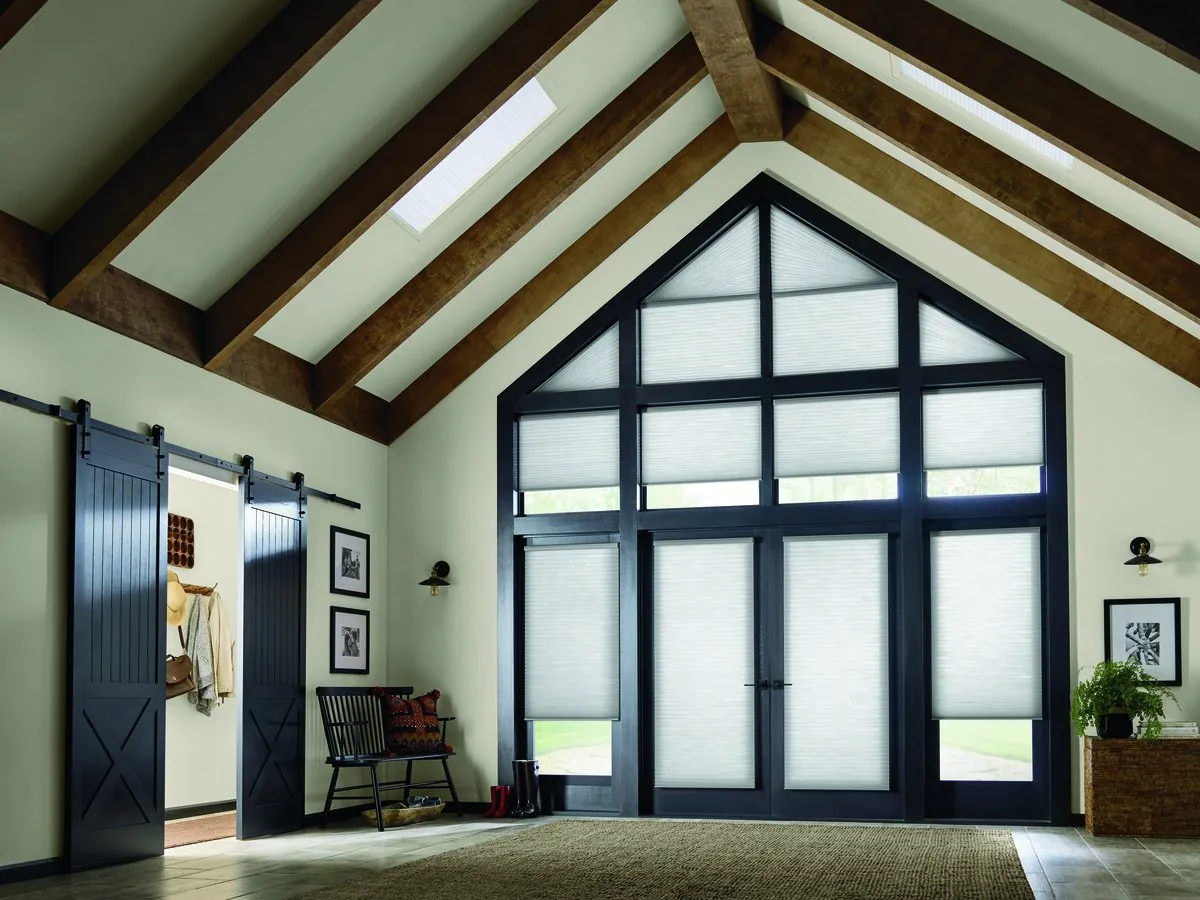
Away from the water, Duxbury’s newer houses sit on wooded lots, and they are generally larger, with bigger rooms and taller windows. Family rooms open onto decks through wide sliders. Entries and stairwells often have tall windows or transoms well above head height. Primary bedrooms may have a wall of glass facing the trees.
The trees help with summer sun, but those big openings still lose warmth on a cold night, and honeycomb shades handle that the same way here as anywhere: the cells hold air between the glass and the room. The differences are scale and reach. Duette can be made in very wide and very tall sizes, and specialty shapes cover angled tops and arches. A vertical honeycomb shade covers a slider and stacks to one side when you want to walk out to the deck.
Bedrooms on these lots can be darker than you expect in the day because of the trees, then bright when the leaves come down. Room-darkening fabric suits a bedroom that needs to stay dim year round; a light-filtering fabric works better in a family room where you want the daylight.
Open-plan rooms in these houses bring their own puzzle: a kitchen, eating area and family room may share one long wall of windows and a slider, each part of the room wanting something different. We keep one fabric and color across the whole wall so it reads as one, then vary the lift, with top-down shades over the sink and a vertical honeycomb on the slider, so each part of the room works the way you use it.
PowerView for the glass you cannot reach
Two-story windows inland and clerestory panes on Powder Point share one problem: you cannot get to them. PowerView motorization solves that. Each shade can be raised or lowered from a phone, a remote or a wall control, and you can group them so a whole wall of glass moves together. Schedules let the shades lower before the sun hits a water-facing room in the afternoon and rise again in the morning.
Motorization also suits the small antique windows in an unexpected way. With no cord at all, the window looks as clean as it can, which matters when the trim is the point of the room. At the visit we plan how each motor is powered and where any connection goes, so nothing looks added on.
You can read more on our motorized blinds and shades in Duxbury page if you are thinking about automating more than the honeycomb shades.
How a consultation runs in a Duxbury house
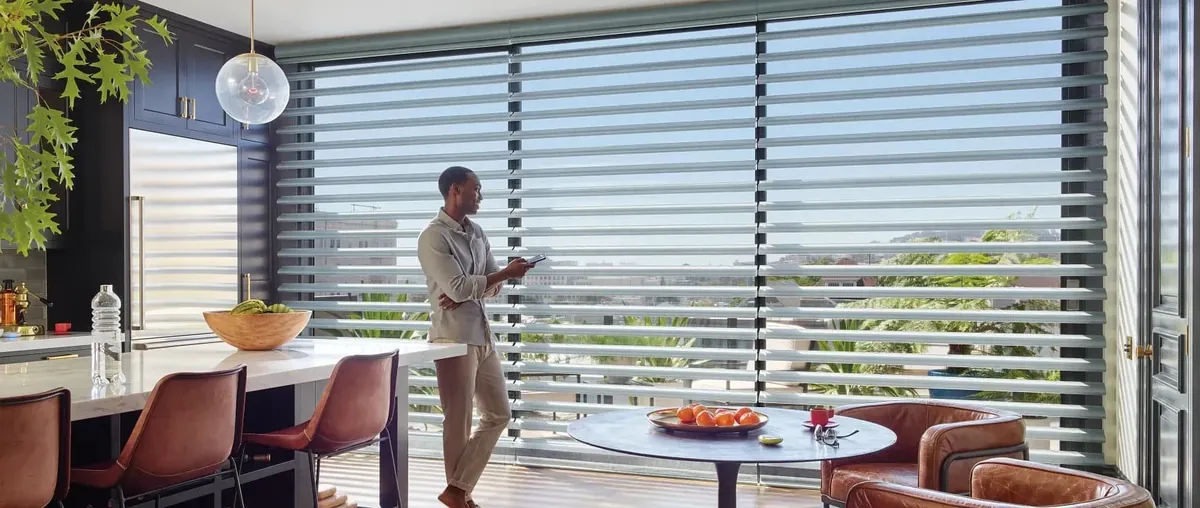
Our vans travel with the sample cases, which matters most in a town where the light in one room can be nothing like the light in the next. A typical visit goes like this.
- You request a consultation online or with the call button, and we set a time that works.
- We start in the rooms that bother you most: the cold upstairs bedroom, the glare-filled room on the water, the slider that nobody uses in winter.
- You hold honeycomb fabrics up to the glass and see how each one handles your light, morning side and afternoon side.
- We check each opening for depth, square and any hardware in the way, then measure.
- We talk through lift options for each window: cordless, top-down, bottom-up or PowerView.
- We write up a free estimate for the windows you want covered and leave it with you to think over.
If you want help with fabric and color across the whole house, ask about our interior design consultations. Our page on what happens at an in-home consultation goes through the visit in more detail.
Duette, Applause and which rooms get which
Duette and Applause are built on the same idea, a fabric folded into air-holding cells. Duette has the deeper catalog: more fabrics and pleat sizes, the vertical shade for sliders, and the specialty shapes that tall inland windows sometimes need. Applause has its own fabric palette and is a sensible choice for standard openings and secondary rooms.
A typical whole-house order for cellular shades in Duxbury might put Duette on the small antique windows at the front, where every detail of the fit is noticed, and Applause on the kitchen and the rooms at the back. On Powder Point the big water-facing glass usually goes to Duette for its sizes. We lay the swatches side by side so the choice is room by room, not all or nothing.
For more on each line see Duette honeycomb shades and Applause honeycomb shades, or the main cellular shades page for the whole range.
Fitting day
Certified Hunter Douglas installers hang every shade we sell. In a house with antique openings that takes patience, and on Powder Point or inland it often means ladders and long headrails.
- We check each shade against its window before a single bracket goes up.
- Brackets go into solid wood, not just the plaster or the drywall.
- Each headrail is set level, even where an old frame is not.
- Every lift is tested, top-down and bottom-up included, and any PowerView shades are paired and grouped.
- We show you how everything works and leave the room as we found it.
The result is cellular shades in Duxbury that look as though they came with the house, whether the house is one of the antiques near the Nook or went up on a wooded lot last year.

A Hunter Douglas Gallery dealer at your door
Gallery dealer is a title Hunter Douglas gives dealers who meet its standards, and Blinds & Designs holds it. and in practical terms it means the whole honeycomb range is open to you: every Duette and Applause fabric, the specialty shapes, the vertical shade and PowerView.
The people who fit your shades are certified Hunter Douglas installers. On an antique house that means brackets set into solid wood behind old plaster and a headrail levelled to a frame that may not be level itself. On a new house it means tall shades hung true and motors set up and tested before we leave.
If your house needs more than honeycomb shades, the same visit can cover the rest: see our plantation shutters in Duxbury, roman shades in Duxbury or everything we do in town on the Duxbury page. And if a shade you already own needs attention, we handle blind and shade repair as well.
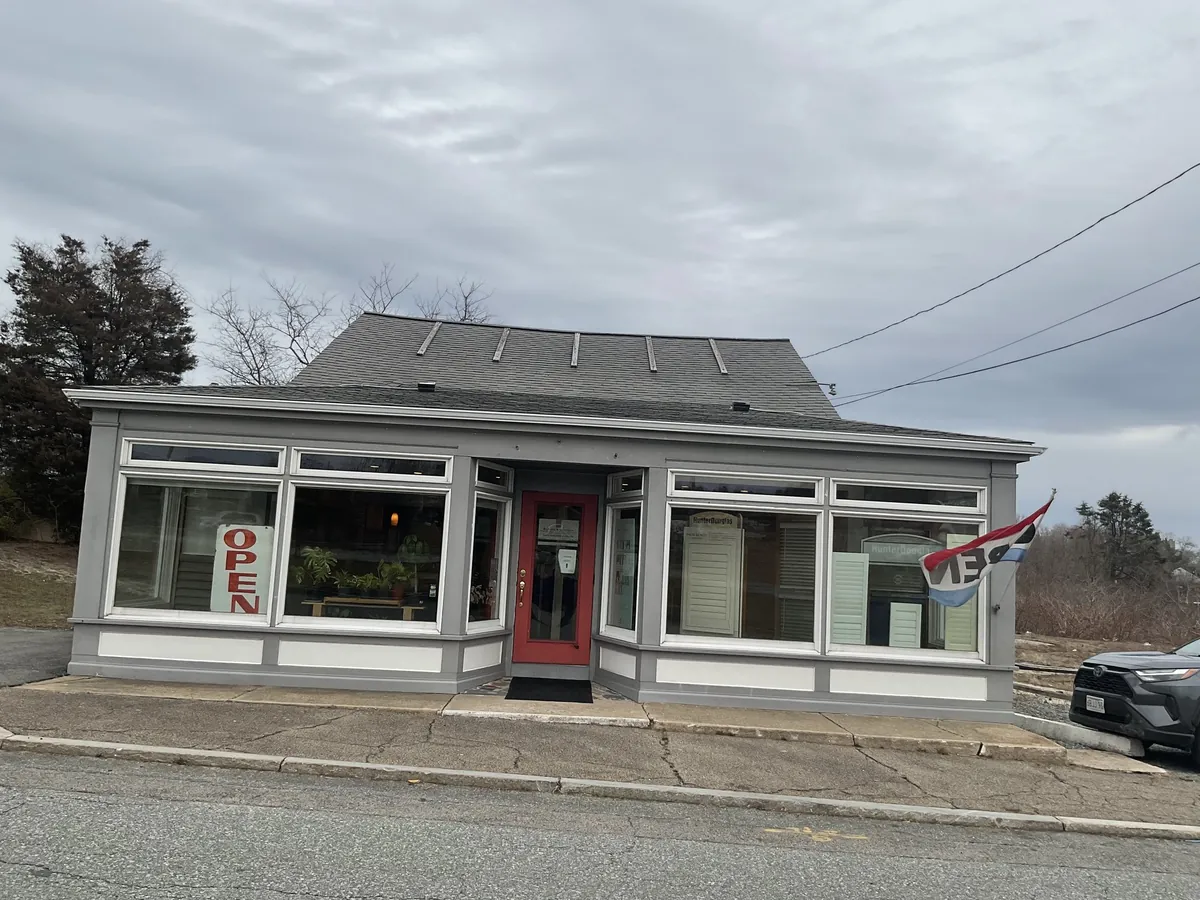
The Sagamore showroom is our nearest
For Duxbury, the nearest Blinds & Designs showroom is in Sagamore. Its address and opening hours are on the Sagamore showroom page, and the call button reaches the people there.
Most customers still start at home, because no showroom can show you how a fabric looks against your own trim or how it handles the light off the bay. A Federal parlor with deep reveals and a glass room on Powder Point need to be seen in place before anyone suggests a fabric. Either way, we can arrange it. Request a consultation and we will come to you, or call ahead and set a time to visit Sagamore.
Questions from Duxbury
Can honeycomb shades fit the very small windows in an antique cape?
Usually, yes. Duette can be made in narrow and short sizes, and an inside mount keeps the original casing in view. We check the depth of each old frame first, because sash stops and parting beads sometimes leave too little room, and suggest a slim outside mount where that is the better fit.
Will a shade block my view of the water?
Not if you choose a top-down, bottom-up shade. Lower it from the top to cut the glare while the lower glass stays clear, or cover the bottom and leave the sky open. Light-filtering fabric keeps the room bright either way.
What about the tall windows over the stairs in a newer house?
PowerView motorization raises and lowers shades you cannot reach, from a phone, a remote or a wall control, and can run them on a schedule. Duette is also made in the tall sizes those windows need.
Do cellular shades work on sliders?
A vertical honeycomb shade crosses the slider side to side and stacks out of the way when you open the door, so the slider holds warmth like the windows around it.
Is there a charge to measure and quote?
No. Measuring is part of the visit, and the estimate that follows is free, written window by window so you can weigh it at your own pace.
Start with a visit
You will know what cellular shades in Duxbury, MA, can do for your rooms once the fabrics are in your hands at your own windows, from the smallest antique sash to the widest pane facing the water. Book a visit and we will arrive with samples, take every measurement and write a free estimate before we go. Or visit the Sagamore showroom, our nearest.