
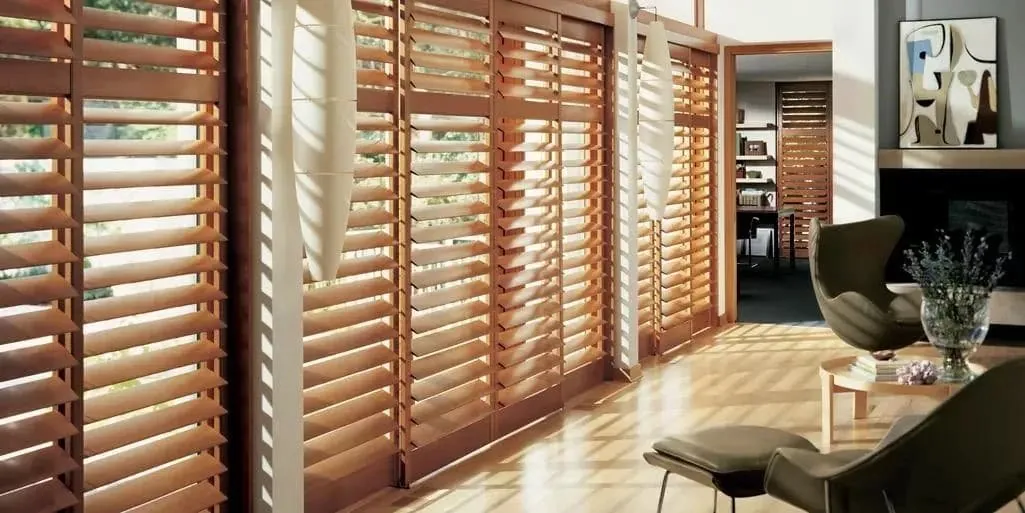
Long glass, low sills and a lot of shade
The houses around Lake Massapoag are mostly colonials and mid-century contemporaries set well back on wooded lots. Many of them have long runs of glass, sometimes a whole wall of it, and sills that sit low to the floor. With deep setbacks and heavy tree cover overhead, the rooms are often darker than all that window area would suggest. Planning plantation shutters in Sharon, MA, starts from that tension between plenty of glass and not much direct sun.
It also begins in your own house. Sharon falls within the territory we serve from Canton, which works as shop-at-home: rather than asking you to come to us, we bring the samples to your rooms, where the light and the windows actually are.
For a house like these, that matters. A louver width or a paint color that looks fine under bright lights can look completely different in a living room under tall trees, and the only place to judge it is in that room.
What the windows here ask of a shutter
Most Sharon shutter plans come back to three features of the housing. Each one shapes the layout, the louver width or the finish.
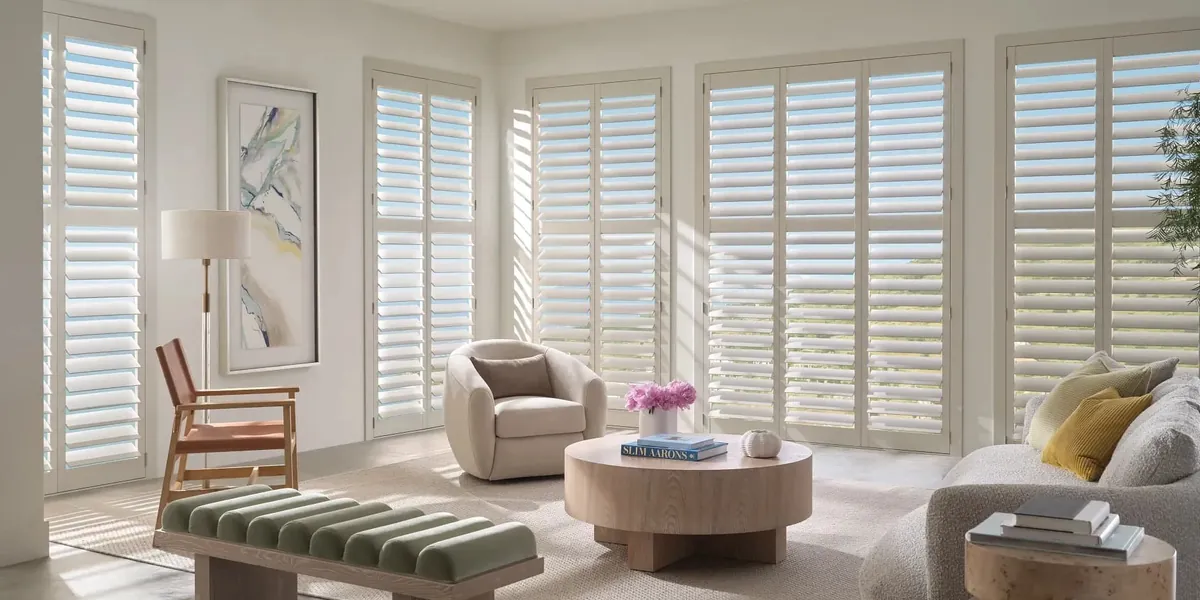
Long runs of glass
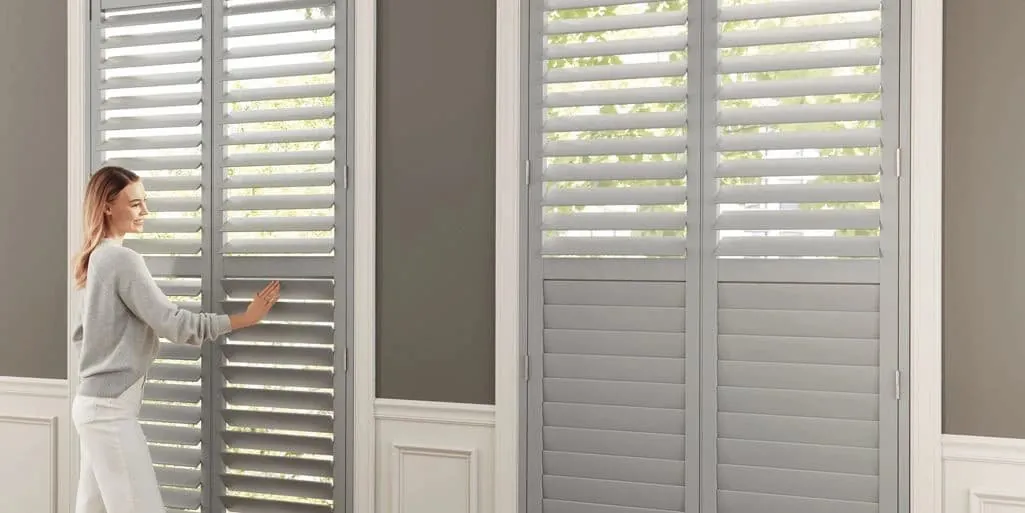
A mid-century wall of windows is divided into a row of panels that fold back in pairs, with rails lined up across the whole run so it reads as one piece.
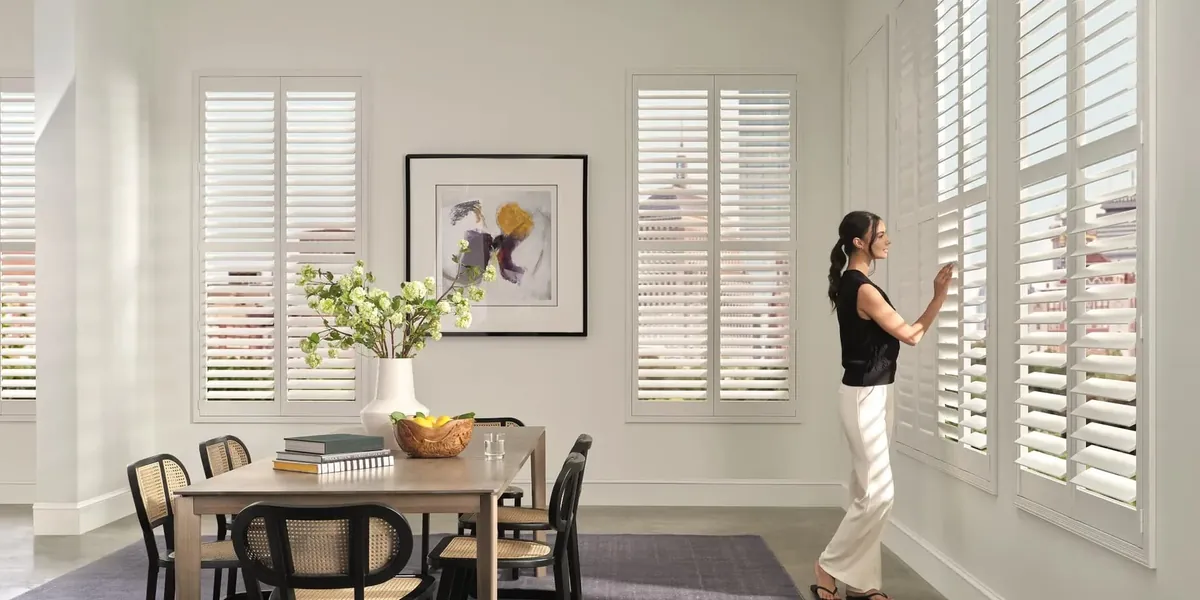
Sills close to the floor
Low sills make for tall panels. A divider rail breaks the height, and we check panel swing against furniture and anything set along the wall.
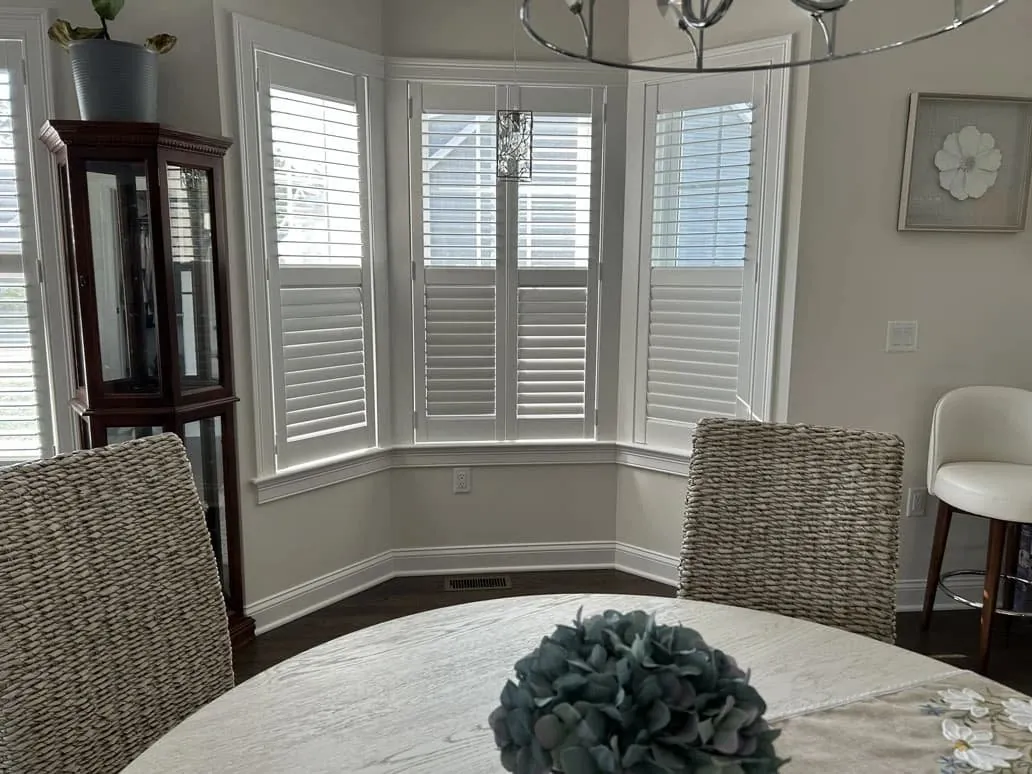
Rooms under the trees
Where daylight is scarce, panels that fold fully clear of the glass and pale finishes that bounce light help a shaded room feel brighter.
Shop at home: we bring the samples to you
Because Sharon is served from our Canton shop-at-home territory, every shutter project here begins with a visit to your house. Our vans carry shutter samples in every collection, louver width, frame style and finish, so we can bring the showroom to you. Our shop at home page explains how the service works across the area.
A visit usually runs like this:
- You request a consultation online or through the call button and choose a time.
- We begin in the room you care most about, often the one with the longest run of glass.
- Samples go up against your own windows, so you can compare louver widths and finishes in the room’s real light.
- We check each opening for depth, squareness and the swing of each panel near the floor.
- Every window on your list is measured.
- You receive a free estimate and take whatever time you need.
To read about the visit in more depth, see what happens at an in-home consultation. If you would like help with color or the rest of the room at the same time, ask about our interior design consultations.

Mid-century contemporaries and their walls of glass
The mid-century contemporaries around the lake tend to open the house to the woods. Their living rooms often have a long, continuous band of windows, sometimes floor to ceiling, sometimes running across most of a wall. It is a lovely way to live with the trees, and a challenging window to cover.
A shutter treats that band as a series of openings. Each section of glass gets its own panels, and the panels are hinged so they fold back in pairs against the mullions between the windows. When they are open, the glass is almost entirely clear. When they are closed, the run reads as a single, calm surface. The trick is alignment: the louvers, the divider rails and the tops and bottoms of every panel line up across the whole run, so the eye travels along it without catching on a mismatch.
Because these houses are about the view, a wide louver usually suits them. Tilted flat, it leaves broad gaps to look through, so even partly closed the shutters keep the woods in sight. For a cleaner look on a modern room, many people choose a hidden tilt, which leaves the face of each panel unbroken.
Working with low sills
Low sills are common in the contemporaries and in some of the colonials, and they change the shutter in a few ways. The panels are taller in proportion to their width, the bottom of each panel sits near the floor, and the space in front of the window is often where a sofa, a bench or a low cabinet wants to go.
So we plan the height and the swing together. A divider rail partway up each tall panel keeps the louvers from running in one long column, and it lets you close the lower half for privacy while opening the upper half to the canopy. We look at what sits in front of the window and make sure each panel can fold back without hitting it. Where furniture will stand close to the glass, panels that fold flat against each other can be a better choice than a pair that swings wide.
In a kitchen or bathroom with a low sill, Palm Beach is the collection we would point you to, painted to match the rest of the house.
Colonials on the wooded lots
The colonials in town are more conventional in their windows, but they share the setting: deep setbacks and tall trees all round. Their openings are mostly standard double-hung sash, sometimes with the lower sill set low in the front rooms.
For these houses, consistency is the aim. We pick one louver width for the street-facing windows and carry it across both floors, so the front of the house looks settled from the drive. A family room at the back with a run of glass toward the woods can step up to a broader blade. Builder trim may be plain, in which case a decorative frame gives each window more presence.
Since the houses are set so far back, privacy from passers-by is rarely the main concern. What matters more is light, and how to make the most of what the trees let through.
Where a colonial’s front rooms have the lower sills mentioned above, the panels run taller than usual, and a divider rail set level with the meeting rail of the sash keeps them in proportion. Upstairs, bedroom windows are generally standard, and a medium louver with matching rails ties them to the rooms below. Kitchens at the back of these houses usually look straight into the woods, so many people leave those louvers tilted up through the day and close them only after dark.
Rooms darker than their windows suggest
This is the defining feature of a Sharon house under the trees. You walk into a room with a wall of windows and expect it to be bright, and instead it has a soft, green dimness for much of the day. Any covering that hangs across the glass makes that worse.
Shutters do the opposite. When the panels fold back, they clear the glass completely, leaving nothing between the room and the light. When you want them closed, tilting the louvers upward sends the daylight that does come in toward the ceiling, which then reflects it down into the room. That is often brighter than a bare window with the light falling straight onto a dark floor.
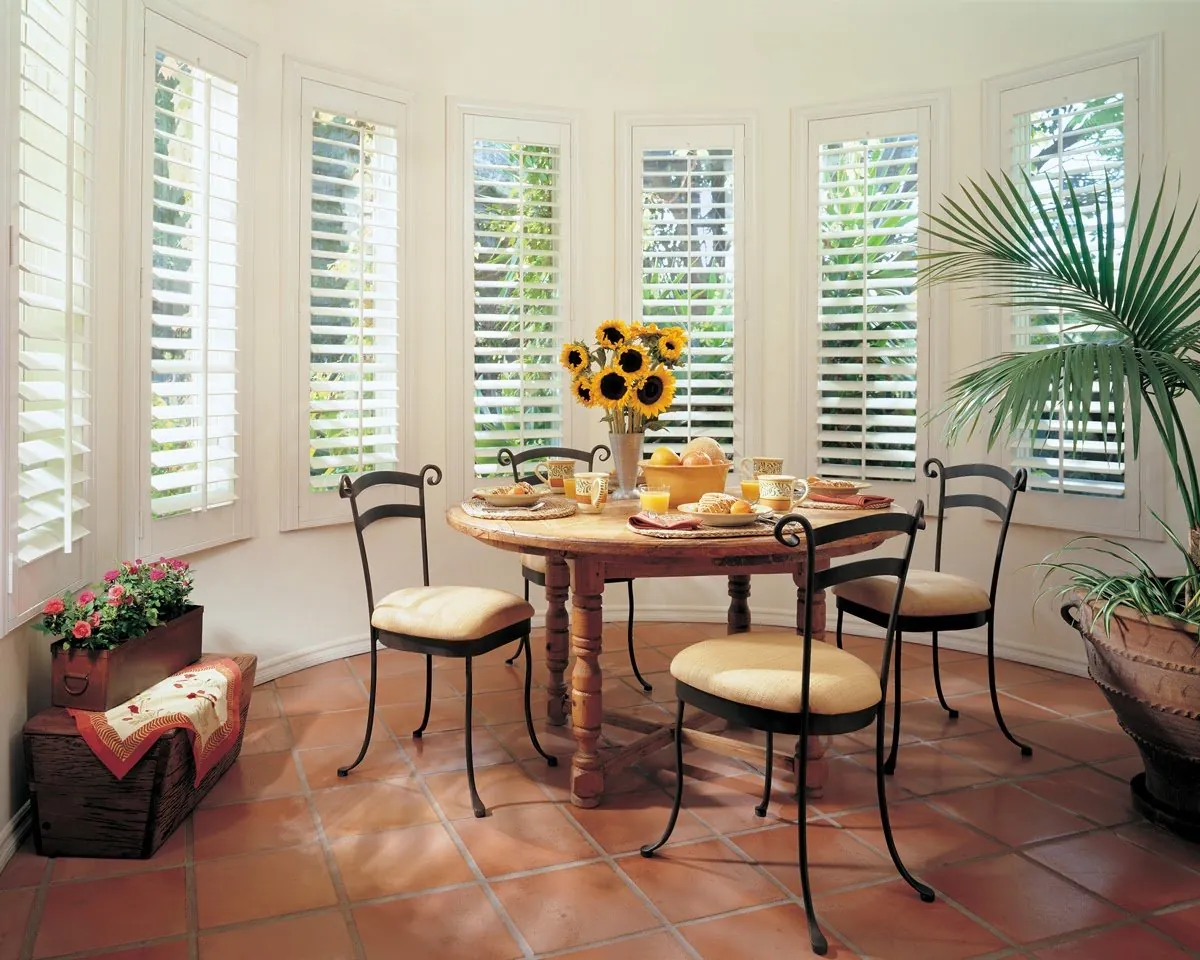
Finish plays its part too. White and soft whites reflect light back into the room, while darker colors absorb it. In a shaded contemporary or colonial, a pale shutter can make a noticeable difference to how bright the room feels. That combination of clear glass when open and bounced light when closed is why plantation shutters in Sharon, MA, suit these rooms so well.
The glass wall after dark
A long run of glass behaves very differently at night. By day it frames the woods; after sunset, with the lamps on inside, it turns into a dark mirror from within and a lit stage from outside. Even on a deep, wooded lot, a bright living room shows through the trees to the road or to the house next door.
Closing the shutters at dusk solves that in one movement. The row of panels swings shut, the louvers close flat, and the wall becomes a calm, pale surface that reflects the lamplight back into the room rather than losing it into the dark glass. The room feels enclosed and settled in the evening with the panels shut, then light and open again in the morning when they fold back. For plantation shutters in Sharon, MA, on a big run of glass, that daily shift is a large part of the appeal.
If some of the glass sits high or out of reach, we will plan those sections with louvers set at one angle, or talk through a motorized shade for that part of the wall.
When the leaves come down
Heavy tree cover is a summer story. In late autumn, when the trees drop their leaves, the same rooms suddenly receive far more daylight, and low winter sun can reach deep across a floor that sat in shade for months.
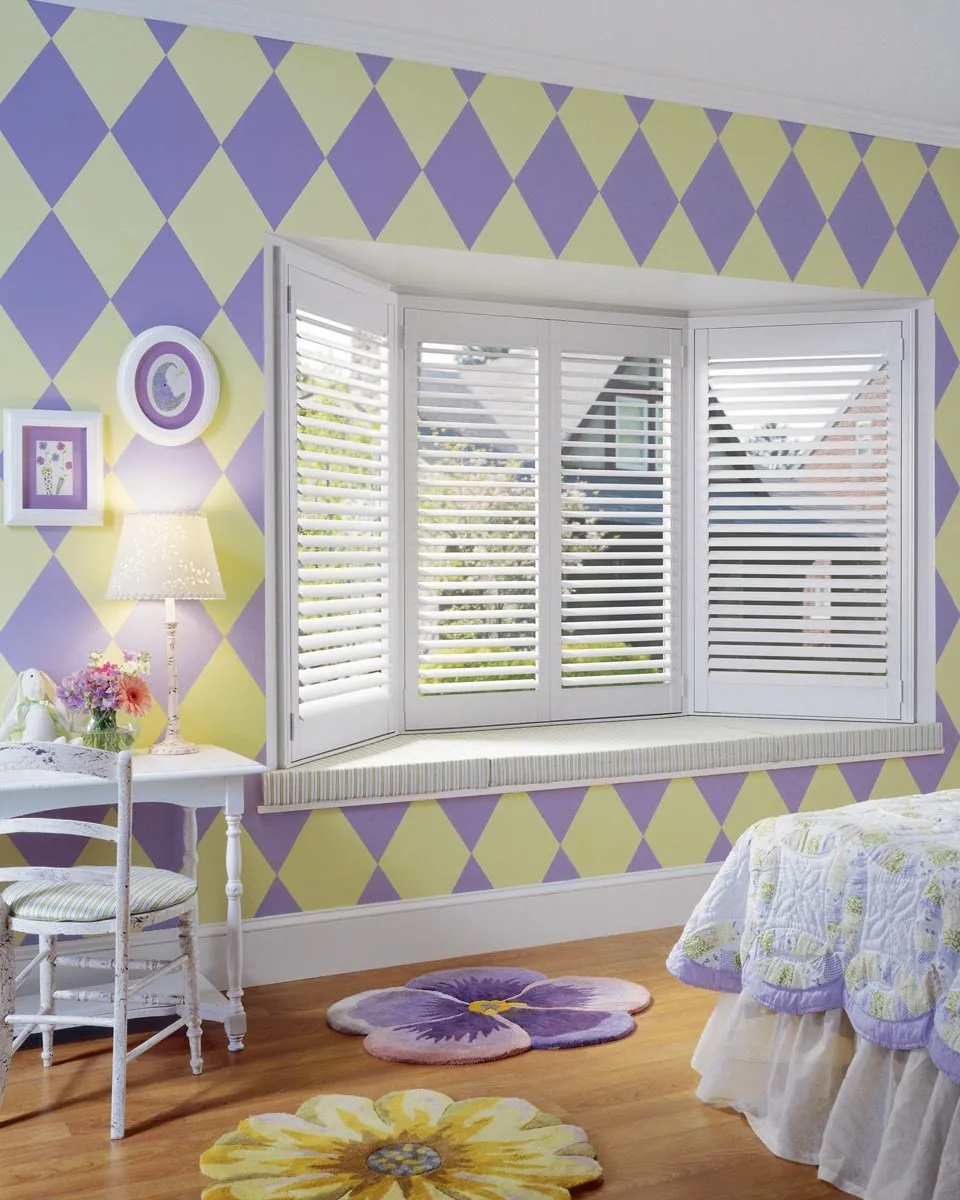
Shutters adapt to that change without anything being swapped out. Through the summer, the panels may stay folded back most of the day to catch every bit of filtered light. Once the canopy thins, the louvers come into play: angled to soften low sun across a screen or a sofa, or tilted up to throw the brighter light onto the ceiling. When spring returns and the shade closes in again, the panels go back to standing open.
That is worth considering when you choose the louver width. A wider blade gives you more control over strong winter sun while keeping the clearest view in summer, which is why many plans for plantation shutters in Sharon, MA, favour it on the main rooms facing the woods.
Choosing the louver width
Louver width changes how a shutter looks more than any other detail, and Sharon’s houses lean toward the wider end.
- Wide louvers for the long runs of glass in a mid-century contemporary and the family rooms facing the woods. Tilted flat, they give the clearest view and let in the most light.
- Medium louvers for standard bedroom and kitchen windows in the colonials. A balanced choice where privacy and light both count.
- Narrow louvers for any smaller or older windows, where a broad blade would look out of scale.
A house can mix widths, as long as each room is consistent. On a long run of glass, one width across every panel is essential, so the run reads as a whole.
Palm Beach, NewStyle and Heritance
Hunter Douglas makes three shutter collections, with the same louver widths and frame styles across all three, so a house can mix them without any visible change from room to room.
Palm Beach is our suggestion for bathrooms, the kitchen sink window and any low-silled window in a room where water is part of daily life.
NewStyle carries most of a typical order, from the long glass of a contemporary living room to the bedrooms of a colonial.
Heritance is real hardwood, painted or stained. A stained Heritance shutter can suit a contemporary with wood ceilings or natural trim, picking up the warmth of the wood instead of contrasting with it.
Each has its own page: Palm Beach, NewStyle and Heritance. The main plantation shutters page compares them side by side.
Color for a shaded house
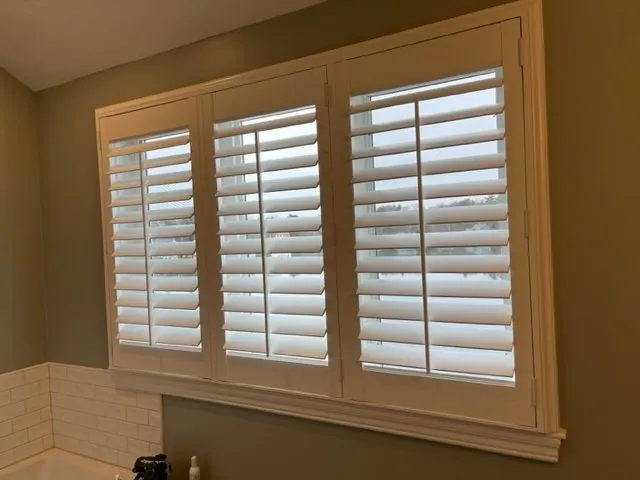
In most rooms around the lake, a white or soft white shutter is the practical choice, because it reflects the limited light back into the room. Crisp white suits the clean lines of a contemporary; a warmer white can sit better beside older painted trim in a colonial.
There are good reasons to go the other way, too. A contemporary with exposed wood, wood ceilings or natural trim can look wonderful with a stained Heritance shutter that matches its tone. In a room with dark walls, a soft gray or taupe can look intentional rather than stark.
We look at finishes in the room itself, in daylight and again in the evening light, because colors under heavy shade shift more than most. When a whole house is being done, settling the color in the main living space first, then carrying it through, keeps plantation shutters in Sharon, MA, consistent from room to room.
Installation by certified installers
Blinds & Designs is a Hunter Douglas Gallery dealer, and our installers are certified by Hunter Douglas. On a long run of glass, their work is what makes the run look right: each frame set true, every panel aligned with its neighbors, the rails level from one end to the other, and each louver closing flush.
The day itself is straightforward. We confirm the plan with you room by room, fit the frames, hang and adjust the panels, check every louver, and show you how the tilt and the panels work before tidying up. You can read more in what happens on installation day. If anything needs attention later, a shutter or a shade, we handle blind and shade repairs too.

Prefer to see a showroom first
The nearest of our showrooms to Sharon is the Franklin showroom. If you like to look around before anyone comes to the house, that is the place to go.
Either way, the shutter decisions come back to your own rooms: how a louver width looks across a wall of glass, how a finish reads in the shade of the trees, how a panel clears the furniture by a low sill.
So the measuring always happens at your house, by us, before anything is ordered.
More for Sharon homes
Shutters are not the answer for every window. A bedroom that needs real darkness, or a long run of glass you would rather control from your phone, may suit something else. Look at cellular shades in Sharon, roller shades in Sharon or motorized blinds and shades, or see all our services in town on the Sharon page.
Questions from Sharon
Is there a showroom I can visit nearby?
Sharon is served from our Canton territory, which is shop-at-home, so we come to you with samples. If you would like to visit a showroom as well, the nearest is in Franklin.
How do you shutter a whole wall of windows?
As a row of panels, one set per section of glass, hinged to fold back in pairs. The louvers and rails line up across the run so it reads as one piece, open or closed.
My sills are very low. Is that a problem?
Not at all. The panels are taller, so a divider rail helps, and we check the swing against anything standing in front of the window.
Will shutters make my shaded rooms even darker?
Usually the reverse. Folded back, they leave the glass clear. Tilted up, they bounce light off the ceiling. A pale finish adds to the effect.
What does the estimate cost?
Nothing. We measure every window you want covered and give you a free estimate, with no obligation.
Book a visit at home
Request a consultation and we will bring shutter samples in every collection to your house, measure each window and leave you with a free estimate. The call button works too.