
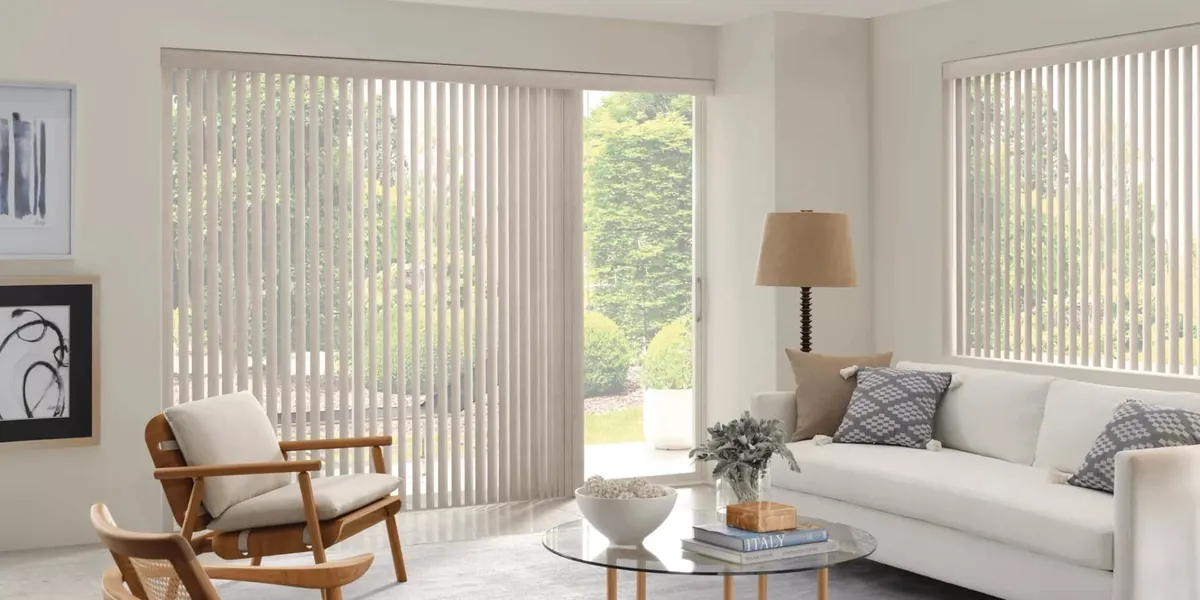
Long glass, low sills and heavy tree cover
Around Lake Massapoag, Sharon’s houses sit deep in the trees. Colonials and mid-century contemporaries stand well back on wooded lots, and many were built with long runs of glass and sills set low to the floor, so the outdoors comes right into the room. Yet step inside on a summer afternoon and the rooms are often dimmer than all that glass would suggest. The canopy overhead takes much of the light before it ever reaches the windows. That balance, plenty of glass and not always plenty of light, is what we plan around when we fit motorized blinds in Sharon, MA.
It changes what a window covering should do. In a darker room, the last thing you want is a shade that hangs part way down all day because raising it is a nuisance. On a long run of glass, moving shade after shade by hand is exactly that kind of nuisance. A PowerView motor solves it: every shade along the run rises fully at a press or on a morning timetable, so the room gets every bit of daylight the trees allow, and lowers together when you want privacy or a softer light.
Low sills bring their own considerations, which we come to below, along with the differences between a colonial and a contemporary.
Motorized blinds for Sharon’s long runs of glass
Each of these Hunter Douglas styles can run on PowerView, and each handles wide, low glass well. We bring all three in the van, so you can see them against your own windows and your own trees.
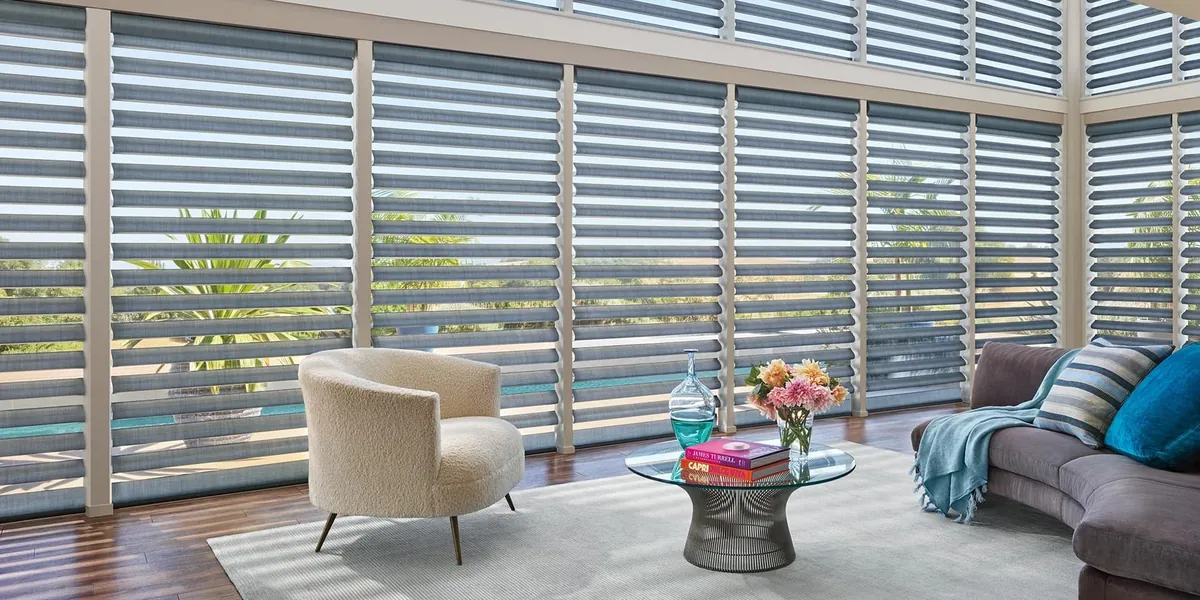
Sheer shades
Vanes that tilt open to keep a dim room bright while softening the view in from outside.
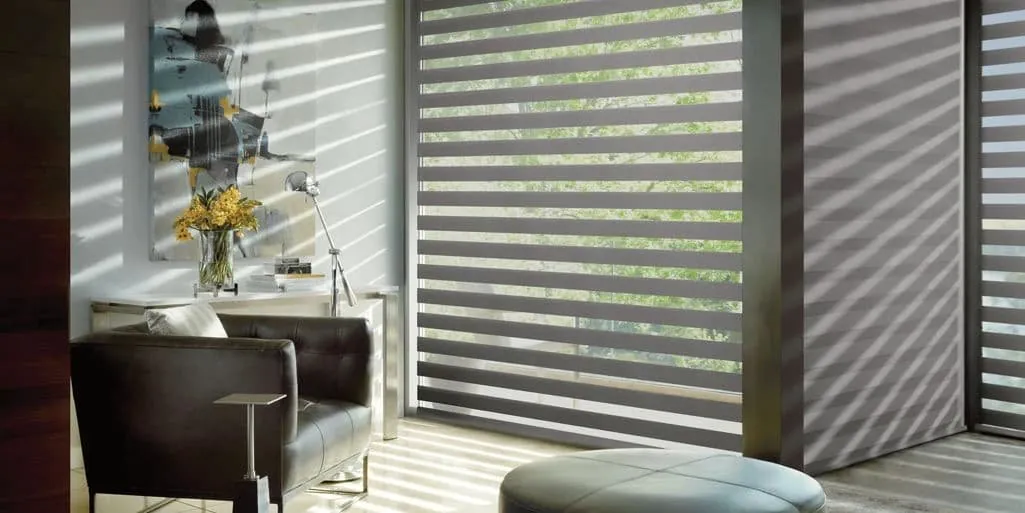
Roller shades
Simple, slim rolls that disappear at the head of a long window when raised, with fabrics from sheer to room-darkening.
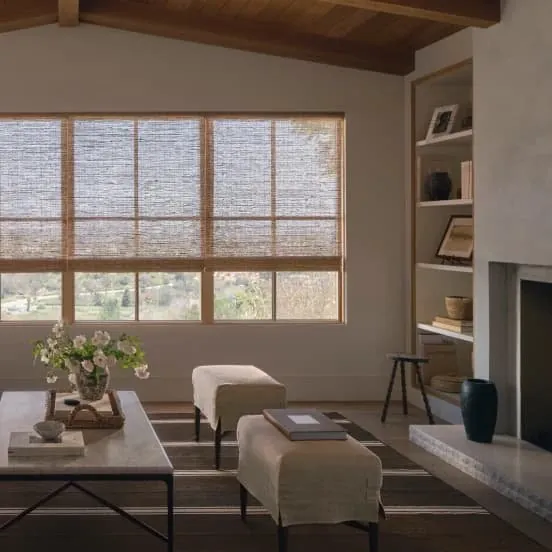
Woven shades
Natural texture that echoes the woods outside, at home in a mid-century contemporary.
Why the trees make the motor matter
Heavy tree cover is lovely and it is also a thief of daylight. In the wooded neighborhoods around the lake, a room facing the woods can stay dim for much of the day in summer, even with a whole wall of windows. The windows are doing their best; the canopy simply takes the light first.
In a room like that, every inch of glass counts. A manual shade that never quite gets raised to the top, because the cord is long or the shade is one of eight along a wall, steals light the trees have already rationed. With motorized blinds in Sharon houses like these, the fix is simple: the shades go all the way up when you ask, every time, and a morning timetable can raise the whole run before you come downstairs.
The flip side comes in late autumn. When the leaves fall, the same rooms can suddenly take low, bright sun through bare branches. The app lets you shift a timetable in moments, or bring a group down part way with a tap, so the house keeps pace with the seasons without anyone walking from window to window.
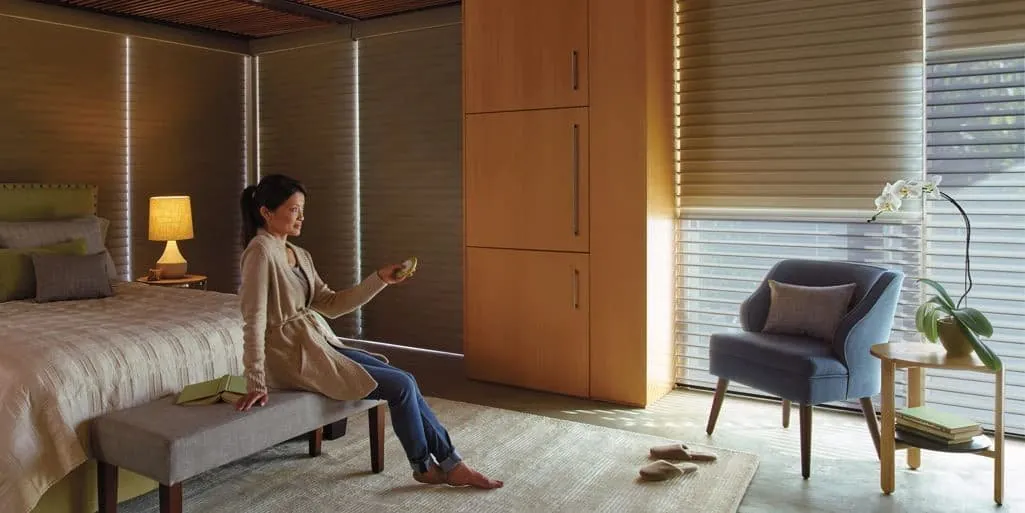
Mid-century contemporaries and their walls of glass
Sharon’s mid-century contemporaries are where long runs of glass are most dramatic. A living room might have a wall of windows facing the woods, sometimes running nearly floor to ceiling, sometimes broken into a series of tall panels. Clerestory windows high on a wall are common too, along with sliders out to a deck.
Grouping is the key in a house like this. A run of six or eight shades should move as one, rising and stopping on a single line, so the wall reads as one clean surface rather than a row of mismatched heights. The app can store scenes for different times of day: everything open for the morning, the deck side lowered part way when the light gets bright, the whole wall closed at night.
Clerestory glass, set high above eye level, is almost impossible to cover by hand. If it lets in glare or needs to close at night, a motorized shade is the practical way to manage it. Some homeowners prefer to leave clerestories bare, which keeps the high light coming in. We look at each one with you at the visit.
Low sills and floor-level glass
Low sills are part of the appeal of these houses. Sitting on the sofa, you look straight out into the trees. They do raise a few practical points for a shade, though.
A shade on a low window travels close to the floor, so we look at what sits in front of it: a sofa back, a radiator cover, a plant stand. The fabric needs to clear all of that when it lowers. We also think about how the stack looks when the shade is raised, since on a long run it forms a line across the top of every window and should sit neatly within the frames. Roller and sheer shades are often chosen for this reason, because they roll compactly at the head.
On a motor, a low window has one more advantage: there is no cord trailing near the floor to catch on a chair leg or a curious pet. The shade simply responds to the handset or the app.
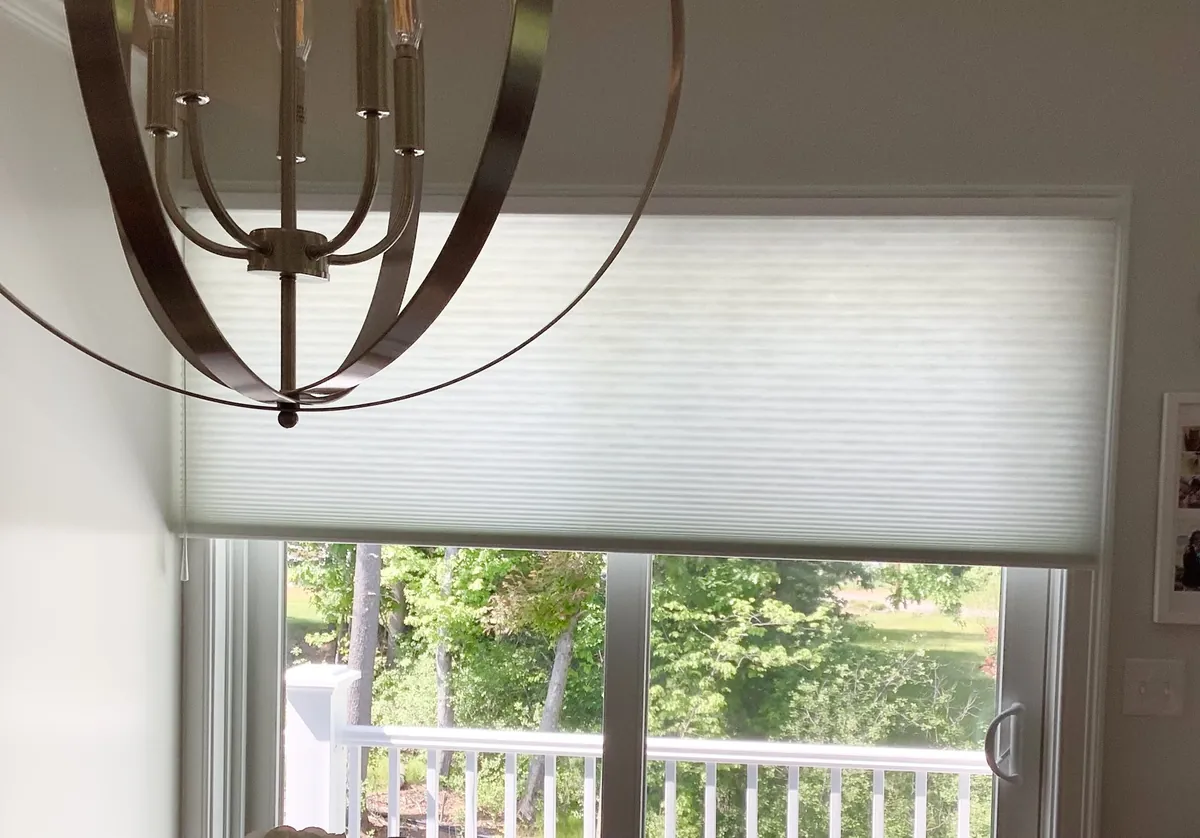
Colonials on wooded lots
Sharon’s colonials share the wooded lots and the deep setbacks, but their windows are more conventional: evenly spaced double-hung windows on two floors, a front entry, often a family room at the back with a slider to the yard. The openings are regular and the frames square, so fitting is straightforward.
For a colonial, motorized blinds in Sharon tend to focus on routine and on the hard-to-reach glass. An entry with a window above the door, a landing window over the stairs and a family room wall facing the woods are the usual starting points. Bedrooms upstairs benefit from room-darkening fabric and a morning timetable, so the early summer light stays out until you want it.
With setbacks this deep, nobody on the road sees much of the house by day. Night is the exception: lamplight carries through the woods, more so in the months when the branches are bare. Set the downstairs shades to come down at your usual hour and they will do it nightly, even on evenings you are out.
Running the shades day to day
PowerView gives you three ways to move a shade:
- A handset, kept in the room, raises, lowers and stops a shade or a group. It suits bedrooms, guest rooms and anyone who prefers a button.
- The PowerView app on a phone or tablet sets any height for any shade or group and saves scenes for different parts of the day.
- Timetables move shades at set times on the days you choose, so mornings and evenings run on their own.
For more detail, read how motorized shades are controlled, and see window covering automation for scenes and timetables. How each motor is powered is something we plan with you during the consultation, window by window.
In-home consultations come first
For Sharon, the consultation happens at your house. Our Canton territory is run as shop-at-home, so rather than asking you to visit a store, we bring the showroom to you: a van loaded with samples parks in your driveway, and every fabric is judged at your own windows, in the filtered light that actually reaches your rooms. That matters more here than almost anywhere, because a sample that looks bright in a store can read very differently under heavy trees.
- Request a consultation online, or use the call button to reach us.
- We start with the room that feels darkest or the longest run of glass.
- Samples go up at the window so you can see how each one handles the light through the trees.
- We plan groups, scenes and timetables with you, from the morning routine to the evening close.
- Every window is measured for width, height and depth, and anything near a low sill is noted.
- You receive a free estimate for the shades and installation.
- Hunter Douglas makes the shades to the measurements from your house.
- A Hunter Douglas certified installer fits them, pairs every shade with its handset and the app, and sets up your first timetables with you.
More about the visit itself is on our in-home consultations page, and what happens on installation day covers the fitting.
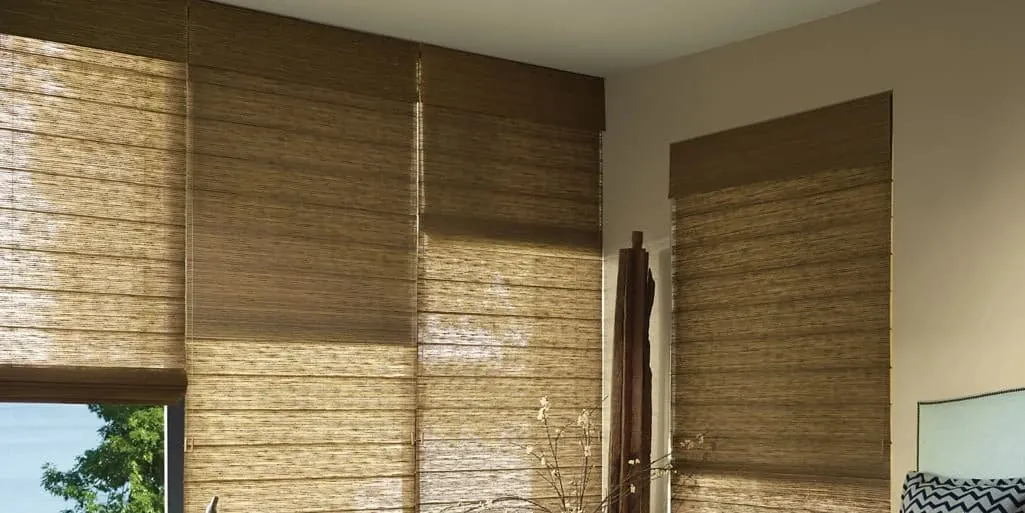
Picking fabric for filtered light
Choosing a fabric under heavy trees is a little different from choosing one in an open, sunny house. The light arriving at the glass is already softened and often tinted green by the leaves, so a fabric that looks crisp white in bright sun can look gray, and a deep color can make a dim room feel smaller still.
That is why we hold samples at your windows rather than describing them. In the darker rooms, lighter colors and light-filtering weaves usually keep the space feeling open when the shades are down. Sheer shades are a favorite because the vanes can be tilted open while the shade stays lowered, letting light through while the view in from outside softens. In bedrooms, room-darkening fabric does its job regardless of the trees, and a lighter face color keeps it from looking heavy during the day.
For the mid-century contemporaries, woven shades and textured rollers are worth seeing too. Their natural look sits well against wood paneling and exposed beams, and in filtered light the texture shows more than the color.
Sliders and decks
Many Sharon houses, contemporaries in particular, open onto a deck through sliders, and the deck is where the house meets the woods. A vertical shade suits a slider well, gliding to one side so the door is easy to use. A vertical honeycomb shade does the same with a honeycomb fabric that can match the cellular shades elsewhere in the room.
Motorized, the slider can join the rest of the wall’s group, so the deck side opens and closes in one movement. On a bright autumn afternoon you can lower the whole run part way and still step outside without touching a shade.
Bedrooms under the trees
Bedrooms in the wooded neighborhoods can stay shady much of the year, but early summer mornings still bring light through the gaps in the canopy. Room-darkening fabric made to fit the opening keeps the room dim until the morning timetable lifts it, a little later on weekends if you like.
In a contemporary, a bedroom may have a long low window or a slider of its own. Grouping those shades keeps them level, and a handset on the nightstand is the simplest way to adjust them before getting up.
Evenings around Lake Massapoag
Evenings change the character of a house on a wooded lot. As the light goes, a wall of glass that framed the trees all day becomes a dark mirror from inside and a bright window from outside. In a contemporary with a long run of glass, that switch is dramatic.
This is one of the jobs motorized blinds in Sharon do most quietly. An evening timetable lowers the long run of shades at the hour you choose, and a separate scene in the app can close only the deck side if you want to keep the front view a little longer. In summer you push the time later; in winter, when it gets dark early, you bring it forward. Each change takes a moment in the app.
For a colonial, the same idea covers the front rooms and the family room, while the upstairs bedrooms keep their own later timetable or stay on handsets.
Home offices facing the woods
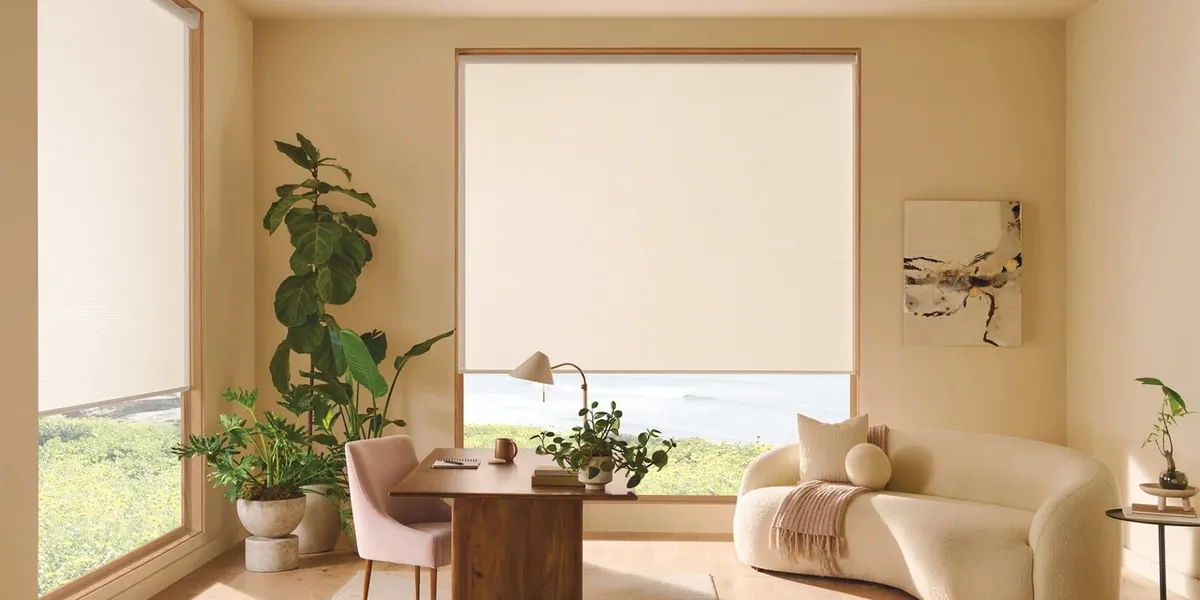
A home office looking into the trees is a pleasant place to work, though the light can change quickly as the sun moves through the branches. Sheer shades and light-filtering rollers soften glare on a screen without darkening the room, and on a motor they can be set from the desk or lowered part way on a timetable at the hour the glare usually arrives.
In a contemporary, the office may be a corner of the main room with the same long glass as everywhere else, so its shades can sit in their own small group, separate from the living area. In a colonial, it is more often a spare bedroom upstairs, where a single shade on a handset is plenty. Either way, the aim is the same: a screen you can read and a room that still feels connected to the woods outside.
Building the system over time
Many Sharon projects begin with the longest run of glass, often the living room wall in a contemporary or the family room in a colonial, and add rooms later. New PowerView shades join the existing setup with the same app and handsets, so nothing installed first needs replacing.
You can see the full collection on our motorized blinds and shades page, and every service we offer in town on our Sharon page. For the darker rooms, it can help to compare cellular shades in Sharon and roller shades in Sharon.

A Gallery dealer for houses in the trees
Blinds & Designs is a Hunter Douglas Gallery dealer. For a contemporary with a wall of glass or a colonial with a family room facing the woods, that means sheer, roller, woven and honeycomb shades and blinds all planned together, each able to run on PowerView.
Hunter Douglas certified installers fit every shade we supply. Estimates are free, interior design consultations are on offer if you want help with a whole room, and we repair blinds and shades you already own.
If you would like to see a showroom
Most Sharon projects are planned entirely at home. If you would also like to look at shades in a showroom, our nearest is in Franklin.
Questions from Sharon
Our rooms are dark because of the trees. Will shades make that worse?
Not if they are chosen well. Motorized shades rise fully every time, so the glass stays clear when you want light, and sheer or light-filtering fabrics keep a room bright when they are lowered.
Can a whole wall of windows move together?
Yes. The shades along a run of glass are grouped so they rise and lower as one and stop on a single line.
Do you have a store in Canton we can visit?
Canton is run as a shop-at-home territory, so we come to you with samples instead. If you would also like to see a showroom, Franklin is our nearest.
What about clerestory windows high on the wall?
Some people leave them bare to keep the high light. If they need covering, a motorized shade is the practical way to manage glass that far above reach.
Is the estimate free?
Yes. After measuring your windows at the consultation, we give you an estimate at no charge.
Let the light in first
The best starting point in a Sharon house is usually the room that feels darkest, the one with plenty of glass and not enough daylight. Tell us about it when you request a consultation for motorized blinds in Sharon, and we will bring samples that suit filtered light, measure every window along the run and show you how a motor would open the room up. To ask a question first, use the call button.